

Soccer, or “football,” as it’s called in India, has recently been the most popular sport in the country after cricket. Growing up, I had some of my fondest memories playing football, playing FIFA on my friend’s PS4 and generally talking about the sport and how players were performing. It was also during this time that Lionel Messi, alongside Luiz Suarez and Neymar Jr., played for F.C. Barcelona; and Cristiano Ronaldo, Marcelo and Gareth Bale played for Real Madrid. Along with other rival teams having some of their legendary players, it is safe to say that this was the Golden Age of football.
This love for football was not unique to my friends and me; in other cities across India like Kolkata and Mumbai, the sport was loved even more! In fact, Kolkata hosts the biggest statue of Lionel Messi in the world, a massive 70-foot-tall (over 21 meters) iron and fiberglass sculpture. Ever since the colonial period, the city has been widely accepted as the football capital of India. Naturally, it was Messi’s first stop on “The GOAT Tour.” However this stop could not have been a worse start to the tour.
Organizer Satadru Dutta, who has brought football legends like Pelé, Diego Maradona and Ronaldinho, was in charge of Messi, Suarez and De Paul’s visit to Kolkata. For football fans in Kolkata, Messi’s name carries weight, memory and emotion. His return was seen as a rare moment for fans who had grown up watching him, celebrating his goals from afar and hoping to see him in person at least once. The Salt Lake Stadium in Kolkata became the center of that excitement.
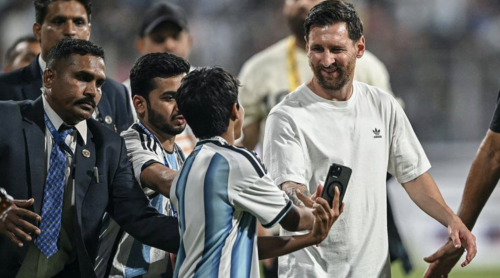
However, on December 13, chaos erupted. What was meant to be a smooth and celebratory evening took an unexpected turn shortly after Messi arrived at Salt Lake Stadium. Rather than having an open interaction with fans, he found himself surrounded by politicians, police officials and VIPs with their entourages, blocking the view for thousands of fans who had come to the event.
As the situation worsened, Dutta himself was yelling, instructing people to vacate the ground and create space for the football star. Messi remained composed, signing autographs and trying to make his way around the swelling crowd. However, after 20 minutes of the crowd increasing in size, security officials decided to cut short his appearance and escort Messi out of the stadium.
Messi’s early departure left many fans disappointed, since, for many, this was a once-in-a-lifetime opportunity. Soon after he left, frustration escalated into anger, leading to vandalism inside the stadium, seats ripped from the stands and thrown onto the field. With this outpour of anger, reports were filed, and Dutta was arrested for poor management and forced to refund the fans who paid to see Messi.
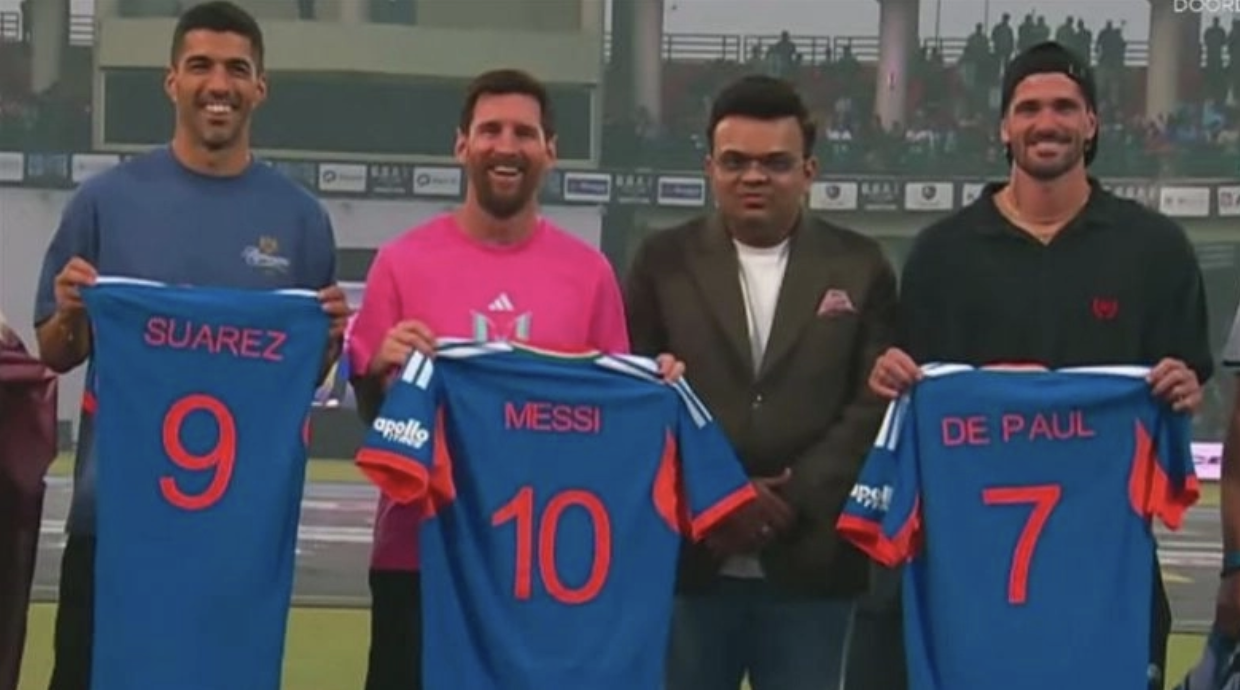
Messi’s visits to other stadiums in Mumbai, Hyderabad and Delhi went smoothly, and the crowds praised the respective organizers for avoiding a Kolkata-esque fiasco. In Delhi, Messi, Suarez and De Paul received Indian cricket team jerseys from the International Cricket Council chairman, along with tickets for next year’s Twenty20 World Cup in India and Sri Lanka. In Mumbai, the trio met notable celebrities like Shah Rukh Khan, Cricket legend Sachin Tendulkar and India’s version of Messi: Sunil Chhetri. In Hyderabad, Messi played games with local political leaders and children. After Kolkata, the tour went smoothly and concluded with Messi expressing immense gratitude for the overwhelming love and hospitality, sharing heartfelt messages and vowing to return, hopefully to play a match (the reason that he cannot play is the massive $900 million insurance on his left leg, covering real matches and not friendly scrimmages).
Overall, as an Indian football fan, I’m glad that his tour was successful and that it catalyzed football love for many young fans. However, I also hope that this event sheds some light on the corruption within the All India Football Federation (AIFF) and helps propel our future players. I have seen it first hand: as a country, India does not lack football talent; instead, it is the country’s lack of facilities and opportunities that impede the emergence of its own GOAT.
