

I have been on both sides of the dinner plate. For years, I was a dedicated vegetarian. Not because of a grand moral epiphany or agenda but simply because the idea of meat felt inherently “gross” to me. I was repulsed by the texture, the source and the reality of what was on my fork. AsI got older, that reaction faded, replaced by a craving for the very thing I used to avoid. Now, I am the person who feels like they cannot live without a burger on a Friday night or a steak at a family dinner. This personal devotion to meat is exactly what makes our current global trajectory so terrifying. Our collective appetite has created a demand that the planet can no longer realistically sustain.
By 2050, the world will look very different. The global population is projected to swell to nearly 10 billion people. To feed this crowded planet, the United Nations estimates that food production must increase by 70%. But we have a problem: we are running out of land, usable water and time. The industrial meat industry, our primary source of protein, is already stretching the Earth’s resources to breaking points.
As scientists and policymakers scramble for a Plan B, an unlikely hero has the chance to emerge. It is highly nutritious, incredibly sustainable and currently thriving in the billions. It is also, to many Westerners, absolutely disgusting. Edible insects, or entomophagy, are poised to be the “next big thing” in global food systems. For this revolution to succeed, humanity must bridge a massive cultural divide, swapping the comfort of a burger for the efficiency of something like cricket flour. The future of food isn’t just about technology; it’s about overcoming the “ick” factor for the sake of the planet.
To understand why insects are the future, we must first look at the cost of the present. According to the Food and Agriculture Organization (FAO) of the United Nations, the livestock sector is responsible for approximately 14.5% of all human-induced greenhouse gas emissions, more than the entire global transportation sector combined. Livestock production occupies roughly 70% of all agricultural land, leading to deforestation, biodiversity loss and massive water consumption.
Enter the insects. Biologically, insects are miracles of efficiency. Since they are cold-blooded, they do not expend energy maintaining body heat. This allows them to convert feed into protein far more efficiently than mammals. Research highlights startling comparisons: producing one kilogram of beef protein requires about 20 kilograms of feed. In stark contrast, crickets require only 1.7 kilograms of feed to produce the same amount of meat. The water footprint is even more dramatic: producing a pound of beef can take up to 2,000 gallons of water while a pound of crickets requires less than one gallon.
However, the efficiency of insects goes deeper than just their water and feed requirement. It lies in their unique ability to solve the global food waste crisis. Approximately one-third of all food produced globally is lost or wasted, ending up in landfills where it decomposes and releases methane, a greenhouse gas 25 times more potent than carbon dioxide.
Black Soldier Fly (Hermetia illucens)address this issue as the heavy lifter of the insect world. Unlike crickets, which are generally farmed for human flour, Black Soldier Fly larvae are the ultimate recyclers. These larvae can consume twice their body weight in organic waste every day. In industrial “bio-conversion” facilities, billions of these larvae gorge on supermarket scraps, agricultural runoff and brewer’s spent grains, waste that would otherwise rot in a landfill.
Within weeks, the larvae convert this “trash” into high-quality protein and fat. It is a perfect circular economy: we grow food, we waste food, the insects eat the waset and we eat the insects (or feed them to our livestock). This creates a closed-loop system that traditional livestock simply cannot match. We cannot feed rotting vegetables to a cow and expect premium beef, but we can feed them to larvae and harvest premium insect protein.
This bio-conversion capability turns insect farming from a mere agricultural sector into a waste-management solution. Cities could potentially integrate insect farms into their sanitation infrastructure, processing tons of organic waste locally and producing protein simultaneously. It transforms the concept of food production from a linear line of consumption to a circle of renewal, arguably the only model that can sustain a population of 10 billion. “Insects are the missing link in a sustainable food system,” says Dr. Arnold van Huis, a tropical entomologist and lead author of the seminal FAO report on edible insects. “We cannot continue to produce meat the way we do now. The math simply doesn’t work for the future.”
Beyond their environmental credentials, insects are nutritional heavyweights. They are not merely a survival food for the desperate; they are a superfood for the future. Many insect species contain more protein per gram than beef or chicken. They are rich in essential amino acids and packed with micronutrients that are often lacking in plant-based diets, such as iron, zinc and Vitamin B12. For example, mopane caterpillars, a staple in Southern Africa, contain massive amounts of iron, essential for fighting anemia in developing regions. In a 2024 study published in Nature Food, researchers found that mixing insect protein into standard diets could arguably solve protein deficiencies in developing nations while simultaneously combating obesity in developed ones due to the high quality of the fats involved.
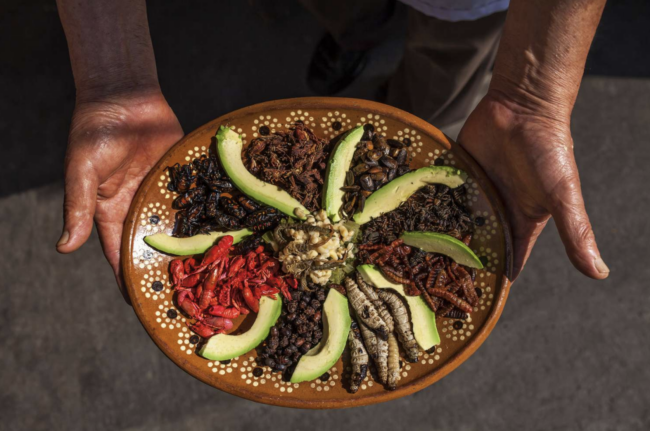
If the science is so sound, why aren’t we all eating mealworm stir-fry? The answer lies in culture, not biology. Globally, entomophagy is not new. It is a daily reality for 2 billion people across Asia, Africa and Latin America. In Thailand, jing leed (fried crickets) is a popular beer snack. In Mexico, chapulines (grasshoppers) are toasted with garlic, lime and salt, adding a crunchy texture to tacos. However, in the West, insects are viewed almost exclusively as pests or vectors of disease. This cultural stigma is the primary barrier to the insect revolution.
I witnessed this firsthand last week in the library. During a free period, I began describing my research into entomophagy to my friend. His reaction was immediate and deeply emotional. “Otto, that is atrocious,” he said, stopping me before I could even finish the sentence. “It’s disgusting. I couldn’t care less about the methane; I am never giving up my precious burgers for a pile of bugs.” My friend’s reaction isn’t an outlier, he represents the western wall of food perception: a psychological barrier that researchers are still trying to dismantle.
Later that evening, I brought the topic up with my brother. Unlike me, my brother never converted back to meat, he remains a dedicated vegetarian primarily because of the environmental and ethical impact of factory farming. I expected him to be the ideal candidate to support entomophagy, the logical middle ground for someone who already avoids beef for the sake of the planet. His response was surprisingly similar to James’s. “I’m already doing my part by not eating animals,” he told me. “Why would I start eating something that’s even more repulsive than steak? Being sustainable shouldn’t mean forcing yourself to eat bugs.”
These two perspectives, one from a meat-lover and one from a vegetarian, show that the “ick factor” is a universal hurdle. Whether you are protecting your right to a burger or your right to a plant-based diet, the idea of insects as food triggers a deep-seated defensive reflex. Dr. Paul Rozin, a food psychologist, explains that the disgust response is a learned behavior. He says that in the West, we have categorized insects as filth and reversing that categorization is much harder than solving the technical challenges of farming them.
Yet, history suggests such shifts are possible. In the 19th century, lobster was considered “sea cockroach” and fed to prisoners because it was seen as garbage food. Similarly, raw fish (sushi) was viewed with suspicion in the United States until the cultural boom of the 1980s transformed it into a luxury item. The insect industry is banking on a similar trajectory.
While history provides hope, the culinary world is providing the flavor. To truly gain support from the West, insects cannot simply be marketed as edible, they must be proven delicious. This is where the world of fine dining has become an unexpected ally in the insect revolution. Leading the charge is René Redzepi, head chef of Noma in Copenhagen, frequently voted the best restaurant in the world. Redzepi shocked the culinary establishment by serving live ants on crème fraîche. But this wasn’t a gimmick, it was a lesson in chemistry.
Insects possess complex flavor profiles that chefs are only just beginning to map. Redzepi’s ants, for instance, are rich in formic acid, giving them a sharp, citrusy burst reminiscent of kaffir lime or lemongrass. Crickets, when roasted, take on a nutty, popcorn-like aroma due to their high fat content. Giant water bugs, a delicacy in Southeast Asia, carry a potent scent of green apple and anise.
“We are discovering a lost palette of flavors,” says Josh Evans, a researcher formerly with the Nordic Food Lab. By framing insects as a luxury ingredient rather than a desperate protein substitute, high-end chefs are engaging in a form of “trickle-down gastronomy.” Just as sushi moved from high-end Japanese restaurants to supermarket deli counters, the normalization of insect cuisine is starting at the top. The strategy is psychological re-branding: if the world’s elite are paying hundreds of dollars to eat ants, the “ick factor” begins to look less like a natural instinct and more like a lack of sophistication.
This culinary exploration extends beyond whole insects to fermentation and sauces. Researchers are currently developing insect soy sauce (fermented cricket garum) which offers a powerful punch of umami, usually associated with meat and mushrooms. If the average consumer can enjoy the savory depth of a cricket-based sauce without ever seeing a leg or antenna, the battle for the Western palate may be won in the kitchen long before it is fought in the grocery store.
Recognizing that most Americans won’t willingly eat a whole roasted beetle, the “next big thing” in this industry is invisibility. The current trend in insect agriculture is processing bugs into unrecognizable powders, flours and oils. A growing number of startups are entering the market with this strategy. Companies like Exo and Chapul have launched protein bars made with cricket flour that look and taste like standard energy bars. The goal is to normalize the ingredient before normalizing the animal.
This shift is also regulatory. In recent years, the European Union has approved several insect species (including the house cricket and the yellow mealworm) as novel foods safe for human consumption. This regulatory green light has spurred investment, with analysts predicting the global edible insect market could reach nearly $10 billion by 2034.
However, while human consumption grabs the headlines, the “next big thing” might actually arrive on our plates indirectly. The most immediate and commercially viable application for insect protein is not in protein bars for humans, but in feed for animals. Currently, the global aquaculture (fish farming) industry relies heavily on wild-caught fish (ground into fishmeal) and soy to feed farmed salmon and tilapia. This is ecologically disastrous; we are emptying the oceans of small fish to feed the big fish we want to eat, and we are burning down the Amazon rainforest to grow soy for chicken feed.
This sector is already exploding. Giant factories in France and the American Midwest are currently churning out tons of insect protein specifically for the aquaculture and pet food markets. If you have bought grain-free dog food recently, you may have already participated in the insect economy without knowing it. This invisible entry allows the insect industry to scale up its technology and infrastructure without waiting for consumers to get over their squeamishness. By the time the average American is ready to try a cricket burger, the supply chain will have already been perfected by feeding the salmon on their bagel.
Despite these advancements, several things still need to fall in place. First, production for human consumption must scale up. While animal feed factories are growing, “micro-livestock” farming for humans is still a small industry, making cricket flour more expensive than subsidized beef or chicken. Automation and industrial-scale facilities are needed to bring costs down to a competitive level. Second, the West needs a new narrative. Journalism and marketing play a crucial role in this. The story needs to shift from fear factor to food novelty. High-end chefs incorporating insects into fine dining can help trickle down acceptance to more and more people, just as they did with sushi. Finally, regulatory frameworks, particularly in the United States with the FDA, need to become clearer and more robust to ensure safety and build consumer trust.
The “next big thing” is rarely comfortable at first. It challenges the current cultural norms and forces us to re-evaluate our habits. Edible insects represent a collision of ancient tradition and future necessity. They offer a way to feed a growing world without destroying the planet that hosts it. While the thought of eating insects may still cause a shiver for many, the reality is that our current food system has potential for severe consequences. In the face of climate change and population growth, a cricket burger might not just be a novelty, it might be a necessity. The future is hopping toward us, the only question is whether we will have the appetite to embrace it.
