

The past 24 hours have held a whirlwind of emotions for New York Mets fans. After owner Steve Cohen put out a tweet on X in the evening reading, “Let me know when you see smoke,” the common conception became that the Mets were closing in on a deal with star outfielder Kyle Tucker. And realistically, they may have been. It was later revealed that the Mets and their president of baseball operations, David Stearns, had offered Tucker a deal worth $220 over four years, an AAV of $55 million, with an additional $75 million signing bonus. At the last minute, though, who else but the Los Angeles Dodgers swooped in and signed the 28-year-old lefty to an irresistible deal: four years, $240 million. The deal holds the second highest AAV in history, $60 million, second only to two-way player Shohei Ohtani’s of $70 million.
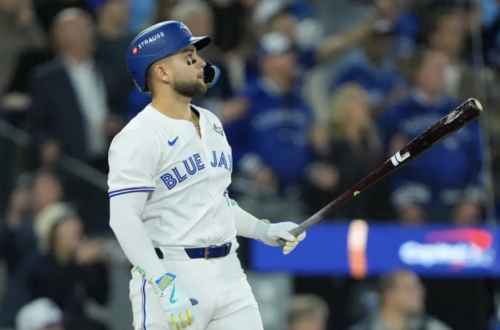
Today, with morale at an all-time low (that is, since the Wilpons sold the team), the Mets came out of nowhere with the surprise signing of infielder Bo Bichette. A former Blue Jay, Bichette will make $126 million over three years with the team, but his contract allows him to opt out after years one and two. Even though he’s never played an inning at any position other than shortstop, with New York, he’s expected to start at third base and diminish Mark Vientos and Brett Baty’s role with the club.
Ever since his rookie season in 2019, Bichette has exhibited some of the league’s best bat-to-ball skills, batting at least .290 in all but one season. Though he has, for the better of his career, been a below-average fielder, moving from shortstop to third base (and having one of the league’s best defenders in Francisco Lindor on the same side of the infield) should improve his defensive numbers. And if third base doesn’t work out for Bichette, the Mets have the option to try him at second base and move veteran free agent signing Marcus Semien, who consistently puts up elite defensive numbers, from second base to third base (or, in a worst-case scenario, he could become the team’s primary designated hitter).
Signing Bichette greatly enhances the Mets 2026 roster and brings consistency to one of the Mets’ major problems from the 2025 season: third base. In 2025, manager Carlos Mendoza experimented with Baty, Vientos, Ronny Mauricio and Luisangel Acuña at third base. None of them batted above .254 (Baty). Now all four remain prospects with theoretically high ceilings and will rightfully get opportunities to prove themselves during the 2026 season. But with Bichette in the lineup every day, Mendoza will no longer have to rely on the prospects’ eternally out-of-reach potential in a starting capacity.
Moving forward, expect the Mets to remain aggressive in the free agent market, both for hitters and for pitchers. Stearns has greatly disappointed most of the fanbase in his inability to retain longtime Mets like Pete Alonso, Brandon Nimmo, Jeff McNeil and Edwin Díaz, and in losing Tucker to the two-time defending champion Dodgers, but he has a plan for the 2026 Mets and will continue to pursue it.
