

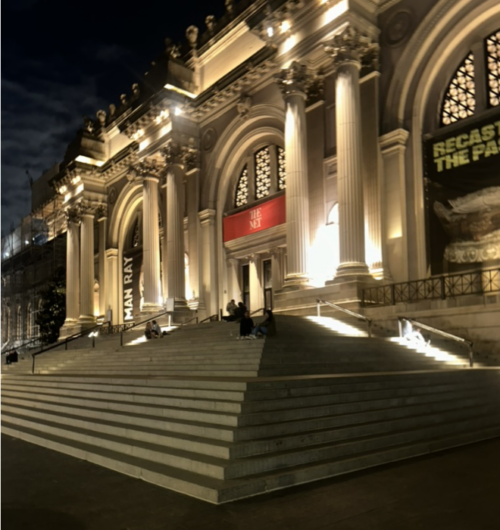
The MET steps carry the weight of my childhood and future in their granite and metal railings. The Metropolitan Museum of Art is renowned worldwide for its extensive collection of paintings, sculptures, ancient ruins, and artifacts, including the Temple of Dendur, medieval armor displays, stone monuments, and Jackson Pollock’s “Autumn Rhythm.” The MET is significant; culturally, its iconic stars are, of themselves, a New York cornerstone.
I The Steps
The MET steps have been altered since the museum’s 1902 opening. They were renovated in 1975 by Kevin Roche and John Dinkeloo and Associates into the steps we know today. The steps were redesigned for safety and width, drawing inspiration from Roman architecture with multiple railings and a broader base. The original steps were narrow, intended to evoke an academic feel and better align with the period’s architectural style. The renovation gave the steps a modern look, made them more accessible, and turned them into an urban amphitheater for multipurpose use.
III The Cacophony
The steps radiate the city’s energy through passionate artists, efficient vendors, buzzing tourists, and locals who use the space as a common area. While sitting, onlookers may notice two artists in particular who perform for tourists and locals on the steps. One is a veteran of the wars in Afghanistan and Iraq who plays the saxophone. The other is a performance artist who pretends to be a Roman statue, moving only when people put a few coins in his podium/bucket. There are also vendors selling hot dogs, pretzels and drinks. Many tourists see the museums and steps as separate stops on their trip, making a note to visit both. One can hear the honks from the taxis that sit outside the Met, laughter, and music.
The steps offer tourists a chance to experience New York’s energy firsthand. Some Upper East Siders, after visiting Butterfield Market on 86th and Madison, climb the Met steps to find a seat for “people-watching.” People-watching is watching other people’s lives, almost as if they were in a television show. There is a gravitational attraction towards the steps. When arriving, I feel as though a performance is about to begin. The steps draw my attention in a way no other place can. Vendors shout to attract more customers, tourists, and locals, all of whom sit, amazed.
IV The Sax Player
Isaiah Richardson Jr. is a veteran of the wars in Afghanistan and Iraq. Richardson plays throughout the afternoon, smiling when passersby drop tips in his bucket. His bucket and sign are adorned with photos of him from his military days and lined with cardboard posters. Richardson’s pictures of himself in the military are grainy and evoke nostalgia, emulating a sympathetic quality. His face has changed since his days in the military: he now has more wrinkles on his forehead and around his mouth, and some grey hair along his forehead. But he seems to have changed mentally as well. He appears happier with his life now that he is pursuing his passion.
When I tried to speak with him, he responded with a straight face and cold demeanor, “I am too famous to be interviewed,” and then continued playing for the crowd. Richardson never receives a standing ovation like most musicians. Instead, he receives attention from people on the steps who signal applause with their eyes and ears, rather than an ovation. By listening to Richardson pursue his passion, they are giving him a gift: they are showing him he matters to the community.
Richardson not only plays popular songs but also dozens of national anthems from around the world for the diverse crowds that visit the MET steps. Richardson has even said to The New York Times that he has a talent for identifying the country people are from. Richardson calls it an “element of surprise” when tourists realize he is playing their national anthem. In 2012, Richardson claimed that he could make $250 in 90 minutes by playing. Ironically, Richardson has noticed that “The Star-Spangled Banner,” the national anthem of the United States, never gets him any tips. Richardson is one of the most essential parts of the MET steps. When many people think of their time on the steps, they think of the saxophone they heard in the background.
V I Am Moving Art
Johan Figueroa-González performs at the bottom of the MET steps. Figueroa-González is painted white like a statue, mimicking the ancient Roman pieces museumgoers see in the MET, and stands on a podium all day. Figueroa-González moves when people tip him. As soon as money slides through his donation box, Figueroa-González slowly stretches as if for the first time in hundreds of years. I saw his arms stretch like they were truly set in stone. Figueroa-González copies body movements observed in art; he appears frozen in time, his movements echoing past works that fill the MET hall. Figueroa-González is stationed at the steps on Tuesdays, Thursdays, Fridays, Saturdays, and Sundays.
Figueroa-González also works in Washington Square Park when he is not on the Upper East Side. Figueroa-González grew up in Puerto Rico and worked as an artist in San Juan for years before moving to New York City. Figueroa-Gonazález used to be centrally located at Washington Square Park, but expressed that the park has changed since COVID-19, and he no longer feels as safe performing there as he used to.
Figueroa-González’s central location is now the MET, but he occasionally visits other tourist attractions to reach different audiences. His location helps people enjoy Johan Figueroa-Gonazález’s work and get to experience it fully. When tourists leave the Met and walk down the steps after viewing the impressive statues, they can see the similarity between the performance art and the statues. The statue at the bottom of the Met steps not only complements the institution’s other art but also enhances the experience of the steps.
VI The Food Vendors
Licensed food vendors sell a variety of items, including hot dogs, ice cream, and halal options. These are located at the bottom of the steps. The vendors arrive around 6:00- 7:00 AM to catch the early morning rush. Around 6:00 PM, you will see all the vendors attaching their carts to the backs of trucks for the night. The vendors primarily get their business from tourists, but many locals appreciate the familiarity they bring to the area. Customers can enjoy a hot pretzel with far too much salt, a boiled hot dog, and some chicken over rice. The vendors also sell overpriced Gatorade and Diet Coke, which patrons will always buy. A vendor at the Central Park Café said the MET is like no other place in New York. He can now tell whether customers are locals or tourists. What are the giveaways? Their walk, talk, and whether or not they seem in a hurry. The vendor said the MET is prime territory for anyone working in a stall. Tourists are usually hungry after leaving the museum and want a quick bite to eat without going far.
VII The Weight of My Childhood
To me, the steps are nostalgia. I remember sitting on them with my childhood best friend, Margot, eating ice cream in the summer after a long day of camp. We would beg our parents for cheese fries from Nathan’s Hot Dogs. In winter, the fountains were empty, and at night we would come with our scooters and ride them in circles inside. I remember taking my first dog, Hope, to the steps, getting her vanilla ice cream, and just sitting with her. Now I do that with my dogs Emmet and Elle. When I was younger, we would linger outside the Met Gala and try to catch a glimpse of some of the stars. The MET steps hold a different significance for me than most: they are part of walking my dog every day, the route I pass on my way off the school bus, and they carry countless childhood memories. I see the steps almost every day, yet I sit on them so rarely now. I just watch from afar, remembering what they used to be and what they still mean.
