


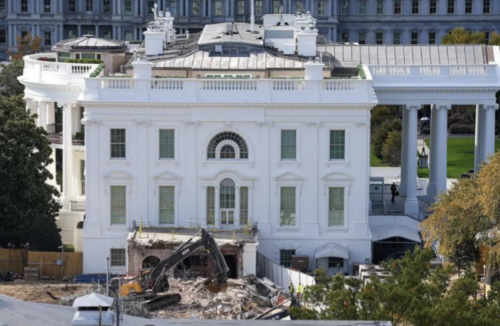
On October 21, 2025, President Donald J. Trump began his $300 million plan to replace the East Wing of the White House with a ballroom. Critics claim that the project is destroying a symbol of our country, while supporters argue that it will modernize the White House. This project marks only the beginning of President Trump’s broader renovation plans, with much more to come.
The White House
In 1791, George Washington set out to create a symbol of power for all Americans, a place where the president could reside and fulfill the duties of the office. Construction began in 1792 under the direction of James Hoban, an Irish architect. In 1800, John Adams became the first president to live in the White House. 14 short years later, during the War of 1812, British forces burned it down, leaving the iconic house in ashes. But still, in times of darkness the White House has remained a symbol of the powers of the president and our country to Americans. A year later, Hoban began to rebuild and finished it in 1817. Even in times of darkness and destruction, the White House has stayed a symbol for the American people.
The White House has several distinct sections, including the East and West Wings. The West Wing is where the president works, housing key rooms such as the Oval Office, where legislation is signed and major decisions are made. Before the renovation, the East Wing contained the offices for the First Lady, Social Office staff and Security-screening operations.
Trump’s Project
The White House has undergone numerous renovations, many of which occurred in the early 1900s. Before Trump, the most recent major renovation was by President Harry S. Truman in 1948. Truman’s reconstruction focused on saving the building from collapse, focusing on its integrity. Truman redid the internal framing with more modern materials. Even though there have been many reconstructions, nothing compares to Trump’s extravagant remodeling.
On Oct. 21, 2025, Trump started his two-to-three-year project to convert the East Wing of the White House into a ballroom for social events. This $300 million project represents a renovation of unprecedented magnitude and came as a shock to many citizens and government employees. While a new ballroom may seem like an unproblematic addition, it has repercussions. The White House is already a cramped space, and with the new addition of the ballroom, the offices of the First Lady, Social Office staff and Security-screening operations will need to be relocated. These are all crucial jobs for the White House and for America, so this project has thus elicited mixed reactions among American citizens.
Public Opinions
This project is highly controversial among Americans. Some claim that, because of the renovation, the president will now be able to host more elegant gatherings. These gatherings are important because they are where the president interacts with key international public figures. Another positive is that by adding the ballroom, Trump is modernizing the White House. Many people, including the president, find that even though the White House is a symbol of power to Americans, it is too old. Trump believes that a proper symbol must be up-to-date with modern technology and architectural designs.
However, a potential negative of this project is the cost. A significant group of people opposed to this project includes preservation organizations. These groups claim the project violates Federal historic-preservation policies and National Historic Landmark guidelines. They disagree with Trump’s opinion on modernizing the White House. They believe that part of what makes the White House so special is its historic value, and if the president continues to modernize it, he will destroy its symbolic significance.
Interview
However, it is essential to remember that major architectural changes to the White House, such as the East Wing, are still relatively recent in historical memory. For example, the East Wing we mainly knew prior to President Trump’s actions was largely constructed during the FDR presidency, with the Kennedys expanding its use to include the First Lady’s office. As a result, it is fair to say that the East Wing doesn’t share the same storied history of the White House.
Either way, architecture teacher Marc Ganzglass offered some historical perspective on the changes. He pointed out that even the neoclassical architecture of the White House was itself not entirely historical in its references to Roman architecture: “If it looks like Ancient Rome in America, it’s not, it’s pointing back to an ideal, a time, in American History where they were looking toward ‘the origins of democracy.’” In the end, Ganzglass says that architecture is always “in flux” and asks who is to say what is to be preserved. In the end, Ganzglass added: “It is better to see it than not see it, and by ‘it’ I mean changes in power. Architecture is an expression of power.”

