

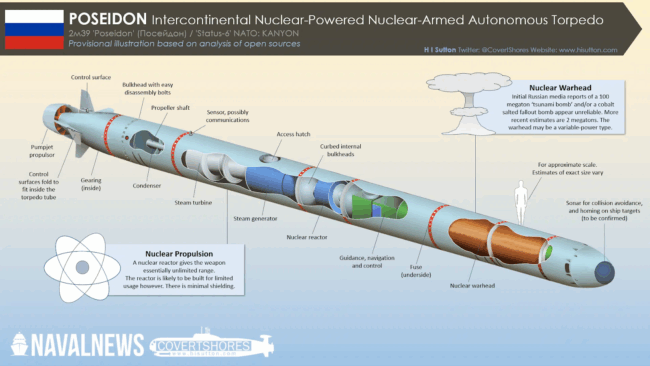
Russian President Vladimir Putin created some major waves earlier this month after announcing the successful testing of the Poseidon Intercontinental Nuclear-Powered Nuclear-Armed Autonomous Torpedo. The frightening weapon of mass destruction is nearly 70 feet long, weighing in at 100 tons. The nuclear weapon can travel, once launched, to speeds of 70 to 110 miles per hour. The two megaton warhead that the Poseidon carries would create a radioactive tsunami that could destroy the coasts of Russia’s opponents. It is no secret that nations like the U.S. have vast coastlines that could be vulnerable to this type of attack.
The news of the Poseidon system’s successful testing follows on the heels of another successful nuclear test of Burevestnik or Skyfall, a nuclear-powered cruise missile, as well as the use in Ukraine of Oreshnik (Hazelnut), a hypersonic missile. According to Putin, the Posiedon is a totally unique nuclear weapon in that “there is nothing like it, and there won’t be anytime soon. There are no interception methods.”
These types of weapons are often referred to as “second strike” weapons. The Poseidon would theoretically be used as a retaliatory attack in response to a first-strike nuclear attack. The Russians are essentially demonstrating they would be able to mount a nuclear retaliatory attack against an aggressor’s first strike. This serves as a deterrent. The fact that Poseidon is launched from a remote submarine lends credence to the “second strike” theory.
China entered the picture quietly by expanding its old nuclear testing site, Lop Nur, in the Xinjiang Uyghur Autonomous Region. While China has not conducted full-scale nuclear testing since 1996, this recent expansion caught the attention of the U.S. and nuclear watchdogs worldwide.
U.S. President Donald Trump has, characteristically, not remained silent on this matter of nuclear testing expansion. In true form, Trump responded by making the argument that the U.S. should perform nuclear testing “on an equal basis” to Russia and China. “Because of other countries’ testing programs, I have instructed the Department of War to start testing our Nuclear Weapons on an equal basis,” Trump recently posted on Truth Social. “I see them testing and I say, well, if they’re going to test, I guess we have to test.” This statement was made after Putin’s Posiedon statement.
Trump’s comments triggered energy and nuclear officials in the Trump administration to request a meeting with the White House and the National Security Council to discuss the nuclear testing option in the U.S. The last full-scale nuclear testing carried out in the US was in 1992. Sources close to Energy Secretary Chris Wright and National Nuclear Security Administration leader Brandon M. Williams have signaled both their concerns that resuming nuclear testing in the US would be ill-advised. These calmer minds seem to be suggesting that Trump’s concern for not being “the only country that doesn’t test” is not a reasonable rationale for potentially accelerating an arms race. Of note, the U.S. is known to have an advantage in computer simulation of nuclear weapons, which can translate into real-life testing more readily than any other nation.
With Russia, China and the U.S. now posturing with all this talk of nuclear testing, has the world entered a new Cold War Era? Is this new birth of nuclear testing, which has remained dormant for over 30 years, merely a political threat or a legitimate concern for humanity? Have we entered the dawn of a new arms race?
