

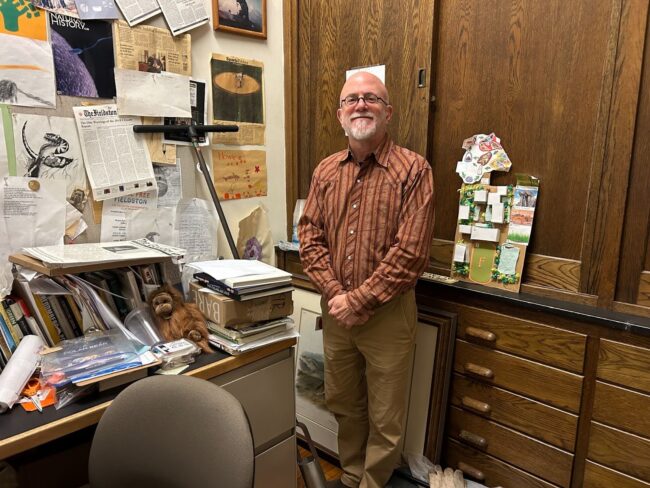
Characterized by his love of animals and nature, Howard Waldman teaches various academic classes in the science department. You may know that he leads the Science Research program along with Dr. Koppa and also teaches Ecology and Animal Behavior elective classes. However, did you know he is an avid Tai Chi enthusiast and has been for 32 years?
Tai Chi is a martial art that promotes relaxation and long-term health. “Some people call it moving meditation. Other people say it’s a form of Qi Gong, which is an energy discipline some people practice. I think it’s really all of those things,” shares Waldman. The practice involves a series of postures linked together through smooth movements. It emphasizes rooting oneself by dropping weight into one’s legs in a certain way, “which makes them strong and which relaxes our back,” comments Waldman.
When asked how he became interested in Tai Chi, Waldman responded, “when I was a kid, I used to watch a TV show called Kung Fu [including] this Buddhist monk.” He added, “I love the message of peace of harmony that the monks in the temple always talked about.” Later, Waldman became interested in a different form of material art called Aikido. However, a back injury forced him to take a break.Waldman explained, “Then I saw a little poster about Tai Chi, so I decided to just try it. And I tried it once and I never went back to Aikido. I just liked it so much.”
Since becoming a teacher at Fieldston, Waldman made an effort to incorporate Tai Chi into all of his classes. I still remember my surprise walking into Science Research class as a sophomore and learning that I would be taking two classes in one period: Tai Chi and science research. Waldman shares that he includes this in classes, “because it’s so relaxing, and because it’s such a change of pace. I realized years ago what a great way to just stop kids from thinking or talking… and get started on our next thing.”
On top of teaching at Fieldston, Waldman teaches a Tai Chi class in the Inwood neighborhood of Manhattan on Thursday evenings.
Waldman recognizes that Tai Chi could be a useful tool for students in the future. He explains, “Now I don’t think that most of the students are gonna run out and do Tai Chi for the rest of their lives. But it’s great to just give them a taste of something–particularly something that they might come back to years from now when they’re thinking, ‘I need to relax. I need to help my back. What can I do? Oh yeah, I used to do this weird thing with Mr. Walkman.’ Maybe that’s a good way to start practicing these things.”
After practicing Tai Chi for over three decades, Waldman learned numerous lessons. He comments, “Ppeople often talk about meditating or achieving a kind of inner peace. What I found is that I could not do that unless I was moving my body.” Another important lesson he believes in is that “Yyou have to strengthen and prepare your body so that a clear mind can enter.” Lastly, he emphasizes, “You can’t have a healthy mind without a healthy body.”
For aspiring Tai Chi practitioners, Waldman recommends: “Take one of my classes.” In a fast-moving and sometimes stressful environment, Tai Chi is a great way to slow down and relax.
