

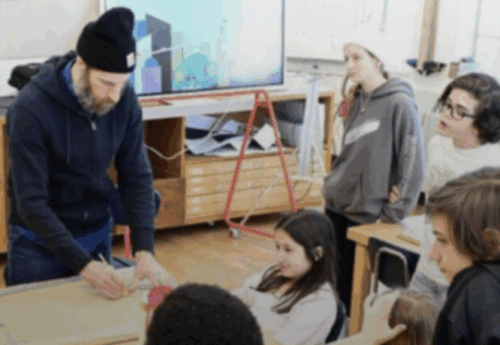
Scott Wolfson is an art teacher and the Department Chair of the Visual Arts Department at The Fieldston School in New York City. I spoke to Mr. Wolfson during his advanced art class at the heavy oak table near the back of the room. The room smelled of oil paint, mineral spirits and linseed oil. The moment we sat down, Mr. Wolfson eagerly told me how he began to love art. He told me how he “was always drawing from a very young age,” describing the times he would “go out for dinner with [his] parents, and [he] had [his] little sketchbook.” While most kids put the crayons down when the food arrived, Scott couldn’t stop. By fourth grade, Mr. Wolfson’s constant creativity began to take proper shape. He and a close friend started making comic books together–his friend wrote the dialogue, and Scott illustrated scenes. And thus began his journey.
The defining point in his career began in high school: “I was probably a sophomore or junior when I took my first oil painting class,” he said. “That’s when I really got hooked.” Scott looked up thoughtfully, recalling his high-school years. He described the class that first drew him in–– “the smell of the paint, the feeling of the paint on the brush, the brush on the canvas.” High school is a place where some find hobbies and skills that they will have for the rest of their lives, and Mr. Wolfson stayed true to this concept. He remembered thinking how he “just wanted to be in the art studio all the time.” As his hours in the art studio stacked up, so did his experience in the field. By the end of high school, Mr. Wolfson had taken almost all the art classes offered to him and found himself yearning for even more time in the studio.
Scott remembers his favorite teacher, who he felt inspired by, because of his lifestyle, one that simultaneously incorporated art, as well as a steady and reliable source of income. He mentioned how he immediately “saw that as, I guess, without naming it, the thing that I wanted to do.” Scott mentioned how his high school self thought, “‘Wow, you could be in the classroom and in the studio.’ I really enjoyed being there, so I wondered, ‘Why wouldn’t someone else want to be in there too?’” Before he knew it, Scott was enrolled in Wesleyan, where he would go on to spend his 20’s doing similar things to his high school art teacher.
At Wesleyan, Mr. Wolfson found the same kind of educational-art balance that previously inspired him in high school. He chose the liberal arts university over a traditional art school after one of his teachers advised him to explore a broad range of schools.. That teacher “steered me away from just pure art school,” he said, “just cause he was like, ‘don’t just lock into a singular thing so early.’”
At Wesleyan, he took that advice to heart, studying in multiple subjects while taking art classes at the same time. Although some lose their passions later in life, Scott never did, and continued to love art through his late teens and early 20’s. Through his art classes in college, Scott continued to be inspired by his art teachers, envying their lifestyle, which includes a healthy amount of art and a stable job. “When they’re not teaching, they’re like in their studio making work. It seemed like it was everything I wanted to be doing.”
Towards the end of his college experience, Scott was offered a position at Wesleyan, which lined up with his goals as an artist. One of Scott’s professors offered him a position teaching in a summer program at Wesleyan. He remembered his teacher explaining to him, “You can stay in my apartment, just house sit for me, take care of the apartment, and you’ll be running the print shop, and you’ll be teaching these high school students.” It was exactly what Mr. Wolfson wanted: an opportunity to be in an art studio as much as possible, while doing something productive in teaching students. “The director of the program interviewed me, and within a week, I had the job for that summer.”
In the following years, Mr. Wolfson continued teaching at this Wesleyan Summer program for the next five summers, while incorporating additional teachings at different art organizations. He did this alongside pursuing his own art career, spending as much time in the studio as he could.”It was kind of immediate. It just, like, sort of struck something in me that was like, ‘Yes, this is what I want to be doing.”’
Scott eventually went to graduate school, earning his Master of Fine Arts (MFA), by 27. Soon after, he began applying for additional teaching positions at colleges and high schools. Eventually, he came across Fieldston, where he applied to and has now been a community member for fifteen years and counting.
“I started part-time,” he said, “and now I’m the chair of the art department.” What started as a temporary position is now an important, lasting role that perfectly blends his two passions: making and teaching art. Wolfson follows photography teacher Mark Stracke, who was Visual Arts chair for forty years, and for many Fieldston teachers, Wolfson is the perfect fit.
Being a part of Fieldston has become a defining part of Mr. Wolfson’s creative and professional life. “I enjoy walking into the studio,” he said. “I enjoy talking about art all day.” Surrounded by students and colleagues who share his enthusiasm, he finds constant inspiration in the classroom. Watching his students discover their voices reminds him of his own journey—the same curiosity that kept him drawing as a kid and painting as a teenager still fuels his teaching today. “I love seeing students grow over the years,” he said. “It’s amazing to watch their work change and evolve.”
As our conversation ended, it was clear that art for Mr. Wolfson is more than a profession— it’s his lifelong goal, involving creativity and community. He’s spent years balancing the studio and the classroom, but still approaches both with the same sense of wonder and passion he felt as a teenager with his first paintbrush. He reminds his students to pursue art only if they truly feel called to it. “You should only do it if you feel like you have to,” he said. “If you can’t imagine doing anything else.”
In a world where creativity is often undervalued, Mr. Wolfson’s career stands as proof that an art career is not a one-way street but a path splitting out into multiple places. His story shows that being an artist is not only about what you create, but about how you share that creativity with others.
