

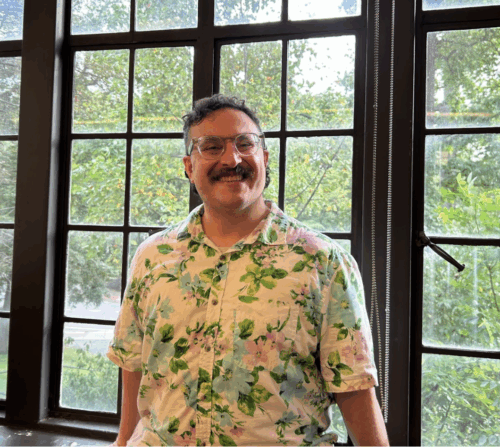
“I love teaching because I like the challenge,” shares Dr. Phillip Keisman. “In order to teach something, you have to understand it systematically enough to give it over to a variety of brains in the room—everybody’s learning differently. How am I going to take what I find interesting to you and your classmates? Who’s more a visual learner and more of a kinesthetic learner?” he elaborates. Keisman joined the history department at Fieldston this past fall, beginning his 15th year as an educator.
Before teaching, Keisman worked as a basketball coach. While studying at Brandeis, he worked as a student manager for their basketball team and eventually got promoted to student coach. “I wanted to be a professional basketball coach when I was in high school,” he remarks. “I spent senior year, into the summer of 2006, coaching at a local high school, and then I worked at a basketball camp in Long Island for a summer. Since then, it’s all been avocational.”
Keisman began his teaching career in Jewish Studies at The Heschel School. He has also served as an adjunct professor at Lehman College, Queens College, The New School and the Jewish Theological Seminary. In addition, he currently teaches community classes and a summer course for adults at various synagogues.
When asked what drew him to Fieldston, he says, “I grew up in Riverdale. I went to Jewish day schools, and my recollection is that I thought Fieldston kids were cool.” He adds, “I find Felix Adler very interesting as a person, and when I was applying to schools for a job, I was attracted to the extension of that vision and the way you talk about ethics and the way you work ethics into humanities.”
Now that Keisman is at Fieldston, he teaches ninth-grade Modern World History and the junior/senior elective Modern Genocide and Mass Violence. “I have always wanted to teach a class on genocide–I mean always–since I was an undergraduate in college,” explains Keisman. “I feel really grateful that I have the opportunity to do it.”
Keisman adds, “I think looking at crimes against humanity in general is depressing. I think the 20th century, in general, is really depressing. But I also think some historians are really good at forcing us to take a victim-center approach and to humanize people that were not humanized in their time, and I think that could build empathy when it’s done well.”
History has been one of Keisman’s passions for a long time: “What’s interesting to me about history is both what we don’t know–like what are the seams that historians debate about–and also how much we do know in a world where there’s misinformation and conspiracy theories. I find a lot of emotional grounding knowing that there are people who have access to actual sources that we can point to.”
