

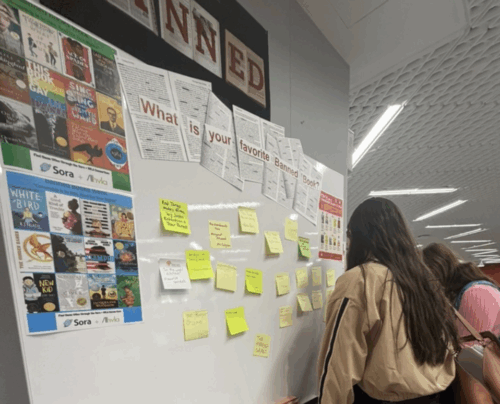
On Friday, October 10, the Tate Library transformed a section of their library into a small, bustling hub of literary revolt for Banned Books Week. Students throughout the upper school gathered to commemorate the strength of words that were silenced, yet refuse to be forgotten. Cookies, brownie, and pizza lured many in, but it was the collaborative activity– a display about banned books– that kept so many there.
During underclassmen lunch, the space was swamped with passion and energy. Freshmen and sophomores recognized familiar titles of banned books, exchanged recommendations, and cultivated colorful scribbles sharing experiences across a whiteboard. One of the popular books on a list of banned books shared by the Tate Library was “New Kid” by Jerry Craft– a story highlighting the experiences of a transfer student of color in a predominantly white institute. What made this book even more memorable and special was the fact that Jerry Craft himself is a graduate of Fieldston! By highlighting a banned book written by an individual from our own community, a deeper connection was built between our students and the pressing issue of banned books. It also served as a proud reminder of the impact our community can have towards a cause like this, both individually and more so collectively.
Then came the upperclassmen lunch. The pastries and pizza were waiting near the uncapped markers, yet the chairs remained mostly empty. It echoed a pattern I’d noticed previously: underclassmen were far more willing to join Fieldston’s book club– even despite hesitance– while juniors and seniors hurried past. Perhaps it’s due to the lack of time to balance multiple clubs, or maybe literature just slips too easily off our list of priorities.
But books and time wait for no one. They remain here– waiting to challenge, connect and comfort so many. So take this as an invitation: step back into the library, upperclassmen. Not to solely complete homework or unwind with friends, but to pick up a story that someone once attempted to silence. Join or even initiate conversations bigger than an assignment. Because reading isn’t just a chore nor an act of leisure– it’s an act of mettle.
Shortly after the event, I sat down with Librarian Katie Elwood to discuss the Banned Books exhibit, which has been a tradition at The Tate Library for decades. Here’s what Ms. Elwood had to say :
1. What role do you think libraries should play when it comes to accessing banned or even challenged books? Libraries should always defend a person’s right to read. Librarian Ms. Colgan jokingly likes to say “all the best books have been banned”, and in a way I think that’s really true. Most of the books that have been challenged are well known, and well loved, and because of this have the ability to elicit strong feelings and opinions. The priority of every library is to provide a curated collection of quality information from a range of viewpoints and this often includes banned and challenged books. The American Library Association has a great website that sums up libraries’ role in censorship.
2. How did you approach choosing banned books to display in the front of the library? We displayed the 10 most challenged books of 2024, and added some other favorites such as 1984 by George Orwell (which is also the theme of this year’s Banned Books Week “Censorship is so 1984”) and the picture book “And Tango Makes Three” which the Florida supreme court recently upheld a ruling in favor of removing from a local school library.
3. Why do you think it’s important for students to understand and discuss book censorship?
- Because access to information and ideas is a first amendment right
- Because access to diverse viewpoints and information is crucial to a healthy democracy
- We want students to know that they have agency in a library; they can choose for themselves what to read.
4. Have you ever received pressure to remove or restrict a book here at school? If so, how do you handle those situations?
Thankfully, the answer to that is no. Tate Library has not had any books challenged. If a challenge were to happen, all of the ECFS Libraries have a Collection Development policy in place. A collection development policy is a document that states the mission of each library and makes clear that the collection has been thoughtfully curated with a selection criteria. The person challenging the book (after reading it) would need to submit an official form, and the book would then be reviewed by the librarians. Again, thankfully this has not been an issue at the Tate.
5. Why do you think it’s important for students to be involved in events like Banned Books Week?
It’s a great opportunity for all communities to reflect on the role that libraries and censorship play in our lives, how information is disseminated, and who has access to information and who doesn’t.
6. How do you see the role of the Tate Library changing when it comes to student activism or free speech?
The Tate Library celebrates and supports free speech and student activism, and is committed to continuing to be a place for trusted and reliable information.
7. If you could recommend just one banned book for everyone to read, what would it be and why?
The picture book And Tango Makes Three because it’s the perfect example of a simple story (a true story) written for children, about penguins, that has unfortunately been misinterpreted and (in my opinion) unjustly maligned since it was published 20 years ago.
