

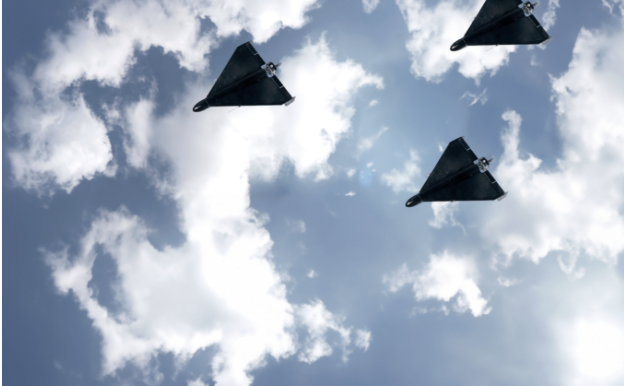
The closest Poland has come to open conflict since World War II was September 9, 2025. Russia invaded Polish airspace leading Poland’s Prime Minister, Donald Tusk, to invoke Article Four of the United Nations Charter. At least nineteen drones entered Poland, some of which were shot down by Poland, NATO missiles and missiles from the Netherlands.
Tusk invoked Article Four of the North Atlantic Charter, requesting urgent talks with allies to discuss Russia’s aggressive use of their drones. Article Four does not guarantee military retaliation on the part of NATO. Instead, it requires members to consult whenever a member believes its territorial integrity or security is threatened. It has only been invoked nine times since 1949. NATO members will meet to decide how best to proceed.
Currently, Moscow and Belarus have given contradicting statements about the activity of the drones. Moscow reported that the drones hit planned targets in Ukraine, with no targets planned for Poland in the programming, Belarus said the drones had simply “lost track.” Germany disagrees, saying the drones were “clearly set on this course.”
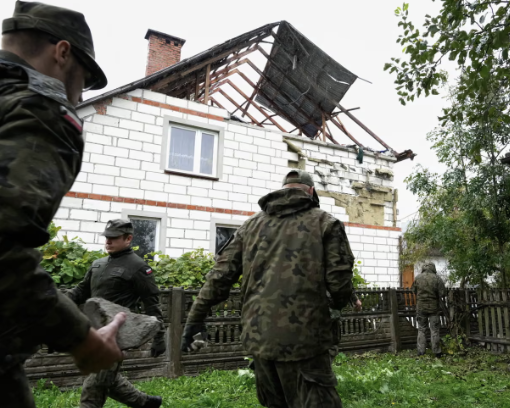
Source: The Guardian
Two reports have been made in Poland explaining the damages. The roof of a house in Eastern Poland was greatly damaged, but no injuries were reported. A car was also struck, again with no injuries sustained. Airports were shut down and flights to Warsaw diverted.
For the first time, NATO engaged its fighter jets directly against enemy targets within allied airspace. Poland scrambled F-16s, the Dutch sent F-35s, Germany activated Patriot Defense systems and Italy dispatched AVAC surveillance aircraft. People woke to the sounds of fighter jets and explosions in the sky.
Donald Tusk calls the drone strike a “large-scale provocation,” urging that Poland be prepared for “every possible scenario.”
The drones that were recovered on the ground were identified as Gerva drones, also known as “dummy” drones, unarmed but capable of long range, up to 700 kilometers. Were they sent to assess NATO’s defenses, or was this really a mistake? Russia and Belarus both claim it was an accident, yet NATO leaders condemn the recklessness and urge allies to remain cautious.
President Zelensky is adamant that the drones were not a mistake. He warns the attack sets a “dangerous precedent” for Europe and supports an air shield around nations bordering Russia. Many see the drones as an intimidation tactic. Either way it is a turning point for Poland.
The drones over Poland are not the only incident. In just three weeks, Russia has flown drones into Romania, sent fighter jets into Estonian airspace, buzzed a German Navy frigate in the Baltic Sea, meaning they flew very close and very low over a German warship as a form of intimidation, and backed an influence campaign in Moldova’s elections.
In Estonia, Italian F-35 pilots intercepted Russian MiG-31s after they flew more than five miles into NATO airspace with their transponders switched off. The Russian pilots even waved before being escorted back over the border into Kaliningrad. Estonian officials warned the incident shows Russia’s invasion may not stop at Ukraine.
Airports in Denmark and Norway were shut down after unexplained drone activity, which officials suspect could also be traced back to Moscow. Denmark’s prime minister said she could not rule out Russia as the culprit. The Kremlin dismissed Europe’s concerns as “exalted hysteria.”
Meanwhile, Moldova has faced its own battle with Russian interference. Prior to the election, the Kremlin released a campaign of disinformation and unrest. Moldovan authorities detained 74 people, claiming they disrupted a Russian-backed plot to incite chaos. President Maia Sandu responded saying, “Moldova is our home, and our home is not for sale.” Moldova’s parliamentary elections are now over, with the pro-EU Party of Action and Solidarity winning the majority.
Analysts say these moves form a broader Russian strategy: probing for weakness, testing NATO’s resolve and undermining pro-European governments.
Already, NATO members are divided over how far to go. Poland’s foreign minister has threatened military action if Russian aircraft stray into Polish airspace again. Germany’s defense minister, however, cautioned against falling into what he called a Russian “escalation trap,” insisting that “prudence is not cowardice, but responsibility toward peace in Europe.
Russia has warned that any aggression will be met with a “decisive response.” President Zelensky says Putin is deliberately escalating, and that Europe must prepare. The alliance now faces the same question Poland does. Does this moment end with another strongly worded reprimand of Russia, or does it finally demand concrete action?
