

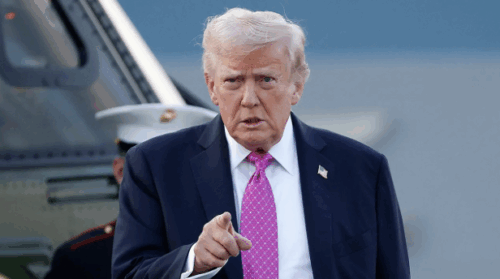
President Donald Trump filed a lawsuit on September 15 against The New York Times, claiming the newspaper and several of its journalists defamed him in a series of articles related to his financial records. Trump has also stated that the Times aimed to undermine his campaign in the 2024 election, saying that the Times’ endorsement of Kamala Harris was a result of the newspaper becoming a “mouthpiece for the Radical Left Democrat Party.”
The lawsuit, filed in a Florida federal court, claimed that two articles were “specifically designed to try and damage President Trump’s business, personal and political reputation.” The articles in question include “For Trump, a Lifetime of Scandals Heads Toward a Moment of Judgment,” written by Peter Baker and published on October 20, 2024, and “As [2024] Election Nears, Kelly Warns Trump Would Rule Like a Dictator,” written by Michael S. Schmidt and published on October 22, 2024.
“For Trump, a Lifetime of Scandals Heads Toward a Moment of Judgement” by Baker argues that Trump has accumulated a large number of scandals over his life, including business failures, lawsuits, investigations, and ethical controversies. This article highlights the fact that, unlike many politicians whose single scandal might derail their careers, Trump has created a system that prevents him from being derailed. When confronted with the consequences of his actions, Trump puts on a performance in which he portrays himself as having been “attacked” or “targeted,” presenting his scandals in a way that frames him as the victim. He uses these altercations to fuel his campaign by gaining sympathy from voters. As Baker writes, “He has survived more scandals than any major party presidential candidate, much less president, in the life of the republic. Not only survived but thrived.”
During his first term, Trump was involved in a total of 178 scandals and controversies. These incidents can be categorized into seven subcategories: legal and constitutional issues, domestic policy and governance failures, foreign policy and national security conflicts, administrative ethics violations, civil rights concerns, misinformation in the media and in campaigns, and election-related events.
Each of these categories reveals a new aspect of the controversies that shaped Trump’s presidency during his first term. Legally, Trump faced allegations of violations of law, court cases, executive overreach, attempts to subvert democratic institutions or constitutional changes. According to a count by U.S.A. Today, the President has been involved in 4,095 lawsuits. Some examples of this include his attempts to overturn the 2020 U.S. presidential election, the federal prosecution of Donald Trump, and the Trump v. New York lawsuit. Any decisions and policies implemented domestically, which often involve health, the environment, the economy, or administrative governance, can be included in this broad category.
The administration’s response to COVID-19, marked by chaos and disorderly conduct, as well as attempts to dismantle the Affordable Care Act, shows Trump’s failure to govern properly. Internationally, Trump faced several cases of foreign interference involving other nations during his presidency. From the withdrawal from the Iran nuclear deal to controversial summits with North Korea, his foreign policies fostered international uncertainty.
Trump also violated ethical values, resulting in multiple of his administration officials resigning over scandals. This included cabinet officials who had been previously appointed by Trump himself. The President was accused of profiting from his presidency through business opportunities by directing government spending towards his own properties.
In terms of civil rights, actions like the family separation policy, his handling of the many George Floyd protests, and his policies on immigration raised major civil and human rights concerns. The Trump administration was frequently criticized for spreading false or misleading information, claiming “sometimes we can disagree with the facts.” Finally, Trump was involved in many election-related controversies, including the rejection of the 2020 results and the January 6th Capitol riot. These events show Trump’s unprecedented challenge to American democratic norms.
In this article, Baker reflects on how Trump has handled these scandals. His tone is both accusatory and reflective. Baker recognizes that many of these issues have not eroded Trump’s electoral viability—at least, not yet. Trump has denied accusations, launched counterattacks against those who levy them, and framed these advances as persecution. This is a crucial part of his political identity and raises the question: at what point does his history of scandals become determinative? Can so many controversies, legal challenges and public disapprovals accumulate to a point where they matter in undermining his candidacy? Or will he continue to deflect and leverage these acts?
Schmidt’s article “As Election Nears, Kelly Warns Trump Would Rule Like a Dictator” includes an interview with John Kelly, Trump’s first-term chief of staff. During the interview, Kelly said Trump “prefers the dictator approach to government.” He warns that if re-elected, Trump “would love to be just like he was in business… he could tell people to do things and they would do it and not really bother too much about whether what the legalities were and whatnot.” He argues that Trump exhibits a fondness for authoritarianism, is contemptuous of constitutional and legal constraints and lacks a basic understanding or respect for constitutional norms. Kelly comments from a nonpartisan standpoint, setting aside the influence of either political party. He emphasizes that some of Trump’s recent statements have crossed a line, even for him—particularly in his talk of using the military internally—and this prompted Kelly to speak out “on the record.”
Furthermore, Kelly defines fascism as a “a far-right authoritarian, ultra-nationalist political ideology and movement characterized by a dictatorial leader, centralized autocracy, militarism, forcible suppression of opposition, belief in natural social hierarchy.” He said that, based on his experience, the definition “accurately described” Trump. He adds, “Certainly the former president is in the far-right area, he’s certainly an authoritarian, admires people who are dictators—he has said that. So he certainly falls into the general definition of fascist, for sure.” In response to the article, Steven Cheung, a spokesman for the Trump campaign, told The Times that Kelly has shared “debunked stories” and “beclowned” himself.
This is not the first lawsuit Trump has had involving the Times. In 2021, Trump filed a $100 million suit against The New York Times, three of its reporters (Susanne Craig, David Barstow and Russ Buettner), and his niece Mary Trump. He claimed they all conspired to obtain his tax records and breach a confidentiality agreement. Later, in May 2023, New York State Judge Justice Robert Reed dismissed the 2021 lawsuit against The Times and the journalists, finding that Trump’s claims “fail as a matter of constitutional law.” Journalists are protected under the First Amendment when engaging in lawful reporting, particularly in relation to matters of public interest, as was the case here. Along with this decision, Judge Reed ordered Trump to pay nearly $400,000 in legal fees and costs to The Times and its reporters.
Even though Trump has already suffered a major courtroom defeat concerning The Times, his most recent lawsuit advances claims with a similar line of argument. Trump’s allegations center on him being “misportrayed with respect to his wealth and business dealings,” and that The Times has acted with the intent of shaping public opinion against him. The President recently posted on Truth Social, “The New York Times has been allowed to freely lie, smear, and defame me for far too long, and that stops, NOW!”
On September 19, 2025, U.S. District Judge Steven Merryday dismissed the lawsuit in its initial form. The judge’s statement surrounding this lawsuit consists of criticism for the President himself and the filed complaint. Merryday did not rule on the content within the defamation claims; rather, he dismissed the complaint under the grounds that it was improper and failed to comply with federal pleading rules. He criticized the complaint’s length, format, tone and organization, describing it as “decidedly improper and impermissible.” He said that most of the complaint is spent on “praise for the plaintiff, repeated invective, editorial-style discourse and political harangue.” In his decision, Merryday wrote, “As every lawyer knows (or is presumed to know), a complaint is not a public forum for vituperation and invective — not a protected platform to rage against an adversary.” He also said the complaint “extends far beyond the outer bound of [expressive latitude] … the complaint consumes eighty‑five pages. Count I appears on page eighty, and Count II appears on page eighty‑three.”
All of this comes down to the idea that Trump’s lawsuit was inappropriate- not because of its content, but because of its tone and structure. In his dismissal, Judge Merryday emphasizes that a legal complaint is not intended to be a place to express anger or an opinion. It is intended to lay out facts and legal claims in a clear, objective way. The actual defamation claims, which Judge Merryday referred to as the “Counts,” do not even show up until page 80 out of 85, which he saw as excessive. This lawsuit was described as feeling more like a campaign speech than a serious legal argument. Considering the overly emotional descriptions, unfocused writing and improper structure of this lawsuit, its dismissal was to be expected.
In the end, Donald J. Trump v. The New York Times Company, Peter Baker, and Michael S. Schmidt serves less as a serious legal effort and more as yet another chapter in Donald Trump’s long-standing strategy: deflect criticism, attack the press and cast himself as the perpetual victim. But the courtroom is not a campaign rally, and judges are not political supporters. As Merryday made clear, the law requires clarity, precision and fact, not eighty-five pages of praise for the President and insults to those who stand opposite to him. The dismissal of this lawsuit reflects the broader truth about Trump’s presidency, showing that while he continues to seek power through spectacle and outrage, the institutions he challenges are holding firm. Whether this commitment to free speech will persist remains an open and pressing question for the future of American political discourse.
