

Climate Week NYC 2025 started on September 22, and it was truly incredible. The event, first held in 2009, is timed to coincide with the United Nations General Assembly Week each year for greater international appeal. Since then, this annual gathering has inspired similar events across the country, including SF Climate Week and DC Climate Week.
One of the things that makes Climate Week so special is its accessibility. Events take place across all five boroughs, with most being free and only a select few requiring a small entrance fee. This means representatives from major international companies can be found rubbing shoulders with foreign non-profit leaders and even (if you can believe it) New York City high school students.
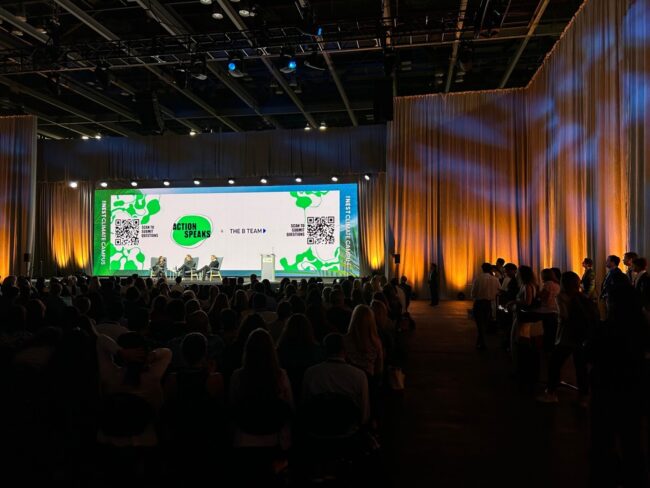
I had the pleasure of visiting The Nest Climate Campus’s event at the Javits Center last Tuesday with the leaders of the Environmental Club (Hannah Saez-Zadoff, Malaika Singh and Stella Brothers, Form VI). While The Nest Climate Campus hasn’t released the exact numbers yet, over 130 speakers presented this year, continuing their history of being the largest in-person climate event in the US. The organizers describe themselves as a “climate action platform and official event partner of Climate Week NYC.” Each year, the multi-day conference they host serves as a way for people to educate themselves about climate change and the efforts to combat it, while also being an invaluable networking opportunity.
The first event our group attended was a panel on the main stage, featuring the CEOs of Patagonia and IKEA discussing the approaches their companies take on sustainability. Hundreds of people packed into the hall, all rapt and listening intently to every word. I learned a lot from both the CEOs’ discussions with the moderator and the subsequent audience questions they answered.
First, it’s apparently relatively simple to turn plastic bottles into fleeces. Second, while customers are willing to pay higher prices on luxury products made sustainably, companies like IKEA, whose products can be more essential, don’t have as much flexibility. People like saving the planet, but they also like being able to afford a table to eat off of. Third, not all climate efforts are bad for business. In fact, IKEA’s sustainability efforts have reduced its annual energy usage by 29%, saving the company over $8 million yearly.
After the panel, we explored the main exhibition area. There were too many companies and exhibits to list them all, but some stood out: faux leather chairs made from mushrooms, which felt and even smelled like leather; a Chevrolet EV that can drive upwards of 400 miles on a full battery; a solar-powered shipping boat; and more. The incredible variety of projects was really impressive to see, and shows the multitude of ways available to fight global warming while still turning a profit.
What really stuck with me, though, was how hopeful everyone seemed. The current presidential cabinet seems determined to dismantle as many environmental protections and regulations as possible, putting both citizens and the planet at risk. Yet despite the chaos all around us, most people I talked to felt incredibly confident about our ability to curb our footprint effectively. According to one of the panelists, while it may seem like sustainability is leaving the public eye, 95% of CEOs remain committed to sustainability and 88% say they feel the case for it is even stronger than it was 10 years ago. Despite this support, many people still don’t feel comfortable talking about sustainability–which means it is up to us to set the standard, make our voices heard and pave the way.
