

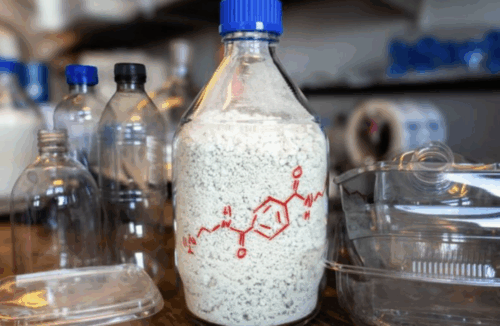
Greenhouse gases are one of the major man-made problems that have contributed significantly to the current climate crisis. A major offender and contributor to greenhouse gases is the production of disposable plastics. Plastics alone contribute, on average, nearly 2 million tons of greenhouse gases, such as carbon dioxide, annually. For decades, environmentalists have focused on reducing the production and use of plastics to lessen the greenhouse gases they produce. Scientists from the University of Copenhagen, however, have come up with a novel solution: converting plastics that already exist into a product that can capture carbon. Their findings are published in this month’s issue of Science Advances.
Researchers from Denmark, led by PhD candidate Margarita Poderyte, have explored the role of carbon capture as one of the leading solutions to combat climate change. Carbon dioxide (CO₂) is one of the leading greenhouse gases that gets trapped in Earth’s atmosphere and leads to global warming. Differing methodologies currently exist that try to mitigate this global warming issue by capturing greenhouse gases like CO₂. Poderyte and her team have come up with a solution that addresses two problems: what to do with plastics that already exist, and how to add to the carbon capture armamentarium.
According to Poderyte, this research has accomplished this goal by “turning waste into a raw material that can actively reduce greenhouse gases, we make an environmental issue part of the solution to the climate crisis.” Through the chemical reaction known as aminolysis, researchers converted (or upcycled) PET (polyethylene-terephthalate) plastic into a new material referred to as BAETA, a new type of carbon absorbent. The chemical reaction to create BAETA involves adding ethylenediamine (a compound that binds to CO₂ easily) to the plastic to convert it from a polymer to a monomer. That final material is referred to as BAETA, which is very effective in binding to CO₂.
PET plastics are among the most commonly used plastic products, which include bottles, textiles and all types of packaging. Poderyte and colleagues innovated the upcycling of PET plastics into BAETA, addressing plastic waste disposal while presenting a breakthrough in carbon capture using that raw material. The applications are limitless. If there were increased efforts to collect the millions of tons of plastic in our oceans, for example, this invention would not only have a positive impact on ecosystems but also serve as another efficient way to reduce greenhouse gases. The research uses the waste that already exists to our collective advantage.
From a mechanistic standpoint, once the BAETA has absorbed the CO₂, a heating process can be used to concentrate and store it, and eventually the gas can be used as a sustainable energy source. While this conversion does require energy, its benefits would significantly outweigh the energy required. The BAETA units could be used in industrial plants, for example, in order to capture and convert the harmful CO₂ emissions. There could eventually be a role in similar situations, like chimneys, and any other common source of CO₂, which would be highly scalable over time.
The next step is to implement this technology. According to Poderyte, “We see great potential for this material, not just in the lab, but in real-life industrial carbon capture plants. The next big step is scaling up to produce the material in tonnes, and we’re already working to attract investments and make our invention a financially sustainable business venture.” Plastic that, put simply, eats carbon is an ingenious solution that can both address plastic pollution and curb the climate crisis.
