

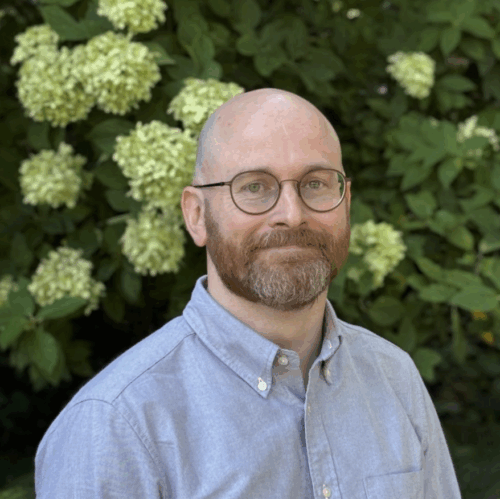
Students walking through the halls at Fieldston this fall will notice a few new faces. Among them is the school’s newest psychologist, Dr. Will Holland. His journey into the field did not begin in a typical classroom or clinic, but in the outdoors, on hiking trails and in spaces where relationships mattered the most.
Holland first trained to be a Latin teacher, but quickly realized that his passion leaned less toward reading texts and more toward connecting with students. “I didn’t care as much about teaching the content as much as the relationship building,” he explains. Though he chose not to pursue classroom teaching, he still wanted to work closely with high school students.
Holland’s own formative experiences outdoors—hiking, backpacking—opened another door. “Those health-promoting experiences in the outdoors as a teen and young adult shaped me. Wilderness therapy was my first time working in a therapeutic capacity with high schoolers, and something really clicked. I saw how impactful an important relationship can be on mental health, and I wanted to be a therapist.” This realization led him to pursue a PhD in psychology, with the goal of becoming a therapist in a school setting.
For Holland, schools feel like a natural fit. “Students spend so much of their lives in schools. They are a kind of home base away from family, where belonging—or the lack of it—really shapes a person’s experience.”
Holland was drawn to Fieldston for many reasons. Having attended Trinity and built friendships with Fieldston students at summer camp, he already understood the pressures, joys and challenges of New York City independent schools. The school’s new initiative to assign a psychologist to each grade, following students from ninth grade to graduation, especially excited him. “I’ve never heard that before,” he says. “It fits with what adolescents really need: a trusted adult who will be there for the whole journey.”
Holland’s first weeks have only deepened his enthusiasm. “Fieldston is energetic, fun, intellectually stimulating and bright. Covering a ninth-grade advisory gives me a chance to connect with students in a smaller setting. My goal is to meet every single ninth grader so they know my face and my office, and to demystify what it means to talk with me.”
Beyond one-on-one counseling, Holland hopes to encourage peer support. He sees students as powerful resources for one another: “Things are more helpful when students support students.” Drawing on his hiking background, he compared it to climbing a mountain, noting that growth happens when everyone takes turns leading and learning from each other.
Outside of school, he is also navigating new challenges and joys. “I’m a new dad to a five-month-old, which doesn’t leave much room,” he says with a laugh. “But I hope to stay connected to the outdoors and to bring my daughter to homecoming one day. When she’s older, I’d love to come to more games and performances.” As a former musician, playing in jazz and indie bands in high school and college, he is particularly curious about student bands on campus and is excited to learn more about them.
For now, though, his focus is clear: “Whether students talk to me once in four years or every week, I want them to know I’m here to support them – and to help students feel they are part of a community where everyone feels like they belong.”
