

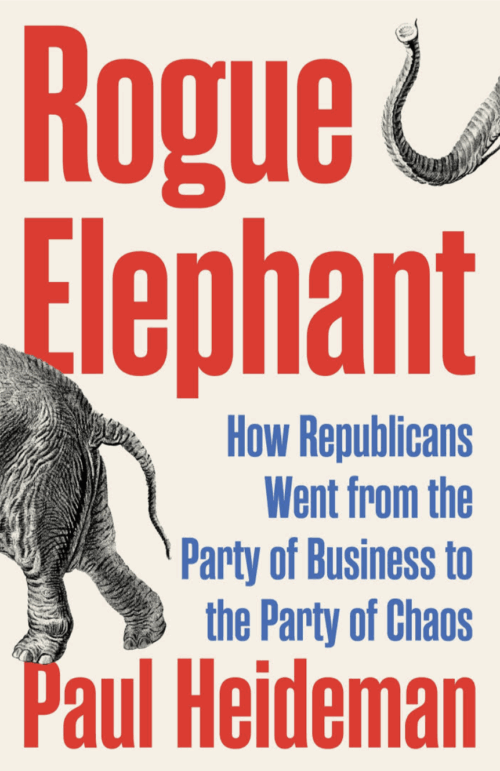
I recently sat down with Dr. Paul Heideman, a Fieldston history teacher and author, to discuss his new book “Rogue Elephant,” which examines how the Republican Party has transformed over recent decades. Rather than offering surface-level explanations for Trump’s rise, the book presents a compelling framework for understanding the broader institutional changes that made such a political transformation possible. Dr. Heideman traces structural shifts in corporate political organization that have reshaped American politics since the 1950s, challenging common narratives by presenting recent developments not as aberrations but as logical outcomes of longer-term trends in elite political coordination. What struck me most about our conversation was how his research reframes our understanding of contemporary political change. Here is our full conversation.
James Bloom: Congrats on your new book!
Dr. Heideman: Thank you.
Bloom: I’d love to start by asking you a few questions about your writing process. I think a lot of Fieldston students would be interested in that. What was the initial spark or inspiration that made you want to write this piece?
Heideman: In 2021, my grad school advisor asked me to write an article for the journal that he edits on whether the Republicans were becoming a working-class party, which was a claim that was being made a lot after 2020. In the course of investigating that claim, I found that, one, I didn’t think that was really true, and two, if that wasn’t true, I needed some other way of explaining what was happening with the party. This led me to try to come up with a hypothesis that could explain what’s been happening with the party over the last couple of decades.
Bloom: While writing the book, did you face any writer’s block or have moments you had to overcome?
Heideman: I wouldn’t say I had writer’s block. It was more that I had times where I had to figure out what pieces of the puzzle were missing. So it was more about needing to find the right detail to anchor an argument or trying to figure out what the essential dynamic was in this period. The real problems of writing the book were mostly analytical, not in terms of how to write a book like this, but rather trying to explain something. The real work is in figuring out the explanation and how all the parts fit together. Once that’s clear, the writing itself is easy. So the hardest part wasn’t the writing—it was the research and shaping the material into something coherent.
James: That is really quite an interesting explanation.
Heideman: Oh, thank you.
James: So has teaching influenced your writing at all?
Heideman: You know, not very much, because this book is kind of written for political scientists, maybe to be used in college classes, and also for a general audience. But it’s really not aimed at a high school audience. So I haven’t found that it’s intersected with my teaching a whole lot. That said, I am teaching a new class on political parties next spring that does come out of this research. So, more than the teaching impacting the research, I’d say the research has impacted the teaching—since it led me to design this new course.
James: That’s Interesting. Moving on to the book’s contents, one of the book’s central arguments is that business leaders and elites played a pivotal role in the fall of McCarthy, but that opposition wasn’t able to sideline Trump. So what would you say changed between those two times?
Heideman: During the 1950s, when McCarthy was in power, American businesses were pretty well organized in a couple of groups, one was called the Committee for Economic Development, and one was called the Business Council. These were groups where titans of industry got together and tried to figure out what the United States should do on all kinds of policy questions. There was a bill being debated in Congress about whether the United States should make it a law that the government is trying to pursue full employment. There were fights between the Federal Reserve and the Treasury in the 1950s, and these groups are hammering out their positions on this. These business groups were really, really active in trying to shape the direction of American society. Because of that, they were really well-positioned when McCarthy started to look like he was a threat to what they wanted. They were able to use their influence to push him offstage.
What changed in the 1970s was that there was a moment when business leaders realized that groups like the Committee for Economic Development and the Business Council—organizations that had, from their perspective, done a good job shaping American politics from the 1940s into the 70s—were no longer effective. Faced with economic crises, such as the oil embargo, and other challenges of the 1970s, they recognized that these existing groups weren’t doing a good enough job anymore and that they needed new ones.
One of the major organizations founded at that time, which remains influential in American politics, is the Business Roundtable—an organization composed of CEOs from the largest American corporations. Over the course of the 1970s and into the 1980s, especially with the election of Reagan, these new groups essentially got everything they wanted. The labor movement in the United States was dealt a severe blow during this period. If you look at the percentage of American workers in a union, it has steadily declined ever since.
It’s funny, once these business groups start getting everything they want, they start to fall apart because there’s not as much urgency for them to say, “We have to be able to get this right.” What you see is various groups, such as the Business Roundtable and the Chamber of Commerce, which were very important in the 1970s, shifting away from shaping the overall direction of the American economy in American politics. Instead, they become much more narrowly focused, for example, on trying to defend corporate management from laws that would increase the power of shareholders. But these groups are no longer steering politics.
At the same time that big businesses are losing their influence, smaller business groups begin going off in different directions. So, not all businesses are marching in the same direction anymore. For example, in the 2010s, the Koch brothers, owners of a large oil and energy company, began raising money for Republican candidates who were farther to the right than the party’s mainstream. They’re like, “No, no, no, we want a totally different strategy from what the rest of corporate America wants.” Suddenly, corporate political action splintered into different directions, making it much harder for corporations to mount the kind of unified action that would have been necessary to expel Trump from the Republican Party after January 6th.
So even though Trump and McCarthy are both these kind-of right-wing demagogues whose actions posed serious threats to American society in some key ways, they’re successful in pushing McCarthy off stage, and they fail to push Trump off stage.
Bloom: I would also say that, to some extent, the fact that Trump lacks the backing of mainstream business leaders actually amplifies his message.
Heideman: Yes, he gets to say, “They all hate me”. Although now you’re seeing all these corporations and CEOs coming to Trump to cut individual deals. They’re not acting as a class. They’re coming to Trump and saying, “How can we make a deal that just benefits me?” This continues the same pattern: corporations aren’t trying to steer the overall direction of American society; rather, they’re just out for their very narrow interests.
Bloom: And I’d say you see a similar pattern in universities — do we stick together, or do we try to be the first to cut a deal?
Heideman: Yep, exactly.
Bloom: And even with foreign countries and tariffs.
Heideman: Yes, all of that. Yep.
Bloom: You’ve argued that the Republican Party has moved sharply to the right, but I would note that Trump has also taken some more moderate – or at least unorthodox – stances, like supporting gay marriage, pledged to protect Social Security and Medicaid, signed an executive order linking U.S. drug prices to European levels, eliminated taxes on tips and moderated his position on abortion. Also, tariffs are not a very traditional Republican policy. So how would you square these positions?
Heideman: On social issues, he has moderated some Republican stances, most notably on abortion, in that he basically told the party to stop talking about abortion. Others, like the attack on trans people, are definitely more intense under Trump than under the previous administration. So I wouldn’t say there’s been a uniform moderation on social issues. There have been some. And given the importance of abortion historically to the Republican Party, that’s not insignificant.
Other than that, in 2016, he ran on protecting Social Security and Medicaid. And that absolutely was a moderation from where the Republican Party was at prior to that. It’s part of the reason why, actually, if you look at surveys and voters in 2016, voters on average saw Trump as more moderate than Hillary Clinton, right? Which is not how we think of things.
Bloom: I think it was actually the same in 2024.
Heideman: Yes, so that’s definitely true. However, he has now done the biggest Medicaid cuts in history. Now, he’s done bigger cuts to the welfare state than Reagan. In some ways, he’s more extreme than the Tea Party, in terms of what he’s actually done on Medicaid.
Tariffs are interesting because I don’t think it makes sense to understand them as a left–right issue. For example, Barry Goldwater, who was really important in the history of conservatism and the Republican Party, was a very pro-tariff candidate. The people behind him were small manufacturers in the United States who were threatened by international competition, so he supported tariffs. On the other hand, Franklin Roosevelt’s New Deal was very pro–free trade. So I don’t think it works to say “free trade is right-wing, tariffs are left-wing.” It’s more complicated than that. There are both left-wing and right-wing versions of free trade, and both left-wing and right-wing versions of tariffs.
I would say overall, while there have been a few areas where Trump has zigged, where the party had historically been zagging, the general trend is very clear that he’s pulled the party even farther to the right. And you can measure that not just by Trump’s actions, but by looking at the ideology of Supreme Court justices appointed. Basically, every measure, with a few notable exceptions like abortion, Trump has pulled the party even farther to the right.
Bloom: So Trump’s rise to power in the party is still described as a hostile takeover by many. But in your book, you argue that his succession was more of a continuation and a natural progression. How would you explain that?
Heideman: So, I would say that Trump’s nomination and victory were very much a hostile takeover of the party. The Republican Party did not want him. In fact, Trump did not expect to win. He didn’t even have a victory speech written in 2016. He told Melania, we should have the plane fueled up to go to Monte Carlo afterwards, because we’re going to lose, so we might as well go on vacation. Party leaders like Paul Ryan in October of 2016 were telling Trump “you either drop out or you take this party to the worst defeat in its history. Those are your options.” So the party really did not want him. And that was very much a hostile takeover of the party by becoming the nominee.
In office, however, Trump’s first term did not break with traditional Republican priorities in any major way. What was the biggest domestic policy that he passed in his first administration? A tax cut a very traditional Republican policy. What kind of judges did he appoint to the federal judiciary? Very traditional Federalist Society selections. On foreign policy, he talked about making peace with North Korea, but actually, he wasn’t willing to offer North Korea anything fundamentally different from his predecessors, so nothing fundamentally changed.
The biggest change you could point to is Russia. There was the whole Russia investigation during Trump’s first administration, along with all the controversies around Ukraine. But if you look at Trump’s actual policy toward Russia, especially the sanctions, he was more aggressive than Obama had been. So with Trump, it’s always most important to look at what he does, not what he says. And if you look at his actions in his first administration, he governed much closer to an average Republican president.
Then, of course, once you get to January 6, there’s a real break. Traditional Republicans would not have supported January 6, and that’s why Mike Pence refused to go along with it. However, for virtually the whole of his first administration, most of his actions, even when he tried to break out of the Republican mold, were unsuccessful. And that’s the big difference between his first administration and second administration: in his second administration, he’s largely succeeded.
Bloom: In the introduction of your book, you describe a vicious circle in which the insurgents of one era become the establishment of the next, only to be encountered by more extreme insurgents. Do you see a version of this dynamic playing out on the left side of the aisle as well? Or would you say it’s purely a right-wing phenomenon?
Heideman: I think it’s much different in the Democratic Party. In the Democratic Party, you don’t see the same kind of attacks on leadership from the left wing of the party. For example, Alexandria Ocasio-Cortez never went after Nancy Pelosi the way conservatives went after someone like John Boehner. Conservatives openly said, “We hate John Boehner,” and before him, they went after Newt Gingrich in a big way too. Among Democrats, the fights between leadership and the left wing are much more muted.
There was tension between Ocasio-Cortez and Pelosi, sure, on certain issues. But Ocasio-Cortez never called for Pelosi to step down or tried to overthrow her in a leadership vote. By contrast, look at Republicans: before Mike Johnson, Kevin McCarthy was brought down by internal dissent. Paul Ryan was pushed out by internal criticism. There’s just nothing comparable to that among Democrats.
So while there are tensions between the left and right wings, the intensity of factional conflict is much less among Democrats. Part of the reason is that the most progressive Democrats want bigger spending bills—things like Build Back Better. To pass those, they need the leadership’s cooperation. You can’t pass some of the biggest spending bills in history by telling leadership to go screw themselves.
Republicans are different. What the most conservative members often want is simply to stop spending. That means they can go back to their districts and say, “We fought to stop spending, but leadership sold us out,” and their voters accept that. Democrats can’t do the same. You can’t even bring a big spending bill to the floor without leadership’s help, so progressive Democrats depend on leadership in a way conservative Republicans don’t.
That’s why the Republican right has much more freedom to attack leadership. For example, when Kevin McCarthy was Speaker, Marjorie Taylor Greene could raise money by saying, “Kevin McCarthy hates me. Send me money.” That works for Republicans. But you’ll never see Ocasio-Cortez or Ilhan Omar fundraising by saying, “Hakeem Jeffries hates me. Send me money.”
Bloom : Interesting. So if you were to send a message to students today about navigating political polarization, what would you say?
Heideman: I would say: read as much as possible, and as widely as possible, to get a sense of things from the broadest perspective you can. And always look things up. That’s my best advice—when you see a claim, verify whether it’s true before you believe it. If it’s a quote, try to find the actual source. Did the person really say that? Is that really what they meant? In a very polarized environment, the best strategy is to slow down, check and try to genuinely understand as much as possible.
Bloom: Last question. Where can the school community purchase the book?
Heideman: You can purchase it from fine booksellers anywhere, available on November 11
Bloom: Sounds great. Thank you, Dr. Heideman.
Heideman: My pleasure.
My conversation with Dr. Heideman left me with much to consider about the nature of political change in America, particularly his central argument that the fragmentation of business elite coordination fundamentally altered the Republican Party’s trajectory.
What I found particularly interesting was his explanation of why Republican and Democratic factional dynamics have evolved so differently, with progressive Democrats depending on leadership for legislative success while conservative Republicans fundraise off opposition to it. Perhaps most importantly, Dr. Heideman’s advice on navigating political polarization — reading widely, verifying claims and slowing down to genuinely understand — feels both timeless and relevant. I encourage our school community to engage with these ideas when “Rogue Elephant” becomes available on November 11.
