

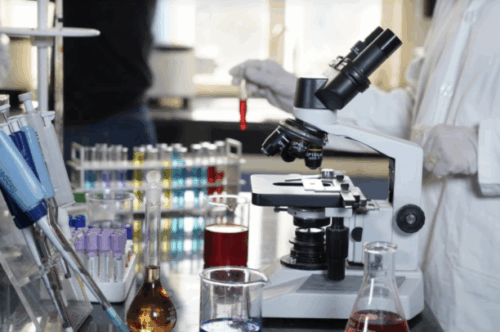
As summer comes to a close and preseason begins, students in the science research program at Fieldston are concluding their internships in labs. After a year of learning how to work in a lab and using tools to collect and analyze data throughout Form IV, these students had the opportunity to apply these skills in a professional setting over the summer.
Mia Seshadri (Form V) is finishing her work in a lab at Mount Sinai at the Center for Advanced Genomics Technologies. The lab works on gene sequencing, using new technology on smaller sample sizes and working to further treatment options for diseases such as cancer, HIV and COVID. Seshadri worked in the lab for seven weeks, with the goal of designing and conducting her own independent experiment to carry out in the final week. Seshadri’s project focuses on a technology called Xenium, which sends out probes that recognize specific RNA sequences and locate them within the cell, enabling the construction of a spatial map of where each gene is expressed. Then, this map can be used to build tissue. Seshadri is using this technology with coculturing (building two types of cells next to each other to see how they affect each other) sensory neurons and breast and ovarian cancer cells.
In addition to creating her own project, Seshadri contributed to the larger lab as well, mastering the process of working with cell culture (building cells) using various materials. Seshadri described one of the challenges she encountered working with the cells: “We had contamination. We accidentally somehow got mold contamination in one of our materials…we didn’t know what it was, but it kept showing up, so we figured out that it was a type of mold (PBS) that arises from cleaning materials. So we were cleaning the glassware with PBS and took apart the experiment piece by piece to find that out.”
Avery Mandel (Form V) also worked at Mount Sinai, in the department of psychiatry. He worked for six weeks in a small lab with postdoctoral researchers, studying the epigenetics and genomics of the brain in relation to mental illness. Specifically, Mandel worked with a postdoc specializing in postpartum psychosis in mice. In addition, Mandel worked with the lab as a whole by dissecting HIV-infected, opioid-addicted and schizophrenic human brain tissue. The lab focused on understanding how genes change in response to battling these illnesses and disorders.
Mandel used compelling technology to accomplish the research. He worked with a FACS machine, which helps sort the nuclei from the brain into two categories: neuronal (in neuron cells) and nonneuronal (not in neuron cells). To do this, they attached fluorescent antibodies to the neuronal cells, enabling the FACS machine to distinguish between them and the nonneuronal cells. The machine accomplished this by inserting one nucleus into one droplet of water at a rate of 2,000 nuclei per second. It then shot a laser through it, and depending on whether fluorescence was present or not, the machine sorted it into one of two test tubes.
Source: Vecteezy
Rose Posternak (Form V) is working at the Albert Einstein College of Medicine at the Montefiore Hospital for four weeks. The lab in which she is participating is part of the Einstein Vascular Biology group. It focuses on lung diseases such as pulmonary hypotension and COPD (Chronic Obstructive Pulmonary Disease). More specifically, the lab examines the role of specific genes and proteins in these diseases. Posternak’s first task at the lab was genotyping in order to collect data on all the mice’s genes, so that it could be standardized and the scientists would know that the changes in the experiment were due to the changes in genes, not other factors. The other important aspect in Posternak’s work included working on an enzyme-linked immunosorbent assay (ELISA). She used a 96-well plate with specific proteins at the bottom of each well. The technique measures the levels of a protein in a sample.
Posternak measured the amount of LRG1 gene, which has been shown to worsen lung disease. She used the proteins in plasma, the liquid that surrounds red blood cells. In addition to LRG1, Posternak has been looking at the MMP14 gene, which is correlated with high levels of LRG1. For this, she used lung tissue samples from mice. Throughout this process, Posternak encountered errors that influenced the results. In the lung samples used for MMP14 gene analysis, the samples were stained with blood. The ELISA evaluates protein levels by measuring the concentration through the intensity of color, so having color in the lung samples can make the data less accurate. This contributed to a large standard deviation.
These hands-on learning experiences taught Fieldston students what it is like to work in a professional setting. It also provided them with the opportunity to learn lab techniques and handle chemicals and other materials that they may not have had the chance to work with at school. This year, they will go on to write research papers about their work, learning more about the process of working in a scientific environment.
