

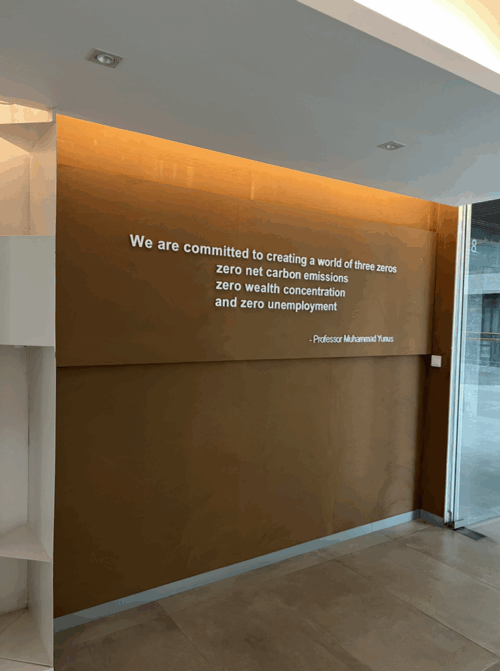
This summer, I visited Bangladesh for the first time: a transformative experience that allowed me to engage with innovative economic and social ideas. Interning with the Yunus Centre of Bangladesh, a global hub for social business created by Nobel Peace Prize-winning economist Professor Muhammad Yunus. I was able to see the impact of social business in action and learn about social justice through an economic lens not always discussed at Fieldston.
Social business is the concept of creating businesses with the primary objective of enacting social change, as opposed to making profit. One of the biggest social business concepts is microcredit and microfinance, created by Professor Yunus when he founded the Grameen Bank in 1983. The Grameen Bank provides loans on a very small scale to people in poverty. The bank targets women in developing countries to lift families out of extreme poverty and was awarded the Nobel Peace Prize in 2006. Many other social businesses now exist, addressing issues in healthcare, technology and more.
The Yunus Centre supports social businesses and continues Professor Yunus’s vision of a world without poverty. As an intern, I was part of a team helping with the Centre’s annual Social Business Day, which occurred in late July in Dhaka. The gala brought together key social business visionaries. This year’s theme was “Social Business is the most efficient path to ensure healthcare for all.” The event featured speakers from all around the world, including renowned primatologist Dr. Jane Goodall. With events like Social Business Day, the Yunus Centre connects people interested in social business with information on how to get started, realizing the United Nations’ Sustainable Development Goals of the United Nations.
Following a successful student protest movement in Bangladesh last summer, Professor Yunus currently serves as the Chief-Advisor to a caretaker government in Bangladesh. The position renders him the leader of the country until elections in February. Because of this, Professor Yunus does not currently work at the Yunus Centre, but the Centre continues work to support social business in his absence.
Towards the end of my time in Bangladesh, my family visited Professor Yunus at Jamuna State Guesthouse: his current residence and office. Unfortunately, the journey to Jamuna was the only time we experienced the infamous Dhaka traffic, culminating in a standstill gridlock that thankfully subsided after two hours. Once we made it to Jamuna, we met with Professor Yunus, as well as Lamiya Morshed- the Executive Director of Yunus Centre and Yunus’s Director of Sustainable Development Goals. Morshed and Yunus discussed the impact of social business, particularly on young entrepreneurs and women who have been taking the lead on addressing social causes through business. Yunus also talked about the Grameen Caledonian College of Nursing in Bangladesh, which provides nursing education to disadvantaged women in rural areas of Bangladesh. He also talked about several young entrepreneurs, particularly Gen Z women. I left the country inspired by how businesses in Bangladesh create a revolutionary reimagining of business that truly empowers all.
