

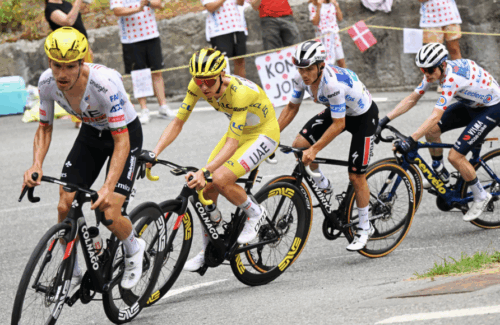
I’ve never been an overly enthusiastic sports fan. I tune in with my family to watch the Super Bowl or the Olympics, but I don’t often go out of my way to watch sporting events. However, in the early weeks of summer when I found myself with little to do, I began watching the Tour de France. I fell in love.
For those who are not familiar, the Tour de France is a men’s multi-stage bike race across France and neighboring countries. Held over three weeks, the Tour consists of twenty-one timed stages and two rest days. At the end of each stage, the riders’ times are compounded, and the rider with the fastest cumulative time at the end of the Tour is awarded the General Classification (GC) prize: the famous Yellow Jersey.
Blindly starting the 2021 Netflix series “Tour de France: Unchained” last year introduced me to the Tour. Even knowing nothing about the sport, I was instantly hooked.
The first season follows the 2022 Tour, beginning in Copenhagen, Denmark, and ending on the Champs Élysées in Paris. Over eight episodes, the show covers a handful of the twenty-two different cycling teams, each with its own goal for the Tour. The larger GC teams have their sights on the Yellow Jersey, while the sprint teams usually aim for the Tour’s Green Jersey, a smaller prize awarded to the rider who racks up the most points during sprint stages throughout the race. Smaller teams typically aim for stage wins or a top ten place in the GC.
The series was addictive. I soon binged the first two seasons (the third and final season of the series came out in July 2025) and promptly forgot about cycling until this summer, when, desperate for anything to watch to pass the time, I turned on the Tour.
Watching the Tour live was a vastly different experience compared to the documentary. I quickly learned that 100-mile stages pass much more slowly in real time, and often last upwards of four hours with little action until the very end.
But following the Tour live also allowed me to focus on the smaller narratives beyond the General Classification. Once the Yellow Jersey was decided, I closely followed the fight for the White Jersey, one of the Tour’s smaller prizes awarded to the best rider under 26 in the General Classification, a detail largely left out of the “Tour de France: Unchained” documentary.
What began out of boredom soon became part of my daily routine. While I didn’t watch every minute of each race, I often left the coverage on in the background while getting ready for work and tuned in to watch as the race picked up.
Some days, I could barely leave the house without checking for live updates. When my job at a nearby research facility began a week into the competition, I downloaded the Peacock app so I could follow the race on the go. I became highly emotionally invested in my team’s success. When they performed well, I was ecstatic. Any poor performance soured my mood for the rest of the day.
Sadly, the Tour does not last forever. Now that the final race has ended, my mornings feel empty without the blabbering of French commentators and the whir of high-speed bicycles, and I am once again faced with boredom.
As for what I plan to do with the rest of the summer? La Vuelta a España, the third and final Grand Tour of the season, begins August 23. Until then, I have a singular goal: to convince my parents to travel to France next July to watch the 2026 Tour de France.
