

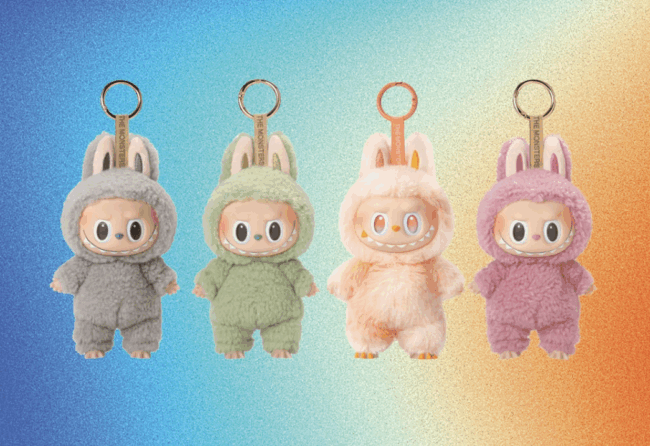
The fluffy, quirky plush bag charms, known as Labubus, have been the it-trend of the summer. Their adorable smiles have captivated everyone, from my five-year-old neighbor to pop stars like Lisa, Rihanna and Lizzo, who wrote about the Chinese collectible in a recent song. I must confess – I’ve even fallen under the Labubu spell myself.
Labubus were first designed by Kasing Lung, a Hong Kong-born artist, in 2015 as a part of his “The Monsters” collection. As a child, Lung’s family moved to the Netherlands, and much of the first Labubu series was inspired by Nordic folklore and mythology he had encountered after his move. There have since been more than 300 different variations of Labubu.

In 2019, Pop Mart, a Chinese toy company, began selling Labubu figurines, and since then, they have taken off. Pop Mart claims that Labubus, “broke the sales record in the art toy category.” The company’s stock market valuation has increased by 600% since it first started selling shares in 2020. In June, Labubu’s sales in the US increased by an estimated 5,000% relative to the same period earlier that year, according to M Science. This can be attributed to the increasing amount of Labubu content on Tiktok and Instagram by popular influencers.

With Labubus being more popular than ever, it is now nearly impossible to buy a Labubu directly from Pop Mart if you do not want to wait in a long line at one of their stores or are not lucky enough to be on the official website right when they restock. Therefore, many rely on resellers as a last resort to acquire the social media sensation.
The issue with resellers is that one cannot be sure if what they are purchasing is a real Labubu or a counterfeit, also known as a Lafufu. Scammers have even gone so far as to put real QR codes linked to the Pop Mart website, tricking customers into buying a Lafufu.

For some Labubu (or should I say Lafufu?) fans, the authenticity of their bag charm is not a top concern. People are finding the longer foreheads and bobbly heads, which are common aspects of all Lafufus, to be quite adorable. Harlan Stark (Form IV) recently bought a Lafufu intentionally while traveling. “I saw it in Scotland and I thought it was really cute. It was $10, so I was like ‘why not?’”
One can’t help but wonder what the future holds for Labubus. Will they follow a similar pattern as the iconic Troll Doll? Initially introduced in 1959, Scandinavian-folklore-inspired Trolls were extremely popular throughout the 1960s and slowly declined in popularity until 2016, when the movie “Trolls” was released, and they started to trend again.

Labubu shares many common characteristics with the Troll Doll. Their defaults are both small and can easily be carried around; they come in many variations, and both were inspired by mythology. Coming in a blind box, however, Labubu is relevant to 2025 because it offers an interactive aspect of unboxing, which can then be shared across social platforms.

While it is unclear how much longer Labubus will be around, as of now, they have successfully provided joy to people across all generations. Apart from being a cute bag charm or serving as an easy way to create social media content, Labubus evokes nostalgia that brings people back to their favorite childhood toys through its funky, youthful designs.
