

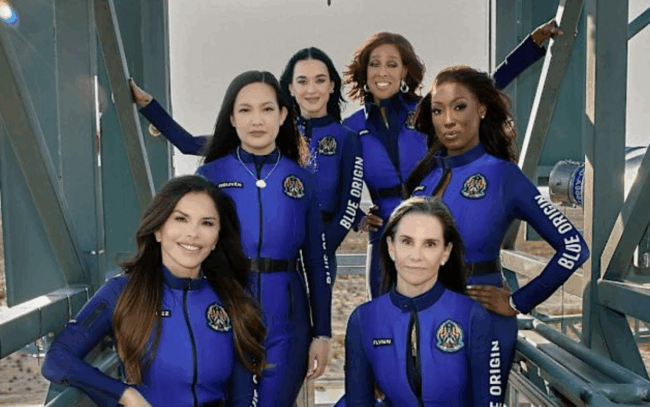
On April 14, 2025, Blue Origin launched a history-making, all-female crew into the suborbital stratosphere for a life-changing ten minutes of weightless spiritual enlightenment. Among the “brave heroines” were singer and songwriter Katy Perry, journalist Gayle King, film producer Kerianne Flynn, former NASA engineer Aisha Bowe, activist Amanda Nguyen and Jeff Bezos’ fiance, Lauren Sanchez. So, what happens when a pop icon, a couple of journalists, a scientist, producer and an activist walk into a mushroom-shaped space capsule?
It sounds like the opening of a comedy act, but it was legitimate and very expensive. The mission, meant as a breakthrough for female representation in space, was no more than a highly staged mission for the media, blurring the line between scientific milestone and celebrity spectacle.
This was not your typical NASA mission. It was wholeheartedly a marketing scheme for a high end brand, not a space agency of the federal government. Picture a luxurious wellness retreat, but outside Earth’s atmosphere with calming blue lighting and Katy Perry singing Louis Armstrong’s “What a Wonderful World.”
Many headlines praised the mission, labeling it “historic” and “empowering” as its crew supposedly gained representation for women in STEM, particularly where they are often underrepresented. But a brief journey to space feels more like a costly influencer campaign than a moment of scientific enlightenment. And, since when can you classify a passenger as a crewmember if none serves a purpose once in flight? So, who was this trip really for?
The mission’s purpose, centered around inspiration and female empowerment, made the high-budget act difficult to neglect. Notably, as well, these brief journeys come at the expense of massive carbon emissions. Yet, instead of entering the real world, our world and investing in long-term transformations, we get to sit back and watch a group of ultra-wealthy public figures as they seek to satisfy their craving for attention—apparently not complete without the matching skin-tight outfits and souvenir patches.
After the capsule returned to Earth, Bowe reflected, “We are inspiring the world right now.” Perry and King knelt to kiss the ground upon touchdown, labeling the zero-gravity experience “oddly quiet.” King shared how the experience was eye opening stating, “You look down at the planet, and you say, ‘That’s where we came from?’ To me it’s such a reminder about how we need to do better, be better,…it’s so nasty and so vitriolic nowadays.”
To the public eye, these may appear to be moving sentiments. But, in just ten minutes, roughly the time it takes for a morning shower, is it possible these women gained complete clarity on the dangers our planet is facing? And did it really take an outerworld journey to have this realization?
This is simply a competition for attention, a launchpad for status. Despite what these women may report to the media, each member of the group is focused on their own image, building a brand for themselves on social media.
This is not a rejection of space exploration, but the way in which these women have presented the phenomenon. Innovation should work to benefit humanity on a deeper scale rather than serve as a curated expedition for the most elite. Yet, when exploration becomes commercialized, it is too easy to lose sight of the wonder, science and societal curiosity that once characterized our journeys into foreboding space flight. Space no longer represents the bounds of knowledge, but rather manufactured entertainment for the media and public at large.
We all desire meaning, curiosity and connections, but we feel miniscule in the eyes of the universe. Yet, when this feeling of astonishment becomes another material good for purchase, it loses its power. Maybe that is the lasting message of this journey: not a scientific breakthrough, not a milestone in space exploration, but a reminder that if you give someone enough money, they can even purchase the illusion of empathy.
Some question whether the mission was ever anything more than a publicity stunt—an experience of zero gravity, a cascade of laughable headlines and glowing testimonials of personal transformation stories. The view from above may have been beautiful, but that could never be enough to change the fate of the world below. What a wonderful world!
