

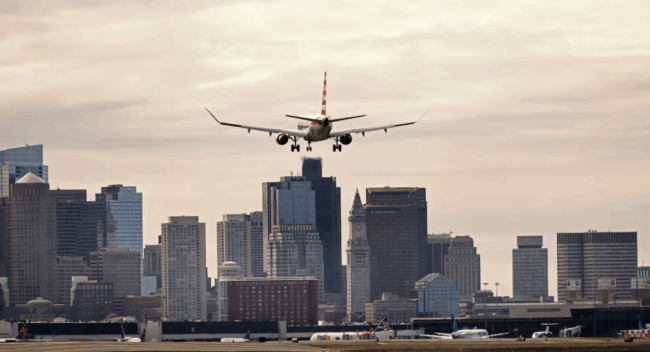
Over the past few months, several aircraft accidents have shaken the aviation industry.
In January, a commercial plane collided with a military helicopter in midair while arriving at Reagan International Airport, crashing into the Potomac River. All 64 passengers on the plane and three on the helicopter were killed in the deadliest crash in nearly 25 years. Days later, a medical plane carrying six passengers crashed in Northeast Philadelphia, killing six passengers and one bystander.
In early February, a Bering Air flight to Nome, Alaska, went missing shortly before arrival. The wreckage from the flight was found in the Bering Sea, 34 miles away, and all ten on board died. Later that month, a Delta Air Lines passenger jet flipped upside down while landing at the Toronto Pearson International Airport.
In March, an American Airlines plane caught fire after landing in Denver, hospitalizing 12 passengers. Just days ago, a helicopter carrying a family of five tourists crashed into the Hudson River, killing all on board.
Amid the recent airplane crashes, concern over air safety has grown. An AP study revealed that 65% of respondents felt more nervous about flying following the Reagan International Airport crash. Conversations about air travel safety were up by 243% on X and 71% on Reddit compared to early 2024.
“Before I found out about the various issues the airlines had, I was comfortable with flying, whether it was through Boeing or Airbus,” said Yanling Li (Form IV). “I’m feeling more nervous now.”
Lucia Mastroianni (IV) also expressed anxiety due to recent accidents. “The recent plane crashes have definitely made me feel a little bit more uneasy while flying, especially when I’m flying a different airline than usual,” she shared. “Whenever I feel turbulence, I can’t help but think about all of the pictures from the news of planes just falling to the ground with no warning.”
Despite growing concerns, flying is still exceptionally safe. In a 2024 safety report, the International Air Transport Association (IATA) calculated that the risk per boarding was one in 13.7 million, meaning there’s a higher chance of dying from food poisoning or fireworks than in a plane crash.
The risk of an aviation accident is one in every 880,000 flights, or about 1.13 accidents per million flights. Although the risk has increased since 2023, with 1.09 accidents per million flights, safety has improved significantly in the long term. A 2024 study from MIT found that flying today is 40 times safer than it was in 1960, with smaller advancements made more recently.
Still, experts say the “[air travel] system needs attention.” As air traffic finally returns to pre-pandemic levels, understaffing remains a critical issue. In January, the New York Times reported that over 90 percent of air traffic control facilities operate below the Federal Aviation Administration’s (FAA) recommended staffing levels, an issue exacerbated by the Trump administration’s layoffs of nearly 400 FAA workers.
Even so, flying remains one of the safest modes of travel, thousands of times safer than driving. The Bureau of Transportation reports that in 2022, there were 42,514 fatalities due to highway accidents compared to 358 deaths due to aviation accidents.
To help ease nerves before a flight, Kristy Kiernan, associate director at the Boeing Center for Aviation and Aerospace Safety at Embry-Riddle Aeronautical University, suggested in an interview with USA Today that understanding how aviation works to combat the fear of the unknown: “Empower yourself with knowledge. That will help people get a risk perception that is a little bit closer to the objectively really low risk that they actually face when they get on an airplane.”
