At the beginning of the year, Mondays quickly earned a reputation for being the worst day of the week. This was due to the new phone ban, which required students to keep their phones in their bags when on campus or else their phones would be confiscated by faculty. This rule was not well-received among the Fieldston student community. As of Jan. 5, the phone ban has been in full effect. Both students and faculty have developed strong opinions about whether it helps learning or goes too far.
WHO WANTS THE BAN?
Phone bans have been an important topic not only in the Fieldston community, but in all of America. Many organizations are conducting studies on the impact of phone bans and how they can help academic life. Parents have been the driving force behind implementing the phone bans in schools, with 74% of U.S. adults saying they would support banning middle and high school students from using cellphones during class. As time goes on, the percentage of parents supporting the phone ban continues to go up. The number of parents with this standing increased by 68% last fall. Studies have also shown that the older parents are, the more likely they are to want the ban. Many students are upset that parents are pushing for the ban. Do these students have a point?
PHONE EFFECT ON STUDENTS
The administrative team at Fieldston says the reason phones are banned is that they have a negative impact on students’ education.
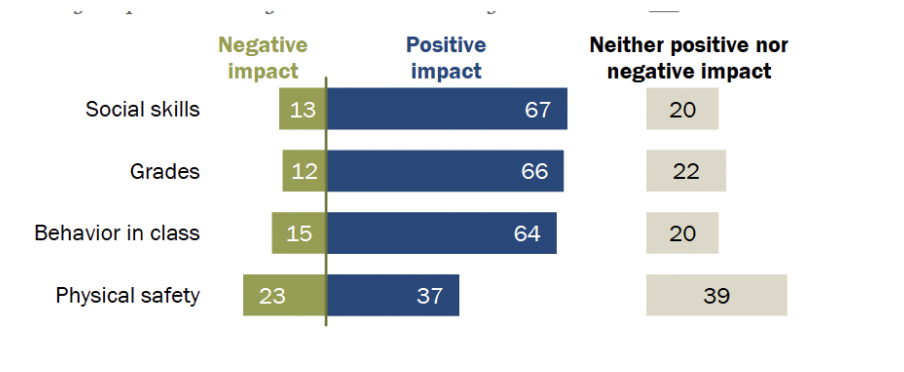
This figure is from a study conducted by the Pew Research Center that shows the effect on students of not having their cellphones with them during the school day. As the research shows, when students didn’t have their cellphones, there was a positive effect on social skills, grades and behavior in class. International organizations like the Organisation for Economic Co-operation and Development (OECD) note that phones disrupt students’ attention, particularly in math classes, leading to poorer performance and lower grades. Thirty percent of students who use phones were distracted by them, and 25% were distracted when someone else used one. Similarly, a study from the London School of Economics found that school phone bans lead to a modest improvement in student performance, with test scores increasing slightly from the average. Low-performing students experienced the greatest gains from this new policy.
Many studies show that without phones students act and behave better, but there are negative effects. An article by Forbes highlights a study conducted by Education Week on a school in Florida revealed that in the first year of the ban, school suspensions climbed by as much as 12%. Many students felt unsafe without their phones and would sometimes act out against faculty members or fellow students. Another study in the article by Forbes published by The Lancet Regional Health offered a different point of view on the subject, positing that smartphones can support education by making learning more efficient, practical and accessible. They can also support the development of digital literacy and promote collaboration, which in turn can enhance critical thinking and problem-solving skills. Many studies exhibit both the positive and negative effects of the phone ban on student life.
THE FIELDSTON COMMUNITY
Outside sources offer different views on the subject, but at Fieldston there is a mixed reaction against the phone ban. Robert Plasse, the Fieldston Student Government (FSG) Form III Representative, said the phone ban was a “bad decision.” While he understood the goal, he thought there was poor execution and it had only harmed the Fieldston community. Plasse has been trying to find a better replacement to the phone ban, “ I found out that it was a PA ban, so we couldn’t do anything.” Plasse believed that,“ The old system worked just as well and did the same thing”
Another important member of the community who has a strong opinion on the phone ban is Karen Drohan, the Form III dean. Drohan is, “In full support of the phone ban,” and has done her research on the subject. Drohan found many studies that demonstrate the positive effects of the ban, and she is confident that, “The science is clear on this.” Drohan has seen how phones can be a, “Distraction to students during the school day,” and she has already seen the positive effects of the phone ban throughout the school.
The person at the front of the movement for the phone ban is principal of Fieldston Upper School, Stacy Bobo. Bobo sees the ban, not as a punishment to the students, but something that can help improve their academic lives. When asked her opinion on the ban and why it was put into place she said “given the times that we’re in, the ban is necessary…kids are very distracted, and I think that’s why we are doing the ban…staying off your phones during class time, which I think was going really well.” While Bobo likes the idea of the ban she knows it isn’t perfect, but “ it’ll eventually fall into place over time.” Bobo did her research on the topic and implementing the ban wasn’t an easy thing to do, but the core reason the ban was put into place was for the safety of the kids. “I mean, right now, you’re 14 and you say something and you believe it, but 20 years from now, you grow, you mature, you change. Do you want someone to retweet what you wrote when you were 14?” Bobo knows not everyone will understand why she put the ban in, but she just wants the students to “try for a little while…actually do it, like, actually do it…really try to not have the phones for the 8 to 3 and see how it goes…encourage one another during the school day to not do it.” Bobo says the phone will keep changing as the years go \on and the current system that is implemented will not stay the same. She is open to feedback, but what she really wants is for the kids to really try out the ban for their own safety.
The phone ban at Fieldston has sparked strong reactions from students, faculty and parents. While research shows limiting phone use can improve focus and academic performance, it can also increase stress and make students feel unsafe or disconnected. As the policy continues, the phone ban raises an important question: does limiting phone use improve learning and student focus, or could a more balanced policy achieve the same goals while also addressing student concerns?