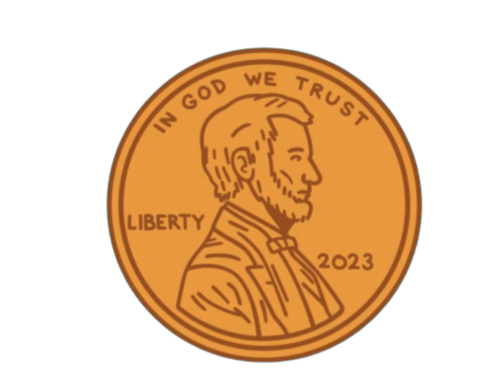
A pretty penny, a penny for your thoughts, a lucky penny, worth every penny. The amber-colored coin has long been the face of the American monetary system. It appears in the media, math riddles and on the street, waiting to be picked up by a fortunate finder. It was first coined (pun intended) 232 years ago with the Coinage Act of 1792. In that time, it has lived to see the Emancipation Proclamation spoken by Abe Lincoln (whose face it bears), the Great Depression and the invention of the radio, right up until Frozen’s release, AI and baggy jeans. However, less than two weeks ago, on November 12, the United States minted its last penny at the historic facility in Philadelphia, saying goodbye to its most iconic coin. The reason was simple: at this point, continuing to produce the penny became financially ludicrous. The one-cent coin costs 3.69 cents to mint, up from 1.79 cents in 2010. Actually, the penny technically has not been profitable since 2005, when it cost .97 cents to make. This change (pun still intended) is expected to save the country $56 million per year.
Kayla Resnick, a Form IV student, had conflicting opinions on the matter. On one hand, she stated that she could “see why they might do it with it not being profitable.” Additionally, nowadays, more and more people use credit cards or mobile payment services over cash and coins. In fact, less than 20% of the nation’s transactions involve physical money. It makes sense to get rid of an uneconomical, underused coin. Apple Pay, Resnick said, is “easier” and “definitely more efficient.”
“But on the other hand,” Resnick adds, “I do think, you know, the penny is the penny! It’s iconic.” Others expressed nostalgia for the coin, too. “I like the pennies,” said Daisy Flattman, a Form IV student, “They just symbolize something to me.”
However, Flattmann had a slightly different perspective. “I don’t think the extinction of a penny is a bad thing, but it’s what led to the extinction of the penny,” she explained, citing “the rapid inflation in this country” as the cause. Inflation is the process by which the value of our currency decreases. For example, something that cost $1 in 2000 costs $1.85 today. So, while the penny— or multiple pennies—may have had buying power many years ago, its monetary value is now inconsequential. While the decision to stop minting pennies is perhaps financially sound, it is also a stark reminder of inflation’s effects.
So, the question is, what comes next? Well, the final round of minted pennies will likely go into circulation in early 2026. Even after that point, pennies will still be accepted as a valid currency. However, the phasing out of this coin will have some effects. For example, stores will have to round their prices to the nearest five cents. $3.99 could turn to $4.00, and $3.96 could turn to $3.95. Furthermore, the threat of discontinuation could loom over other coins as well. While the quarter and dime cost less to mint (14.68 and 5.76 cents, respectively) than their monetary value, the nickel could be another financial disaster. The five-cent coin costs 13.78 cents to produce. Luckily for coin-nostalgists, there are no current plans to phase out the nickel.
Veronica Shafer, another Form IV student, was interested in the coin’s future. “I think it’s interesting how the penny is going to evolve into less of a currency and more of a collector’s item,” Shafer said. Who knows? Maybe one day, the penny will join the esteemed silver dollar and two-dollar bill, becoming a relic to show grandchildren or even sell for more than their one cent. “Save your pennies,” Shafer added, smiling.
Either way, our nation chose 56 million dollars each year over keeping this legendary piece of metal around for another day. The penny will be missed. But, while loss can be difficult, it can also be a source of growth. Perhaps this is the start of a financially stronger nation. Maybe leaving behind the things that hold us in the past can help us strive towards a better future.