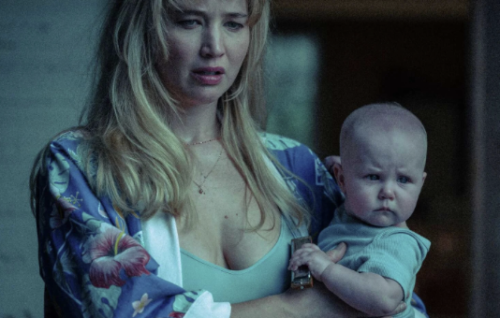
On Saturday night, my friends and I decided to go to the movies to pass time. We got tickets for Jennifer Lawrence’s new film, expecting a light hearted rom-com, like her most recent “No Hard Feelings.” An hour in, one of my friends left the theater, not out of boredom but of sheer disgust. For the rest of the film, the remaining two of us watched Jennifer Lawrence’s character, Grace, fall deep into insanity after having a baby.
“Die My Love,” directed and written by Lynne Ramsey based on the 2012 novel “Die, My Love” by Ariana Harwich, was released into theaters on November 7. It only grossed five million in box office, falling short of expectations, and holds a 73% critic score in rotten tomatoes. The movie does not have an easy to follow, traditional plot and definitely contains some hard to watch scenes, yet it feels raw, authentic and unforgettably uncomfortable.
The film, rooted in an unconventional depiction of early motherhood, is artistically and performatively compelling in every way. Jennifer Lawrence, in my opinion, gives one of her best performances of all time. It achieves such raw intensity by pulling from a sensitive and very real struggle, capitalizing on the emotional weight and complexities of postpartum mental illness. “Die My Love” is a brave disruption to the cliche sit-com style depiction of life after birth that mainstream Hollywood leans towards. But neither of these two narratives, one being pure joy and the other being pure despair, value truth and awareness over entertainment. “Die My Love” portrays motherhood in a way that creates more fear than representation.For most people, the postpartum experience is far less hopeless and extreme. This is something I didn’t really understand until I talked to someone who actually lived it.
Tamara Frankfort Odinec, my mother, experienced postpartum depression after having her first child. Throughout my childhood she mentioned it once or twice, with the conversation scratching the surface of her experience and usually cut short by an “I’m sorry you had to go through that,” or “I’m glad you’re better now.” As her daughter, I understand that my lack of knowledge on the topic could have been a result of her not wanting to burden me. But in a family as open, unhinged and fairly unconventional as ours, the lack of discussion on this topic felt unnatural. Conversations about self confidence, plastic surgery, politics, divorce, therapy and more are not out of the ordinary for us. We routinely dive fearlessly into things most families would stray from to avoid discomfort. Because of this, I assumed that in our family, nothing was quietly off limits and little was left unsaid; this, of course, was disproved when I reflected on the fact I knew nothing about postpartum depression.
I was ashamed that most of my knowledge came from the two Hollywood extremes, allowing me to subconsciously accept the fact that early motherhood was one of two things: perfection or disaster. Yet when I finally sought real insight, my mom opened up immediately. “There’s not really anything like postpartum,” she said without hesitation, “It’s extremely isolating. The truth is, extreme anxiety and extreme depression is isolating no matter where you are. You feel like an alien.” It felt foreign to imagine my mother, a social, charismatic and endlessly positive woman who says “go with the flow” daily, as isolated, anxious and paranoid. In that moment, postpartum mental health stopped being an abstract and distant concept and began to feel like something that is even indirectly part of my story. It is something my mother has experienced and grown from to become the mother she is today.
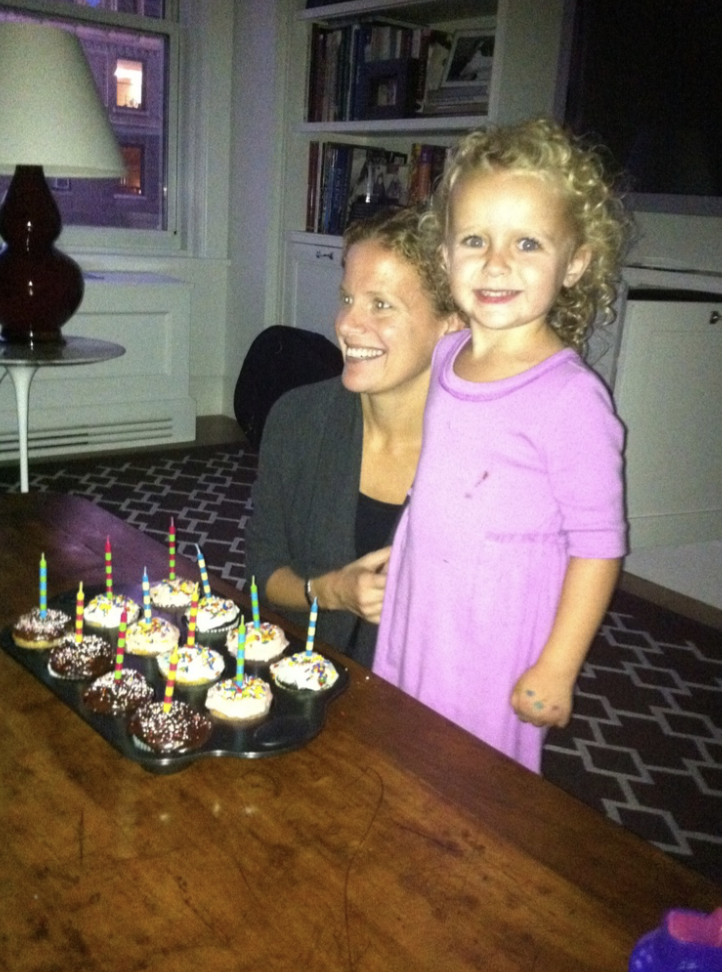
Source: Personal Photo Archive
Her honesty opened my eyes to how lack of awareness and representation shaped her experience. She explained how the hardest part of postpartum life came from her expectations, “I thought Ella [the baby] was just gonna just respond to me and it was gonna be this immediate bond. And instead, I was just overwhelmed by feelings of … anxiety and sadness and I was worried that I wasn’t going to be able to care for my child or keep her safe.”
My mother still holds resentment toward the fact that society gave her a completely false narrative of what motherhood would be like: “I think that if I knew about postpartum depression ahead of time, it would have been much better for me and I would have been able to recognize what was happening and maybe … proactively try to get help.” According to the South Dakota Department of Health, 13% of mothers experience postpartum depression. Yet so many mothers, like my own, still face this common struggle of feeling misinformed, isolated and blindsided by false expectations.
Representation and awareness is essential, but “Die My Love” does not provide the kind we need. In fact, it is no better for postpartum depression awareness than the overly simplified version my mom was exposed to, where raising a kid is a walk in the park. “But I think that mental health is obviously a major issue in the world.” my mom pointed out, “and every struggle is different and [that is why] it’s hard to … generalize movies versus reality.” Hollywood tends to go for extremes. People don’t want the average experience – they want something that evokes emotion and reaction. An entertaining and emotion-provoking movie like “Die My Love” comes at the cost of exploiting and deceiving the audience.
After a while of seeing only two far ends of the spectrum, it’s easy to start to think that there is no nuance to the postpartum experience. My mom even went as far to say that she has “never seen anything close to an accurate portrayal […] of postpartum in the movies.” There is no doubt that Hollywood will continue to depict the two extremes. And there is, unfortunately, close to no chance that a movie depicting an experience similar to my mom’s will hit the screens any time soon. That is why recognizing the balance between reality and fantasy is so crucial.
When I asked my mother what she would say to someone after they watch something like “Die My Love,” she said, “The truth is [postpartum depression] is very common, and if you stay ahead of it, then you’re going to be fine.” It’s okay to enjoy movies like “Die My Love” and sappy sitcoms like Modern Family, but with this, it is essential we try to balance the narrative by seeking real, common experiences like my mom’s.
At Fieldston, we believe openness and representation are central to our education and understanding. However, we often forget how essential these values are beyond the school environment. In a society that is becoming increasingly digital, with everyone desperate to grab viewers’ attention, it is easy to get wrapped up in a false narrative of extremes that sacrifices nuance for dramatic effect. This issue is even more pronounced with a topic like postpartum depression, where conversation is rare due to stigma. Discussion is such a simple yet powerful tool. When we start to ask questions and seek real stories, we realize that most experiences exist in the middle. In a world that seems increasingly polarized with topics seen as black and white, human connection has the power to ground us, reminding us that most things exist in the grey.