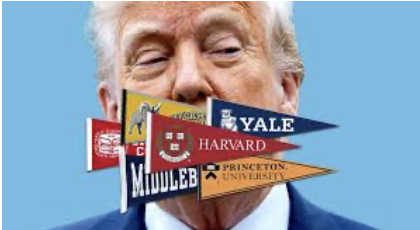
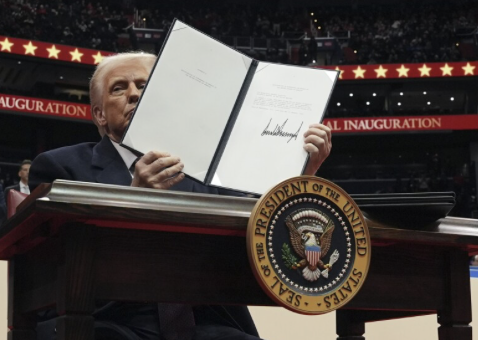
On January 20, 2025, his second day in office, Trump signed Executive Order 14151, titled “Ending Radical And Wasteful Government DEI Programs And Preferencing”. This was President Donald J Trump’s first major action against DEI and the universities that are implementing it.
What Is DEI and Its Benefits?
Although not named until the 1980s, the foundation for Diversity, Equity and Inclusion (DEI) was established in Title VII of the Civil Rights Act of 1964. DEI was left as a vague term and not specifically defined, it was described as initiatives that “prohibit employment discrimination based on protected characteristics such as race and sex.” Before the Trump Administration began implementing rules for colleges, DEI’s goal was to: “Introduce students to new opportunities, expose students to diverse people and environments, Create networks and Develop students”. When selecting applicants, colleges consider factors such as race, gender and religion to create a more diverse and inclusive community. This was a highly controversial philosophy, with people holding a range of beliefs on the subject. One of the most significant people opposed to this idea was President Trump.
Source: New York Times
What Is Trump’s Take on DEI?
While Trump is very vocal in his dislike of DEI he is not the first public figure to speak against it. Clarence Thomas, a Supreme Court justice, is one of the many people to share Trump’s opinion on DEI. Justice Thomas wrote the dissenting opinion for the case Grutter v. Bollinger. This case was a supreme court decision on whether or not the University of Michigan Law school’s affirmative action policy, which considered race in admissions, was constitutional. Thomas said “Schools should not give racial preferences in admissions because such policies are unconstitutional and unnecessary”. Thomas and Trump are just two of the many people against DEI in the past, but Trump’s current opposition to DEI has been outspoken and consistent. On September 22, 2020, during his first term, he issued Executive Order 13590, which banned federal training on systematic racism and sexism. This order restricted public schools and universities from teaching or discussing issues related to race, gender or religion in certain contexts.
In his second term, Trump made a proposal with many elite American colleges called “The Compact”. This proposal offered increased funding to colleges if they complied with certain conditions, including prohibiting consideration of race, sex, nationality and religion in admissions, capping proportions of international students and banning many DEI policies. Initially, Trump sent “The Compact” to nine of the most prestigious colleges in America, Brown, Dartmouth, MIT, the University of Arizona, the University of Pennsylvania, the University of Southern California, the University of Texas at Austin, the University of Virginia and Vanderbilt, but on October 14, he expanded the invite to all U.S higher education institutions. So far, no colleges have accepted Trump’s deal. Many colleges have openly opposed the proposal, with institutions like Brown claiming it undermines academic freedom. The only college that has shown interest so far is the New College of Florida, saying it “would happily be the first” to sign “The Compact.”
How Will This Affect Schools If They Accept?
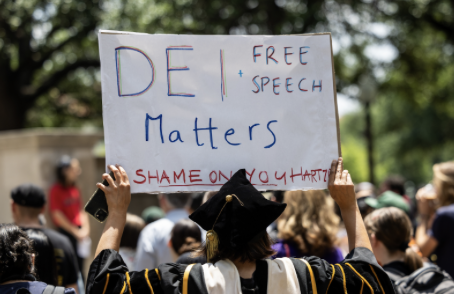
If colleges follow in the footsteps of the New College of Florida and sign President Trump’s proposal, major changes will occur on campuses. The struggle for these institutions is choosing between academic freedom and Federal funding. Asking the question: Is sacrificing the educational foundations of your school worth the funding? If a college signs the agreement, it will: no longer consider identifiers in the application or hiring process, fill no more than 15% of its undergraduate class with international students, and forbid its employees from discussing societal/political events that do not directly affect the school. Many colleges that have publicly declined the offer are being threatened with funding cuts, which makes accepting the deal more enticing for the institutions.
Source: Houston Public Media
How Would This Affect Fieldston?
While Fieldston is a private institution and is not directly impacted by Trump’s changes, many K-12 public schools with similar philosophies to Fieldston are being forced to make adjustments. A core value of Fieldston and many other schools is to learn about the societal impact of different identifiers. This year, our community is reading “Lessons For Survival,” a book that exemplifies Fieldston’s goal to raise the voices of underrepresented individuals. In Lessons For Survival, race is a key identifier that the author, Emily Raboteau, discusses. The book focuses on bringing light to underrepresented voices in the community.
The Fieldston community has developed a diverse understanding of important topics such as race, gender, etc. Trump’s compact applied to Fieldston; it would undermine the school’s core ideologies. Some students have strong opinions on Trump’s proposal, like Eli Wahl (Form III), a student who has been part of the Fieldston community for 11 years, who said, “This connects to our school since learning about diversity is a key principle of our institution.” He goes on to talk about how he couldn’t imagine the school without learning these fundamental values, and he has enjoyed the DEI components of Fieldston since Pre-K.
Another Fieldston Form III student said, “I say you go to school and outright banning something that will affect people’s knowledge of the world is outright wrong. Overall, you can’t just ban a topic that people need to know to educate themselves about the world.” This same student called out how learning about everyone is part of the school experience, and banning it is morally wrong.
While many students view the bill negatively, some also see its positives. Student Aiden Clark (Form III) thinks that, “… many people believe the bill is racist, but it actually is promoting equality.” While Clark understands there are flaws in the bill, he can also see the positives that he believes many others don’t. He shares his thoughts on some of the bill’s positives, such as “… this bill is fighting racism and giving our children a mind of their own.” While he agrees with what this bill aims to do, he also knows it cannot be the only answer. He says, “Even though we need reform, Trump is not the answer, and silencing voices of our fellow community members is wrong”.
This illustrates how members of the Fieldston community can view both the positive and negative aspects of the bill. Even though the bill cannot affect Fieldston, many schools like Fieldston are affected and the foundations of these institutare being changed.