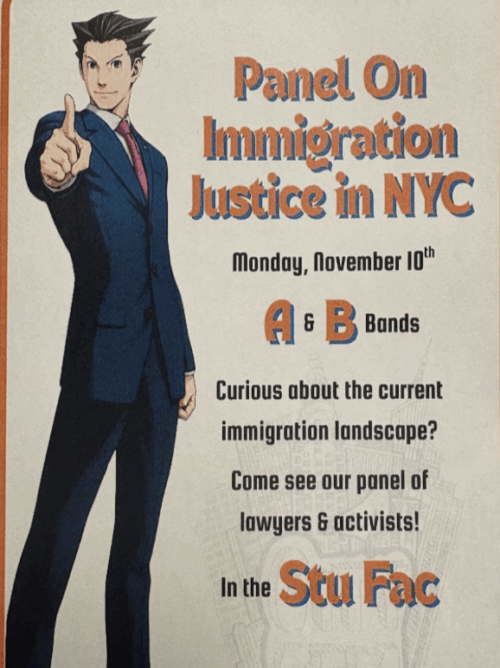
On Monday, November 10, 2025, in The Student Faculty Commons, the fall City Semester cohort hosted a panel discussion on immigration justice, with lawyers, activists, immigration advocates, and immigrants speaking on their experience of the changed immigration landscape in New York City in the Trump Era’s Age of ICE. Six panelists, from around the world, shared their opinions from their respective fields, covering topics of immigration law, food insecurity, the intersection between immigration and criminal law, Venezuelan and teen immigrants and activists for asylum seekers.
First, the panel was asked the question, “Since legal representation is not guaranteed for immigrants, how do immigrants find free representation”? One of the lawyers on the panel chimed in solemnly, “Many have to go without attorneys. The mayor’s office takes those who call and sends them to lawyers, but there’s not enough for everybody.” It was pointed out that some come through recommendations from social workers, others through word of mouth. However, the immigration process can take many years. It took Niurka Meléndez, a panelist and forced migrant activist, eight years.
Belle Burden, a Fieldston mother, lawyer and panelist, shared how the majority of the people in the U.S. are so familiar with their right to an attorney that they don’t realize that right doesn’t apply to immigrants. Burton said, “They’re not guaranteed a lawyer because it’s a civil issue. Having a lawyer can be the difference between being detained by ICE or not.” Additionally, she pointed out, with a lawyer, the defendant is 60% more likely to win the case than if self-representing.
The panelists were then asked, “How do you think your work will be affected by the change in the mayoral election?” The panelists had seemingly high hopes for Mamdani’s upcoming term, saying there would be more funding for immigrants and that it is nice to “have an incoming mayor who won’t sell you out to ICE.”
The final question was, “How can youth help with the immigration process?” The panelists agreed that youth tend to underestimate their power, especially the power that comes with education. They echoed the importance of speaking up, stating that “even just saying ‘I don’t support ICE’ and ‘I want immigrants here’ can have a huge impact.”
Panelist and lawyer Elizabeth Wu shared that there’s not only one way to help with the immigration process: “Everyone has something to contribute, and that contribution can look very different”.
City Semester student Loretta Keefe, who was one of the students questioning the panel, said, “I feel immense remorse for these children because they’re having to deal with such an unfortunate situation at such a young age. Most of the children are living in poverty because their parents haven’t been able to get jobs, and they have not been able to get into public schools because of their status as immigrants.”
The panel offered an impactful look into the city’s immigration system, offering firsthand experiences and highlighting the urgent need for support and advocacy. What they shared showed how challenging immigration can be for children, families and entire communities. In the end, the panelists emphasized the value of young people using their voices to call for change in the immigration system.