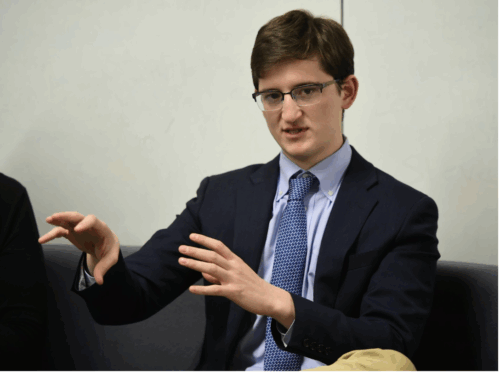
I recently had the incredible opportunity to interview Jeff Stein, Fieldston Class of 2009 and Fieldston News alum, who has accomplished a great deal in the world of journalism since graduating from our school.
Stein attended Cornell University, where he refined his writing style and developed a mastery of investigative journalism. In 2014, Stein founded The Ithaca Voice, a local news nonprofit, in upstate New York. This publication has maintained a full-time staff of reporters and continues to be an essential source of news for its community. Stein went on to become a correspondent for The Washington Post in 2017 and currently serves as the Chief Economics Correspondent for the publication. During his tenure at The Washington Post, Stein has covered Republican tax law, the White House position on NIH funding, and the impact of tariffs on the US economy, to name a few issues he has tackled.
Jeff Stein is a proud Fieldston alum who has practiced what he preaches, as evidenced by accolades such as the 2020 Hinrich Foundation Award for Distinguished Reporting on Trade for stories that shed light on the complexities of doing business in China during the COVID epidemic, in addition to his inclusion in Washingtonian’s 500 Most Influential People of 2024, among other recognitions.
In our wide-ranging interview, we covered topics including the role of AI in journalism, public trust in journalism, news consumption, ethics in journalism, diversity in media and the future of journalism.
SF: So before we start, could you tell me a little bit about yourself, your background and how you became interested in journalism?
JS: Sure. I am a graduate of the Fieldston class of 2009. We used to say “What up ‘09”. I’m not sure what that exactly was a reference to, but it was a joke that persisted throughout the class. I worked for the Fieldston News when I was in high school. I was sort of instantly hooked and got the journalism bug really right away with my friends. The story that I was really consumed with when I was working with the news was an issue basically with the cafeteria workers at the school. Basically they [cafeteria workers] were part of a union that they felt like was not really representing their interests. There was a series of requests that they had for better pay and better working conditions. And after the stories that I wrote with my colleagues at the Fieldston News were published, the workers were able to switch to a different union and eventually got the raises they were seeking that the school had been holding out for. It was kind of an amazing feeling as a young person to be part of that story and to help the workers tell the story and to really get to know some of the people who are responsible for maintaining the day-to-day operations of the school who were sort of neglected. The story cemented my budding interest in journalism and I’ve never really looked back.
SF: Wow, that’s actually very inspirational. I love that journalism origin story and the idea of impact on your community. Do you usually share that story with aspiring writers in the journalism world?
JS: Sometimes. You know, I had so much fun writing for the Fieldston News. It wasn’t all serious stuff, and I think one of the things that a lot of young journalists sometimes miss is that journalism should be fun, should be engaging, exciting, funny, part of life and reflect life in all its weird ways.
SF: How do you see AI changing newsroom practices like fact checking and speed with which news can be reported?
JS: It’s a huge question that smarter people than I will be writing a PhD thesis about, so I don’t purport at all to be an expert. I think the cliche is probably right; there’s opportunities and there’s peril. I think the opportunities really are already in use. I use a service called Otter that is amazing. It produces a transcript that I can search and go through. In the past, I spent hours and hours and hours just listening to recordings and transcribing word for word interviews, doing all this drudgery that can now be automated. And so there are for sure efficiencies. I think hopefully some of the work in journalism that’s not really adding much can be run by AI, like what the stock price of this company did, or the team won the game by whatever score; that kind of work. I’m optimistic that this type of automation does not have too much downside repercussions. I think the potential for misinformation (from AI) and the potential for people to feel like they don’t need to pay for journalism that is vetted through research by individuals concerns me. I think that those are very real, serious challenges and risks.
SF: Where do you think AI should never have a role in journalism?
JS: I do think, insofar as what we’ve seen from AI already, it makes a ton of mistakes. Journalist credibility is a tenuous thing especially when people today are so skeptical of the mainstream media and media generally. I think for the foreseeable future, every fact needs to be fully vetted and backed up by something outside of AI. I think if any young journalists or reporters are using AI to check the accuracy of their stories, my objection is not primarily to the technology per se, but simply its accuracy. There needs to be human oversight.
SF: With more and more Americans consuming their news on social media platforms like TikTok, X, and Instagram, do you think legacy media like newspapers and TV news will become obsolete?
JS: I think a lot of people still see value in everyday reporting. I sure hope that there’s room for people like me. I think what we [journalists] do is still essential and valuable, but I don’t know what the future of the industry holds. Will I turn out to be effectively like a telegram operator? I’m optimistic that for the reasons I’ve said, people will continue to see value in what we [journalists] do and it’s incumbent on us to prove that value, and not take it for granted.
SF: As a reporter, where do you consume your news? Do you get any news from TikTok, Instagram, or X? Or is it just mainly some legacy news, like newspapers?
JS: I use Twitter, but not too often. I’m on Instagram, although not really for news. My wife shows me TikToks that she curates. I obviously read the Washington Post. I read the New York Times regularly. I try to read a broad range of different kinds of magazines, newspapers of different ideologies. I just try to get a really healthy, broad media diet. Social media platforms can be enormous time sucks. But there are also things that you find on there, like conversations happening there that sometimes mainstream media misses. As you know, I cover economics. There’s a lot of economists on Twitter who don’t have their own blogs or don’t have their own columns where I can go and read what they’re up to, what they’re thinking and what they’re seeing. And so there is value there, too. It’s just how do you balance it [soacial media] with all the problems on the social media platforms and how do you keep a lid on it.
SF: Do you think digital news feeds from social media are polarizing the American public more than traditional news delivery, since the algorithms deliver highly partisan news to Americans?
JS: Oh, I think there’s no doubt that’s been very conclusively demonstrated across a wide range of studies. I think it’s pretty clear that there is unhealthy and dangerous radicalization [on the internet and in social media] as well as mental health effects that seem pretty suspect to put it mildly. I think obviously we’re in an era now where the original promises of democratization [of the internet and social media], and really the original promise of the internet to democratize things, you’ve seen sort of more capital agglomeration and elite control over social media platforms.
SF: With this new era of deep fakes, AI, and well-crafted misinformation on the internet, how can journalists ensure the credibility of the news airport?
JS: I think it’s really important to have human verification at every step, especially when there can be a lot of pressure on journalists to do things quickly. When other media outlets report something, there can be pressure on you to match what other outlets have reported. So it’s important to not get too swept up in that pressure and make sure you 100% know something to be true. I think when I talk to young journalists and students, sometimes I feel like they don’t do enough of picking up the phone and calling people, which is the most important thing to do as a journalist; to be comfortable just calling people and getting information yourself so you know it to be true.
SF: Do you feel there is diversity in the journalists who report the stories in the U.S.?
JS: I think it’s a big problem that the media is too homogeneous in terms of class, education, and race. I think that is a big problem and it’s incumbent on newsroom leaders to make sure that the most important thing is to tell the full story. If your newsroom only reflects one slice of perspective, it’s going to be harder to accomplish. I can only hope it gets better over time.
SF: Do you think that most journalism in the future will consist mainly of AI-generated news and algorithmic delivery of that content, or is there hope for human journalists?
JS: God, I sure hope not. I guess the honest answer is I really don’t know what the future holds. I have my own perspective on these things, but I do feel pretty strongly that a 20-second TikTok by one person who’s just writing some stuff or who’s saying some stuff based on what they saw on the Internet is just so much less valuable than a researched, reported article that takes into consideration different perspectives, while making sure all the information is correct. I sure hope that people continue to find that valuable. Whether they will or not, I think, as I said before, is up to us to prove it to them.
SF: What do you think is the most important skill that the generation of journalists must possess, like the next generation?
JS: I worry about a few things. I worry about AI’s effect on writing quality. I spent a lot of years, went through a lot of pain, really refining my writing. AI seems like a shortcut around that, and people are not going to learn how to write effectively if they rely too much on AI. It’s like trying to be a bodybuilder, but not going to the gym. Maybe a machine [like AI] can lift the weight for you, but if you want to lift the weight yourself, you kind of have to just do the reps. And so I worry about that. In terms of other skills, I think the most important thing as a journalist is to be able to relate to other people, to be empathetic, compassionate, understand where people are coming from and be willing to talk to people; not just to get the story out of them, but because you want to make a human connection. I think that the most important skill that journalists can have is that empathy. There’s no good journalism without it.
Although the future of journalism may be seen by some as unclear, Stein provided me with a clear-eyed path for the next generation of journalists. With a healthy dose of realism and optimism, my conversation with The Washington Post Chief Economics Correspondent Jeff Stein came to a close, but not before hearing his call to action. As Stein would say, “it is up to us” to prove the value of journalism for the public good. Stein’s example is powerfully encouraging for any Fieldston News reporter. Stein wears the mantle of accomplished Fieldston alum proudly, and inspires greatness in all Fieldstonians.