Humanity has wrestled with the sea for millennia. Caligula declared war on Neptune. Magellan sought to subdue the oceans by circumnavigating the globe, only to meet death in a distant archipelago. Tempests wrecked the seemingly invincible Spanish Armada. Millions were forced across Atlantic waters in bondage. Mesopotamian reed boats evolved into modern steel leviathans. The sea has been both a great road and barrier in the course of empire.
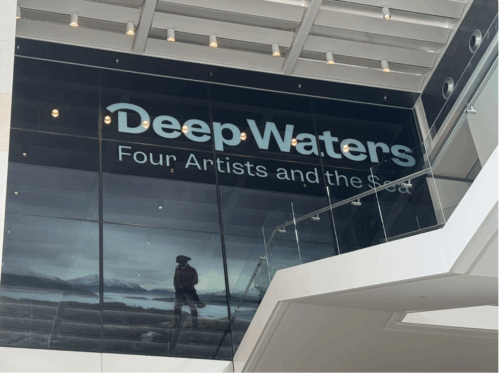
At the Museum of Fine Arts in Boston, the ocean’s role in migration, colonization and industrialization takes center stage in “Deep Waters: Four Artists and the Sea,” on view through November 9, 2025. Curated by Theo Tyson, the show features just two rooms and four works, made centuries apart, following what the museum describes as “a genealogical thread united by the sea.”
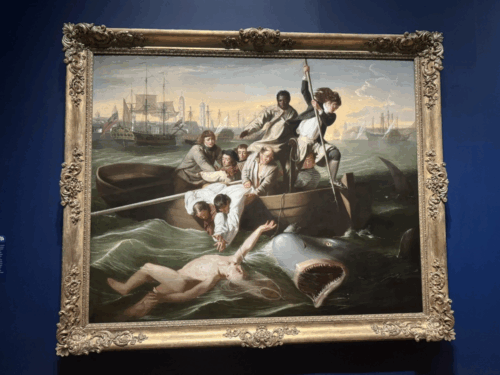
How might a man of African descent come to serve aboard a British ship in a Spanish colony where the slave trade flourished? This question reverberates through John Singleton Copley’s “Watson and the Shark.” The oil painting portrays the true 1749 incident in which a shark attacked a fourteen-year-old cabin boy named Brook Watson in Havana Harbor. Watson—who survived but lost a leg—went on to become a prominent statesman and commissioned Copley to depict the ordeal decades later.
Copley modeled Watson’s figure on the statue of the Borghese Gladiator, aligning with neoclassical aesthetics commonly found in 18th-century art. Curiously, the painter had never seen a shark. His anatomically incorrect rendering—with forward-facing eyes, nostrils emitting air and oddly anthropoid lips—was likely based on second-hand descriptions. The harpoon, pointed at the beast’s maw, could function as an instrument of rescue or an assertion of mastery over nature and the alleged primitive.
The Black sailor reaching towards the imperiled boy is conspicuously absent from preliminary sketches of the work, leading to speculation around his later inclusion. Did Copley intend to gesture towards racial solidarity? Convey concord and kinship in a moment of mortal peril? Delineate the beastly and the humane? The cruel and the compassionate? The painting leaves its viewer in wonder.
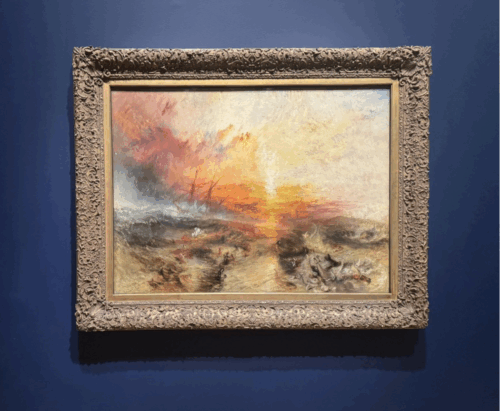
At first glance, J. M. W. Turner’s “The Slave Ship” appears to be a radiant seascape, reminiscent of various works by Poussin, Monet or even Turner himself. Yet, upon closer inspection, the painting reveals another scene of maritime catastrophe. Beneath a fiery sun, limbs and chains thrash amid churning waves.
Painted as an indictment of the slave trade, Turner recalls the 1781 Zong Massacre, when the captain of the British slave ship Zong ordered more than 130 sick enslaved Africans to be thrown overboard so their deaths could be claimed as insurance losses.
Turner evokes the Burkean concept of the “sublime,” or the simultaneous awe and terror that arises when considering man’s helplessness before the vast, indifferent and uncontrollable power of the natural world. By dramatizing the sea and sky, Turner casts nature as both executioner and avenger. Some interpret the incoming typhoon as impending divine justice upon the moral depravity of slavery.
“The Slave Ship” also addresses the ocean’s role as a medium of commerce and exploitation. The primary highway of the transatlantic slave trade continues to facilitate a great majority of global trade today, perpetuating exploitative hierarchies and environmental degradation.
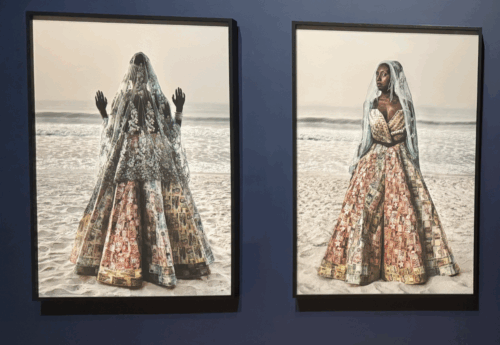
Adjacent hangs “Some People Have Spiritual Eyes,” a two-part self-portrait by Ayana V. Jackson. The artist’s dress, structurally reminiscent of the Victorian era and composed of Ghanaian cedi notes stitched together, represents how imperialist greed commodified human beings. She presents herself as a citizen of Drexciya, an imaginary Afrofuturist underwater kingdom populated by the children of pregnant women who passed away during the Middle Passage.
Jackson stares directly at the viewer in the first panel, her expression solemn. She states, “Many people have suffered from having their identities displaced through a racist colonial gaze.” Her response? A distinctive gaze of her own, meant to challenge conventional ideas of “beauty and civilization and the narratives of slavery and the ocean seen elsewhere in this gallery.” In the second panel, she faces the sea, possibly paying her respects to what she regards as a colossal grave.
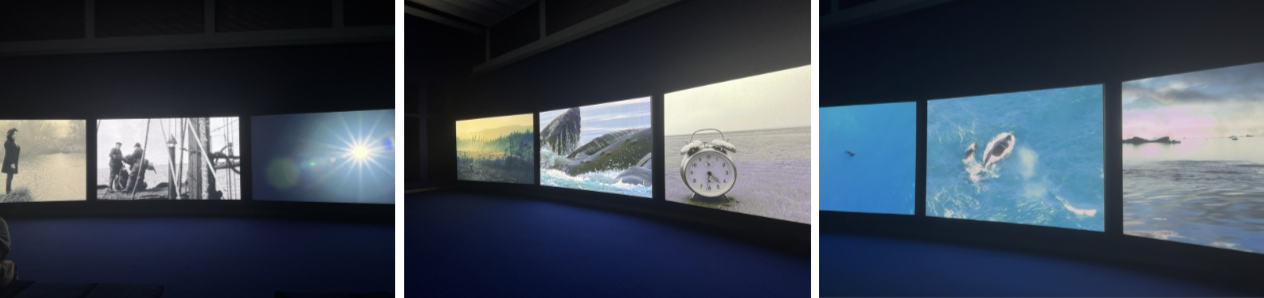
The second room immerses viewers in the stunning footage of John Akomfrah’s Vertigo Sea, a forty-minute, three-channel video installation presented for the first time in New England. Through a montage spanning from the age of Ahab to the present, Akomfrah explores our simultaneous fascination, exploitation and dependence on the sea. “It’s a very impactful viewing experience, especially with the surround sound—it’s old movie theater style,” said one visitor.
One moment, we witness miracles of nature—whales breaching, jellyfish drifting in bioluminescent light, panoramic shots of the shore—and the next, we are plunged into horror—industrial fishing, marine life flayed by harpoons, reenactments of the Middle Passage, refugees adrift on rafts, polar bears dying on melting ice. As the Boston Globe notes, the ocean’s “dizzying crosscurrents of colonialism, the trans-Atlantic slave trade, contemporary capitalism and ongoing migrant strife” course through this film.
“This exhibit encompasses two of our greatest masterpieces, ‘The Slave Ship’ by Turner and ‘Watson and the Shark’ by Copley, in conversation with contemporary photography and video art,” said Laura Gomez Ickes, a Visitor Information Specialist at the MFA Boston and K-5 art educator. “It brings everything together and makes the art even more impactful. Despite the gory or sensitive subject matter, it’s very important that it’s being shown. It’s one of my favorite exhibits here, and I am very glad that it’s staying for as long as it is.”
“Deep Waters: Four Artists and the Sea” asks us to face what we have done to one another and to the natural world. It is an elegy and an indictment.
The ocean may be the site of evil, but this exhibition reminds us that perhaps the greater evil lies not in the sea, but in ourselves.