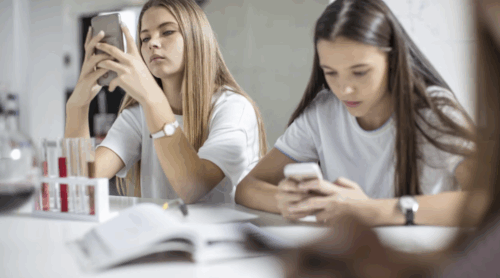
Does technology enhance or limit our learning? To what extent are devices beneficial to students, and when are they harmful? What would a phone-free Fieldston look like?
These questions are increasingly relevant this year, since there will be a complete ban on cell phones on the Fieldston Campus, including the Quad and outdoor athletic facilities. This ban will have multiple stages.
At the start of this school year, the same cell phone rules will be in place as last year: placing your phone in a caddy at the beginning of class and silencing it, restriction of phone use in the Tate Library and restriction of cell phone use during assemblies. Beginning October 1, 2025, every Monday, students will be required to store their cell phones and smartwatches in their backpacks from 8:30 AM to the end of school.
Kyle Wilkie-Glass shares, “My impression is that the digital free Mondays, I think they’re a really great idea because they basically allow us to practice and they allow us to iron out any kinks that are coming up as part of the policy.”
The full ban will kick off on January 1, 2026, when the use of cell phones and smartwatches on campus will be strictly prohibited from 8:30 AM to the end of school.
This new policy was motivated by multiple factors. When recounting these factors, Dr. Stacey Bobo describes, “Ten years ago we did cell phone bans and then we lifted them because people felt that we just need to give the kids technology, and I think we did so without a lot of education.” Since then, “we saw an increase in bullying across schools. We saw an increase in writing things that are inappropriate. Kids believing everything they see, not checking it out for themselves, and a decline in reading,” comments Bobo, “Last year [Jonathan Haidt] wrote his book and it started a movement around the country about going back to cell phone bans.” Jonathan Haidt’s book, The Anxious Generation, details the dangers of cellular devices and social media, especially towards adolescents and children.
Bobo also sees a problem with phones hindering human interaction: “If I let you guys be in a room together, you’ll all be on your phones… My hope is that it will get this group talking a little bit more to one another, as opposed to through this device,” she adds.
Many of the problems with phones stem from how we communicate on them and the apps we use. “My real issue is around social media,” states Bobo. “I think most of our discipline, our issues, venture from people writing things they shouldn’t have written, being unkind to one another.” For this reason, she believes, “the biggest problem of this is not the phone itself. It’s what’s on the phone.”
Both Bobo and Wilkie-Glass are worried about the negative effects of social media. Wilkie-Glass shares his concern, “I think students in particular are subject to way too many inputs. There are too many text messages flying at you, TikTok notifications, Instagram notifications, Snapchat notifications… that it eventually dulls a lot of the world.”
To mitigate the harmful effects of technology Bobo says, “we have to teach media literacy more than anything.” Fieldston plans to incorporate more programs related to technology through assemblies, courses, and more. Bobo explains, “All the teachers [in the upper school] have committed to doing one activity that centers around media literacy.”
Another factor influencing this policy was Governor Hochul’s state-wide cell phone ban that began in September for public schools. “While that was happening at the state level, I think a lot of independent schools were looking at what they would do to respond to this kind of crisis of mobile devices.” shares Wilkie-Glass. Fieldston is included in that group of independent schools.
However, some students at Fieldston still have concerns about the policy. A Form III student observes, “I think it’s important for people to pay attention during class, but when you’re outside of class it’s a whole different scene, and it’s not like everyone has their head buried in their phones the whole time.” Another form III student notes the benefits of having a phone during the school day: “I like to see my schedule and text people during lunch to meet up.”
On the other hand, some students are looking forward to not using cell phones. Saskia Sommer (Form VI) spent a semester at The School for Ethics and Global Leadership, SEGL, learning without a cell phone. She remarks, “A big aspect of the phone policy [at SEGL] that worked well is that we all knew about it going in and had selected to be there because we wanted to learn from our peers and to spend more time having face to face conversations. My hope for Fieldston is that the same is true.” Sommer adds, “It was honestly a really positive experience, and I’m excited to see how it will play out at Fieldston.”
As October approaches, we will soon see how this new system unfolds. Will it benefit our learning? Will it be effective in restricting cell phone use? Will a cell phone ban during the school day mitigate the harmful effects of devices on health and well-being? Only time will answer these questions.