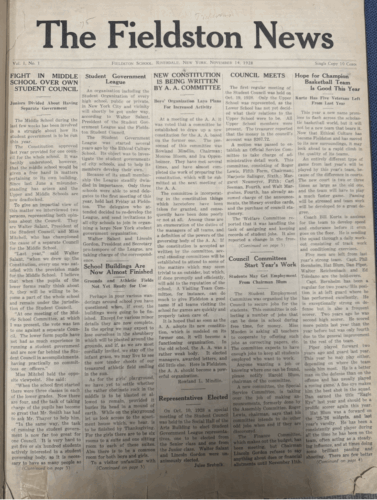
Since 1928, Fieldston student journalists have recorded their thoughts, observations and questions in The Fieldston News, each piece of writing creating a cultural and political time capsule. The history of the paper is therefore inextricable from the history of the Ethical Culture Fieldston School, the United States and the broader world. With this understanding, in honor of the publication’s 100th volume, we are putting together a special edition of The Fieldston News. The edition features the work of generations of student journalists, along with commentary from current Fieldston News editors and Bob Montera, who has been the faculty advisor for forty of the paper’s one hundred volumes. As you read, we hope you consider the following question: What does it mean to live in the middle of history?
To start this project, I spoke with eight alumni to discuss their time learning and practicing journalism at Fieldston, hoping to hear how student journalism impacted their lives and careers.
Journalist Maggie Haberman, who graduated from Fieldston in 1991, is a White House correspondent to The New York Times and former student of Bob Montera’s journalism class. She shared over email that although she does not have the sharpest memories of high school, she does “remember Mr. Montera making journalism appealing to me in a different way, primarily for the ability to share people’s stories and inform the public about events.” While she does not recall writing articles for The Fieldston News, she added, “But I will also say there’s no lesson in journalism as significant as actually doing the job, and so the newspaper is a vital way for students to discover that.”
Also among the school’s top alumni journalists, Julie Hirschfeld Davis is the Congressional Editor at the New York Times, and has covered politics in Washington for over 20 years. She is the co-author of the book “Border Wars: Inside Trump’s Assault on Immigration.” Davis first developed an interest in journalism in the 5th grade in Ethical Culture, where she attended a journalism after-school course. As soon as she got to Fieldston, she began writing for The Fieldston News, encouraged by Montera, who taught his history class through the lens of journalism. By her senior year, in 1993, Davis was a co-editor-in-chief of the News, the first step of her journalism career. “When I think back on my time at the News, there was this sense of community. My love of being in a newsroom really began when I was in our little basement,” she said. The basement, which the engineering rooms now occupy, housed the print shop run by Art Jacobs and Carl Smith (Smith was the arts assistant at the time, and is now an Uppers School graphic design teacher who still provides invaluable help to The Fieldston News).
Davis advises high school journalists to “be curious and humble about what you may not know or understand.” She warns against falling into the trap of digital communication, as she believes face-to-face discussion is critical for quality journalism. “Don’t shy away from the hard questions, and ask them in person if you can. It’s getting harder and harder to write about and cover topics where people may be very strong and divergent on both sides,” she said.
Davis believes high school journalism develops inquisitiveness in young people that is useful regardless of their future careers. “You develop some really critical skills to do with asking questions, questioning authority, confronting people in ways that might not always be comfortable, questioning your own views and trying to tell the truest, most accurate version of what is going on,” she said. “Be willing to have your own views and beliefs challenged. That is really important just for being good citizens of the world. And I think that ability to put your head down and try to get to the bottom of an issue in a way that is fair and accurate, you can’t start that too early. High school is a great place to start.”
Davis still keeps in contact with her co-editor-in-chief, Nick Corman. Corman also continued in the world of journalism after his time at The Fieldston News, working as a journalist briefly after college before joining Google, where he worked for 10 years on news partnerships. Now, he works at an app called News Break, which focuses on business development and partnerships.
Corman’s time at The Fieldston News was “a really nice team building and friendship forming experience, because we would stay late after school, we would go down to the graphics room, and we would do lots of work. Sometimes we’d have dinner, sometimes we’d catch a later bus. Very often we would stay even later than that, so we would sort of drive one another home just to make sure everybody got home.”
Montera said, “Those nights were happily called Hell Nights. No one would leave until the issue was ready for printing. It required intense commitment.”
The process of creating the paper served as valuable experience, according to Corman. “Anytime you’re young and writing, editing other people’s stories and figuring out what exactly should be in a lead, what is most interesting, how to integrate, how to do interviews, how to integrate quotes, facts and information and sort of structure a story. Anytime you’re doing that, as someone who’s young, that undoubtedly helps you later,” he said. He remembers two impactful stories that he wrote during his time at the News: a piece profiling potential principal candidates and an article on medical benefits at Fieldston needing to be extended to the same-sex domestic partners of faculty.
Source: Sophia Ahmed
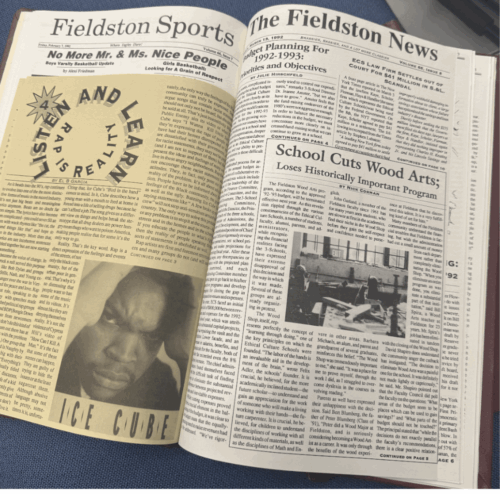
Andrew Blum was an underclassman during Davis and Corman’s leadership, and was inspired by their joy in the process of making the paper in the printshop, which held the computers, printing presses and dark room. In order to write stories, students would write at home on computers, then bring in floppy disks with the stories on them. As transferring files was impossible, the first News job of freshmen would be to type up other people’s stories. One disk held the master files for the issue on it, and students would pass it around the room, saving stories to the disk. Then, with the help of Carl Smith, they would laser print the issue and half-tone the photos in the darkroom.
Blum remembers, “We would go down between classes and see the newspaper being printed on the printing press, which was amazing. And then we would have to gather people down to collate it together, because it would get folded. All the ninth graders would have to come down and you, and we make them collate the pages. Everything had to happen in the room; it was very physically collaborative. Nick and Julie did a really amazing job of creating that sort of sense of collaboration in the print shop, so that got me hooked.” By sophomore year, Blum held the title of features editor, and the next year, in 1994, became a co-editor-in-chief with his friend Britton Mann.
During his time at the paper, “there was a fair amount of appetite for trouble. There was a fair amount of writing about the administration,” said Blum. When Blum was an editor, a reunion of the 1970s sit-in where Black students occupied the administration building at Fieldston took place. The paper wrote about the reunion and discussed how progress since the original sit-in had been limited. “We were eager to write about it, and eager to hold the administration to account,” Blum said. He wonders “how that arc of diminishing or continuing to go against the administration has continued.”
Blum continued in journalism post-high school, immediately pitching and writing stories after graduating college. He spent 10 years working mostly as a magazine writer, writing about architectural design, often working for Wired and the New York Times art and leisure section. He then switched to writing books; he published his first book, about the infrastructure of the internet, in 2012. He also contributed as an editor for various magazines. He is now working on his third book, which will be about energy infrastructure.
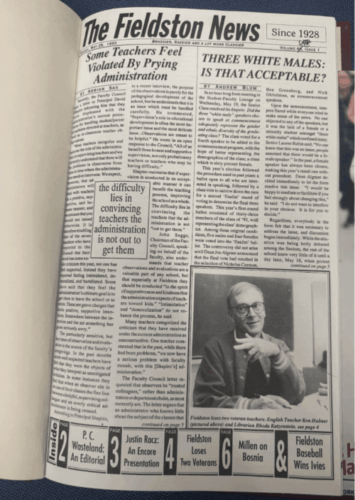
The same year Blum was editor-in-chief, Daniel Edward Rosen, a family friend of Blum’s, took his first journalism class with Montera and began writing for the news. “It was an incredible class. It really was looking at a story from all aspects, and having that both empathetic approach, and then looking at what are the causes and the historical factors here that have caused things to occur,” said Rosen. Through the journalism class, Rosen wrote Q-and-A articles interviewing notable artists like the playwright Wendy Wasserstein and the Poet Laureate Billy Collins, as well as covering a school cheating scandal and other Fieldston happenings.
Rosen did not immediately pursue journalism after leaving Fieldston, first working in the theater industry before realizing he wanted to write. While working at ESPN, he had the opportunity to write a chapter of a book on the history of African American quarterbacks. He loved the experience of interviewing, and began pitching articles to Newsday after he left ESPN. He started off as a stringer doing breaking news around the city, working at various publications, such as The New York Daily News, the New York Post and the New York Observer. Now, he works at the New York Sun as a senior investigative reporter.
Rosen credits The Fieldston News with building experience managing an intense workload and creating early opportunities for real journalism. He said, “Above all, The Fieldston News always had the standard that has really stood the test of time. I do put that on Montera. That class is just the one thing that stuck with me all these years, and that was almost 30 years ago.”
David Schleicher, a current Fieldston parent, also remembers Montera’s class as transformative. Schleicher was an editor-in-chief of The Fieldston News from 1995-96, and is now a professor of property and urban law at Yale Law School. As an academic, he has written for publications including The Atlantic and The New York Times, and currently has been writing frequently for Vital City.
Mr. Montera was, he said, “the coolest teacher then, and the coolest one I’m guessing now.” He recalls Montera sending him to spend the day shadowing reporters at City Hall, at a time the press were at war with Rudy Giuliani, igniting his interest in journalism. However, after attending the Medill Cherubs Journalism program, Schleicher decided he preferred sharing his own options, so Montera moved him to editing and gave him a column. Schleicher looks back fondly at the column, “You’re Wrong Too,” an example of the argumentative spirit that characterized his time at the News. “It’s good to do a project that’s barely overseen by adults,” he said. “The Fieldston News gives students a lot of freedom.”
For Andrew Holm, a current Fieldston board of trustees member, the impact of Fieldston journalism is deeply personal, although he, like Schleicher, did not go on to pursue journalism. Holm, who graduated from Fieldston in 2001, was the Editor-in-Chief of The Fieldston News alongside Katherine Orr, Gillian Warmflash, and his wife, Jaqueline Harrington. He first met Harrington in 7th grade (he went to Ethical, she went to Lower) and “by the time Jaqueline and I were named co-editors, we were very good friends, and we started dating in the fall. As co-editors in chief, we spent a lot of quality time in the workshops and editing articles late at night, putting us in proximity with each other quite a bit.” Holm and Harrington married in 2011, and now send their children to Fieldston. “I think Mr. Montera and our old team compete for credit for my wife and my marriage, as to who sort of helped set us up,” he said.
Recent graduates of Fieldston have also been impacted by their experiences with the News, which have inspired some to pursue college journalism. Sophia Gutierrez, a current junior at the Medill School of Journalism at Northwestern University, was an Editor-in-Chief of The Fieldston News four years ago. At Northwestern, Gutierrez writes for campus publications including the Daily Northwestern and Blackboard, a Black student publication. “I’m living out The Fieldston News dream of studying Journalism at Medill and writing for publications” she said.
Montera was Gutierrez’s champion throughout high school; he remains her mentor, and she plans to stay in contact with him for the rest of her life. “Bob Montera really embodies what that paper is, which is more than a community. It’s a lifestyle. It is eating, sleeping, breathing and loving writing together, bringing together very, very bright students who are interested in various things.” At Medill, Gutierrez feels well-prepared by her Fieldston education. She advises current students: “Don’t discount The Fieldston News as a battleground of ideas. It’s all got to start somewhere. In this case, it starts in Room 112.”