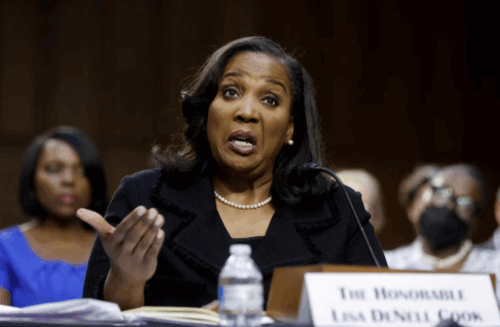
For the first time in the Federal Reserve’s 111-year history, a president is attempting to fire a Federal Reserve governor. President Donald Trump’s effort to remove Lisa Cook from the Federal Reserve Board of Governors has ignited a constitutional showdown that could reshape the independence of America’s central bank—and the case now sits before the Supreme Court.
In late August, Trump posted on social media a letter informing Cook that he had “sufficient cause” to fire her, making him the first president to pursue such action since the Federal Reserve’s founding in 1913. “Pursuant to my authority under Article II of the Constitution of the United States and the Federal Reserve Act of 1913, as amended, you are hereby removed from your position on the Board of Governors of the Federal Reserve, effective immediately,” Trump wrote. Cook’s response was defiant: “President Trump purported to fire me ‘for cause’ when no cause exists under the law, and he has no authority to do so. I will not resign.”
The cause Trump refers to stems from allegations by Federal Housing Finance Agency Director Bill Pulte, who accused Cook of claiming two separate properties as her primary address within weeks of purchasing each with financing in order to secure a lower rate. Pulte accused Cook of having “falsified bank documents and property records” to purchase a house in Ann Arbor, Michigan, and a condo in Atlanta, Georgia. Cook has denied any wrongdoing. The Trump administration has also launched a criminal mortgage fraud probe into Cook, issuing grand jury subpoenas from both Georgia and Michigan.
The result of this legal battle hinges on two words in the 1913 Federal Reserve Act: “for cause.” When establishing the Federal Reserve, Congress included provisions to shield the central bank from political interference; however, it did allow governors to be removed “for cause,” though the act doesn’t define the term or establish removal procedures. No president has ever removed a Federal Reserve governor, and the law has never been tested in court until now.
U.S. District Judge Jia Cobb ruled that Trump’s mortgage fraud claims likely were not sufficient grounds for removal. She found that the “best reading” of the 1913 law only allows Federal Reserve governors to be removed for misconduct while in office, not for actions taken before confirmation. Cook’s lawsuit alleges Trump violated her due process rights by providing no meaningful notice or opportunity to respond to allegations. A U.S. appeals court upheld the decision allowing Trump to fire Cook in a 2-1 decision, with two Biden appointees in the majority and a Trump appointee dissenting. The administration quickly appealed to the Supreme Court. “The President lawfully removed Lisa Cook for cause. The Administration will appeal this decision and looks forward to ultimate victory,” said White House spokesman Kush Desai.
This case has historical implications for Federal Reserve independence, a cornerstone of modern central banking. The Federal Reserve’s ability to set interest rates and implement monetary policy without succumbing to short-term political pressures is widely regarded by economists and policymakers as essential for maintaining price stability, controlling inflation, and preserving long-term economic health. This independence allows Federal Reserve officials to make difficult but necessary decisions that may be politically unpopular in the moment but economically sound over time. “If we’re going to allow politics to determine the membership of the Fed, what does that mean for the future of our economy?” questioned Jane Manners, a Fordham law professor who studies presidential power.
The Supreme Court has allowed Trump to remove officials from various independent agencies this year, most recently the Federal Trade Commission, but previously signaled the Federal Reserve is distinct, calling it “a uniquely structured, quasi-private entity” with a singular historical tradition. Cook’s attorneys argue the allegations are pretextual, designed to “effectuate her prompt removal and vacate a seat for President Trump to fill and forward his agenda to undermine the independence of the Federal Reserve.” Trump has demanded aggressive rate cuts and berated Fed Chair Jerome Powell over monetary policy.
The removal of Cook would provide Trump with significant leverage over Federal Reserve policy, as it would allow him to appoint a fourth member to the seven-member governing board, effectively giving his nominees a controlling majority. This strategic positioning became even more apparent this week when another Trump nominee, White House economist Stephen Miran, was narrowly confirmed by the Senate in a largely party-line 48-47 vote. Despite the ongoing legal battle over her position, Cook participated in the Federal Open Market Committee’s recent policy meeting, where she voted alongside the majority to implement a quarter-point interest rate cut. Notably, Miran cast the sole dissenting vote, arguing instead for a more aggressive half-point reduction, a position that aligned more closely with Trump’s repeated calls for deeper rate cuts.
So, can Trump fire Lisa Cook? The answer lies in a legally intricate and historically unprecedented situation that is testing the boundaries of presidential power. While the 1913 Federal Reserve Act does explicitly grant the president authority to remove governors “for cause,” the complete absence of precedent has necessitated that courts interpret this provision for the first time. Lower courts have identified several significant legal obstacles to Trump’s removal effort: the administration failed to provide Cook with adequate due process protections, including proper notice and an opportunity to respond to the allegations levied against her; the mortgage fraud claims involve conduct that occurred before Cook’s Senate confirmation, raising questions about whether “for cause” applies to pre-appointment behavior; and the Federal Reserve’s unique quasi-independent structure that further complicates the matter.
This is more than a dispute over one governor; it’s a fundamental test of separation of powers and agency independence. The Supreme Court’s decision will establish precedent for presidential power over independent agencies and determine whether the Federal Reserve can maintain its traditional insulation from political pressure. For now, Cook remains on the board while the nation’s highest court prepares a defining judgment on the balance between presidential authority and institutional independence.