Two Notes:
- The section of the essay that directly pertains to American politics begins at the second header.
- Gaius Marius was credited with the Marian reforms in the 19th century
Ave, Imperator
Why study the classics? Because, sometimes, we can see the authoritarian thread that extends the ancient world to the contemporary world. In exploring the world of Caesar Augustus, we can better understand the world of Citizen Trump.
In 27 BC, Gaius Octavianus—known today as Octavian—stood before the Roman Senate and renounced the extraordinary powers he had accumulated during years of civil war, a declaration that would define the next five centuries of Roman governance. He vowed to return power to the Senate and the Roman people, even claiming—according to Cassius Dio—that although it was “in [his] power to rule over [Rome] for life,” he would relinquish “absolutely everything” to prove he “desired no position of power.” Elections and state magistracies responsible for apportioning administrative duties continued to exist, but nominally. The Republic, at least in name, was preserved; in substance, it was gone. Rome now functioned under the will of one man. Caesar Augustus, the first emperor, was born.
Surely such a tremendous upheaval of Rome’s prior political order would have bred disorder and strife. Yet, to many, Caesar was Rome’s destiny. Through extensive propaganda efforts, most notably in Virgil’s Aeneid, any attempts to reinstate effectual suffrage and other democratic practices were rendered obsolete. Virgil was hired to make Augustus look good.
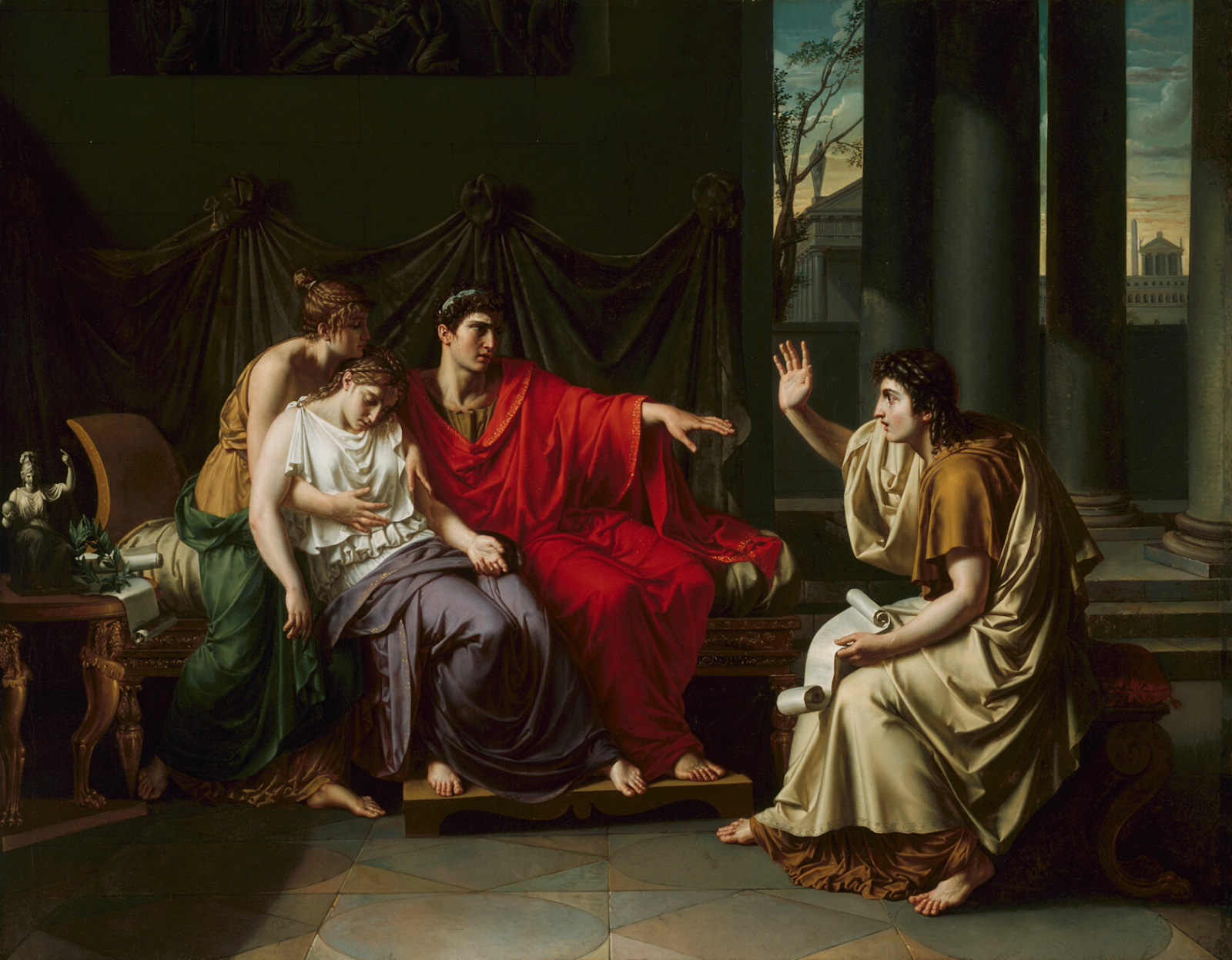
Source: Art Institute of Chicago
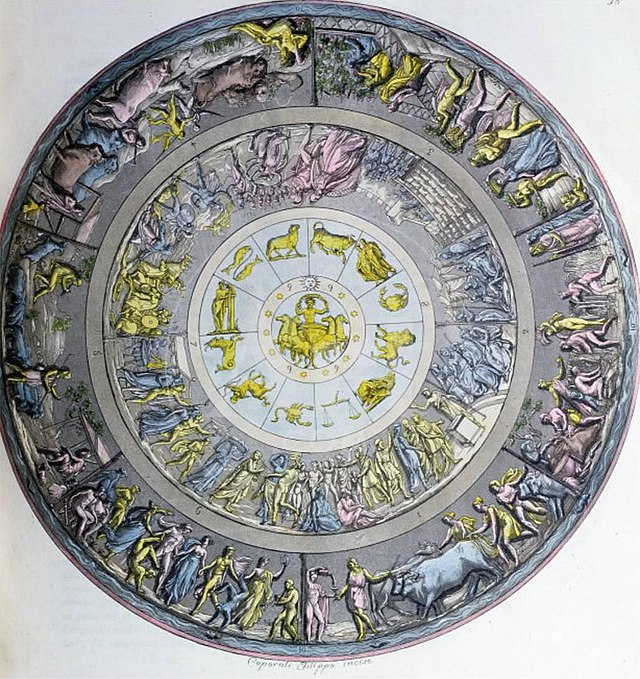
Aeneid casts Augustus as descended from the great Trojan hero Aeneas and the sovereign foretold by Jupiter to lead Rome. Virgil gives an ekphrastic description of Aeneas’ shield, forged by the god Vulcan. On the shield is a tableau of Rome’s past and present: from the twin founders, Romulus and Remus to the Augustan victory at the Battle of Actium. The naval battle is portrayed as not merely a human conflict, but a theomachy. The divinely ordained prince confronts Mark Antony, “backed by a foreigner’s wealth and international forces,” while Anubis and other foreign, “monstrous” gods face Rome’s Neptune and Venus. A triumphant Augustus stands at the center of the shield—the Peaceful City finally realized.
The epic poem then names and anoints its hero: “Here is the man whose coming you so often here prophesied,” Virgil writes, “Here is Augustus Caesar, son of a god, the man who will bring back the golden years and extend Rome’s empire.” Thus, the populace jubilantly welcomed their consecrated ruler, certain that the age of Roman splendor had returned.
Source: Wikipedia
The promise to “restore” a lost golden age has been repeated through the centuries—invoked by those claiming to be “inheritors of Rome” or to establish a “kingdom of heaven,” and even in modern political discourse. National renewal through a mythic past is like an opiate for the masses.
But perhaps Augustus’ rise was destined—not by providence, but by the aggregate actions and decisions of political elites and popular assemblies alike. Augustus was not uniquely responsible for Rome’s transformation. Scholars have studied the collapse of the Republic for centuries, and its eventual downfall was precipitated by a number of factors. For this analysis, I will examine those forces that share notable analogues with contemporary America.
In the late 2nd century BC, statesman and general Gaius Marius completely reformed the Roman military. The most salient of his “Marian reforms” was to open military service to the capite censi—the landless poor. Facing a manpower shortage, Marius created Rome’s first professional standing army. But, as the military continued to siphon recruits from the lower classes of Roman society, the “loyalty of a Roman legion became much less about how much legal authority a general or official had” and “much more about who was providing that legion with its wages, plunder, and plots of farmland.” The soldier’s allegiance was to their commanding generals, not to the state of Rome.
The full ramifications of the Marian reforms became clear when Lucius Cornelius Sulla, a lieutenant of Marius, launched a coup d’état in 88 BC and marched on Rome. Never before had a Roman army attacked the city of Rome itself. After six years of civil war, Sulla assumed supreme power in 82 BC. Though his dictatorship was short-lived—he resigned in 79 BC and the Republic was temporarily restored—Sulla set a new precedent that may have irrevocably impaired Rome’s republican future. He had demonstrated that an autocrat could be installed using martial force.
A few decades later, the die was cast. The Roman scholar Cicero records that the general Pompey, a protégé of Sulla, once quipped of his mentor’s insurrection, “If Sulla could, why can’t I?” Though Pompey never managed to make his musings a reality, his greatest adversary—Julius Caesar, the maternal great uncle and adoptive father of Augustus—did. In January of 49 BC, Caesar famously marched his legions across the Rubicon into Rome, igniting a series of civil wars that ended with him becoming “dictator for life” in 44 BC.
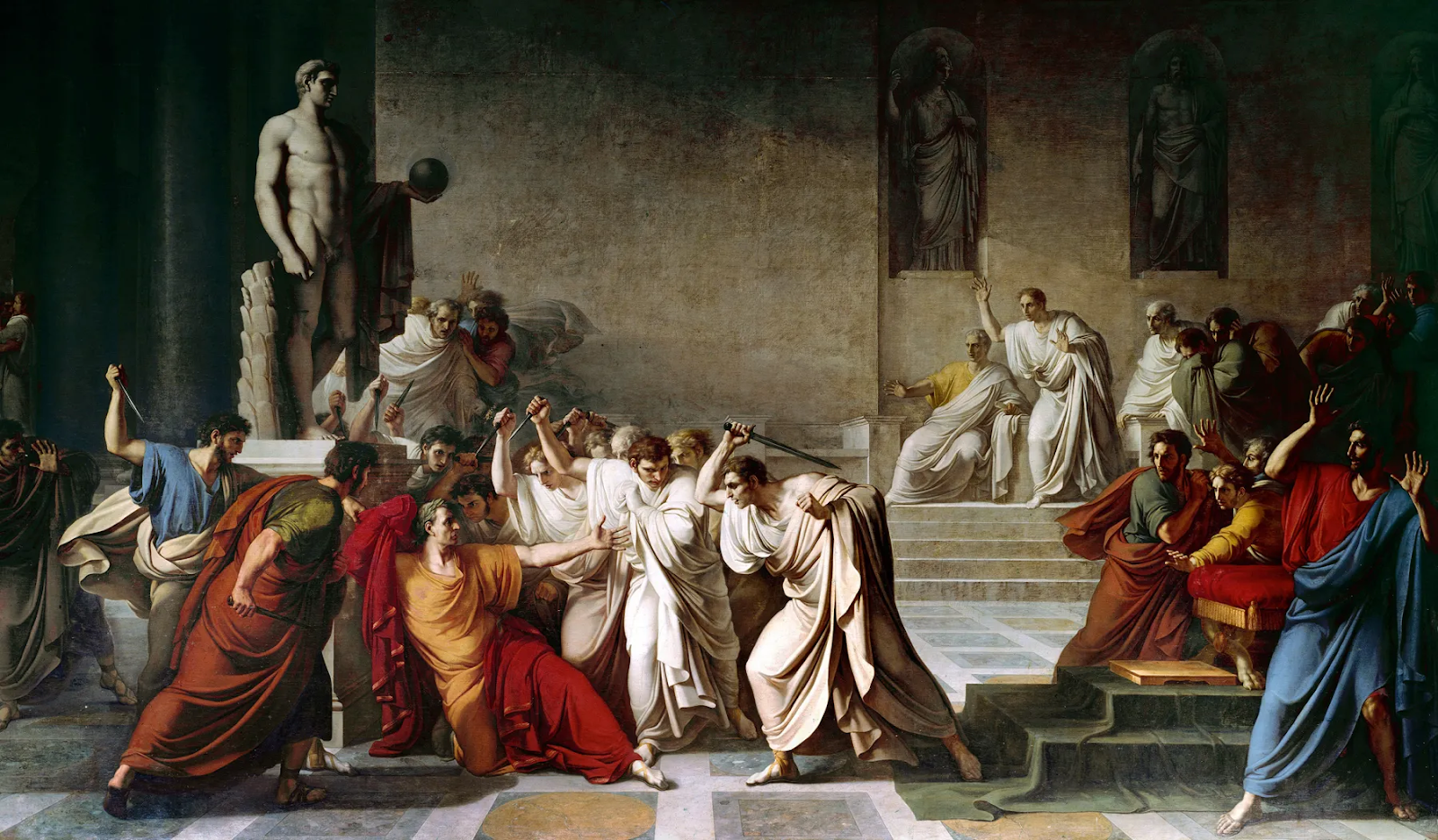
Caesar was assassinated only months later, and Rome once again descended into turmoil. What originally was a successful attempt to remove a tyrant became a catalyst for further civil war and unrest. The entrenched influence of tribal politics and populist rhetoric had corroded the Republic to an irreparable degree, and the Roman populace yearned for structure and security. When Gaius Octavianus emerged from the chaos, presenting himself as the sole guarantor of peace and stability, Rome’s disillusionment with republican governance evolved into acquiescence for a new imperial order. Augustus’ ascent to the curule throne was all but inevitable.
Those About To Die
“There is nothing I dread so much, as a division of the Republic into two great Parties, each arranged under its Leader, and concerting measures in opposition to each other. This, in my humble apprehension, is to be dreaded as the greatest political Evil, under our Constitution,” wrote John Adams, the second President of the United States, in a letter to Jonathon Jackson in 1780.
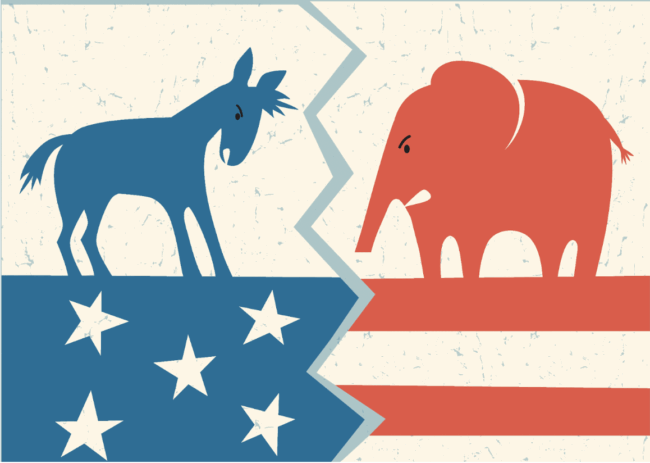
Though 21st century America doesn’t have legions of soldiers sworn to individual generals like Marian Rome, factionalism manifests itself in a different way: as two massive political parties, just as Adams feared.
According to Pew Research, Republicans and Democrats are more ideologically divided now than at any other point in modern history. Most concerning—and most reminiscent of the late Roman Republic—is the shift in loyalty from the United States as a whole to political parties and their leaders. Members of the opposing party are no longer perceived as fellow countrymen, but as mortal enemies—legislatively, culturally, and even morally—who must be defeated and silenced to preserve the sanctity of the nation. The pursuit for constructive governance succumbs to the struggle for partisan dominance. As Thomas Mann, a senior fellow at the Brookings Institution, succinctly puts it, this is “the hyper-partisanship that paralyzes our politics and governance.”
Several factors contribute to America’s heightening divisions. According to Duverger’s Law in political science, the first-past-the-post, winner-take-all voting system along with single-member districts encourages the rise of two dominant political parties over time. Third party movements struggle to gain traction, necessitating voters to choose between two main “options.” Gerrymandering further exacerbates polarization by creating “safe” districts where only one party wins. Elected officials have little incentive to appeal to a broad range of voters, instead catering to the most fringe parts of their constituencies—and being rewarded for it.
What I believe the most pertinent source of polarization within contemporary America, however, is the growing extremism and hostility found at both ends of the political spectrum.
The rhetoric and the policy priorities of the current Democratic Party—particularly its emphasis on radically advancing social equality, addressing climate change and pursuing expansive economic reforms—are only resonant with the goals and desires of a small, specific portion of the electorate. While some of these issues are undeniably crucial to create a more just society, the general populace lacks either the capacity or interest to act on them. By channeling disproportionate attention and resources toward these narrow voter blocs, Democratic leadership unintentionally weakens its own ability to build the broad coalitions necessary to enact lasting reforms and effectively counter the ascendant right.
Former Democratic U.S. Representative Adam Smith told the New Yorker that, while he stands in firm opposition to Donald Trump’s agenda, he feels “alone in his own party.” He believes that there is too much focus on “identity, the evils of capitalism, and concepts like ‘settler colonialism’” instead of on more immediate problems in people’s everyday lives.”
According to AP News, in the gubernatorial elections happening in Virginia and New Jersey, Democratic candidates are distancing themselves from “their party’s far left wing—and its most divisive people and priorities.” Instead, their campaigns focus on “rising costs and the economy under President Donald Trump’s leadership.”
Meanwhile, the Republican Party seems to have coalesced under one man and his populist platform. Trump himself has said in his book, “Think BIG and Kick Ass in Business and Life,” “There is nothing I value more than loyalty.” His longtime advisor, Roger Stone, clarified to Politico that, to the president, loyalty means “support Donald Trump in anything he says and does.” Biographer Tim O’Brien adds, “It’s not allegiance to the flag or allegiance to the country—it’s allegiance to Trump.”
The ancient historian Tim Elliot draws striking parallels between Trump and Julius Caesar in his Politico article, “America Is Eerily Retracing Rome’s Steps to a Fall.” Elliot says that the consulship of Julius Caesar dispelled Romans’ of the notion that their Republican system could withstand one person’s audacious actions, just as Trump’s presidency has “reconfigured the boundaries of acceptability in modern U.S. politics, revealing cracks in the ability of institutions to withstand the creep of authoritarianism.”
When Caesar “declared that there was nothing to gain by engaging politically with his opponents, and instead addressed his loyal followers directly, he embarked on a political arms race that drew the battle lines of an internal conflict that consumed Rome for a generation.” He spoke “directly to the people, railing against traditional elites, complaining about noncitizens taking jobs and encouraging violence.”
Trump operates similarly by rallying his base and shunning bipartisan governance. In September 2024, he declined to participate in a second debate with Democratic nominee Kamala Harris, telling ABC News,“When you win, you don’t really necessarily have to do it a second time.” He communicates with his supporters within the “contio” of social media, flooding feeds with a constant stream of inflammatory messages. He deems his opponents as traitorous and politics as a battle between good and evil, morality and immorality and the holy and the heretical.
In his March 4 address to Congress, Trump declared regarding his 2024 assasination attempt, “I was saved by God to make America great again.” With these words, he presents himself as yet another “divinely chosen” leader, and implies that opposing him is tantamount to defying God’s will—remarkably similar to how Augustus is depicted in the Aeneid.
Finally, Elliot states, Caesar’s image was fraught with scandal, but this somehow bolstered his appeal. Trump benefits from a similar phenomenon—his legal troubles or personal controversies seem only to galvanize his adherents.
In a 2024 interview with GB News, the conservative political commentator Michael Knowles asserted that, “The FBI and the DOJ colluded with Democrats to cook up a bunch of fake information with a fake dossier to illegally spy on the Trump campaign.” He went on to argue that attempts to apply conventional logic or reason to the legal cases and controversies surrounding Trump were inherently futile, adding, “We have to recognize it’s not a prosecution but a persecution. The verdict is already in. Trump is guilty and they have to ostracize him to St. Helena.”
Both this narrative of supposed persecution and his brazen, provocative conduct reinforce Trump’s populist image and allegiance with the masses. He is the embattled outsider, confronting a corrupt elite that seeks to destroy him—and therefore, the common man. Trump’s supporters have grown weary of the aristocratic comportment and rhetorical sophistication of political figures such as Roosevelt, who epitomize a distant and unresponsive governing class.
Elliot remarks, “Caesar’s image was mired in what his opposition always felt would be his downfall; his braggadocio (boastful or arrogant behavior), his hostility toward political opponents, a history of financial, political and sexual irregularities. And yet, the more outrageously he behaved, the more devoted his followers became.”
Suffice to say, America’s collective goals and purpose are fraying. As one party radicalizes, the other is incentivized to respond in kind. The middle ground erodes, leaving many politically vagrant yet forced to take a side. The Democratic Party demands stringent ideological conformity, whilst the Republican Party demands utmost loyalty to Donald Trump. As Cicero said of the late Roman Republic, America stands “divided in two.”
Source: Wikipedia
We Salute You!
So, one might ask, what if Augustus is the answer? Would it truly be so terrible to unite America under one leader? After all, Rome entered its famed Pax Romana under Augustus, a golden age of peace, prosperity and stability that lasted for two centuries.
The classical historian Honor Cargill Martin says in a New York Times guest essay, “The ascendant right wing loves ancient Rome.” Certain right-wing thinkers, such as Curtis Yarvin, believe than an “American Caesar” is a “guarantee of ‘cultural peace.’’
Consider Steve Bannon, who believes that the “Roman virtues of manliness and service to the state” collapsed “under the pressure of barbarian immigration and sensual excess among the elite.” Or Elon Musk, who declared in a 2024 podcast that “Rome fell because the Romans stopped making Romans.”
Per this narrative, America now is like Rome then—a once-great civilization rotting from internal weakness and political dysfunction, in need of a bold leader to revive its days of glory. But did Julius or Augustus Caesar truly “save” Rome?
In A History of Western Philosophy, Bertrand Russell identifies the two main types of theory as to the origin of government. The first is that power derives from a divine or inherent “right” to rule, and the other sees government as legitimized by a social contract or agreement among the people. The American founding was firmly in the latter camp; the United States fully rejected monarchy and built a democratic republic created by and made up of “We the People.”
Caesarism—defined by authoritarian, populist form of governance where a single, ostensibly ordained ruler assumes supreme authority—is fundamentally at odds with the republican ideals that both this nation and the Roman Republic were founded on. Such a system would also conflict directly with other libertarian right-wing values like limited government and individual liberty.
Marvin argues that, apart from the problem of comparing a modern pluralistic democracy with a pre-Christian, pre-capitalist Mediterranean empire, the notion that we need an “American Caesar” rests on a mythical understanding of Rome’s history. Archeological evidence has discredited “the idea that there was a consistent pattern of population decline in the late republic.” What the “right has captured is a tradition established by the Romans themselves”—an “uncanny hall of populist mirrors that reflects millenniums-old contortions.”
As aforementioned, Caesar and Augustus fashioned and circulated propaganda about decline and renewal. “It is the promise to make America great again that has carried Mr. Trump to two victories, just as the promise of restoration carried Augustus through five decades of autocracy,” Marvin contends. “The American people, Mr. Trump suggests, are intrinsically suited to triumph. Their natural greatness is simply in need of revival.”
The truth is, a perfect and benevolent philosopher-king is a Platonian fantasy. As John Stuart Mill argues in “Considerations on Representative Government,” “absolute power, in the hands of an eminent individual, would ensure a virtuous and intelligent performance of all the duties of government” only if the ruler was “not merely a good monarch, but an all-seeing one.” He must be “at all times informed correctly, in considerable detail, of the conduct and working of every branch of administration, in every district of the country.” Mill believes rightly that the “faculties and energies required for performing this task in any supportable manner” are so extraordinary that “the good despot whom we are supposing can hardly be imagined as consenting to undertake it.” Furthermore, when this supposed “perfect leader” falters or dies, there is no guarantee of a successor with equal wisdom or virtue. Herein lies the cardinal flaw with authoritarian systems.
According to Elliot, “Romans had assumed their Republic could weather the threat of iconoclastic populism, that their norms were sacrosanct, that their system couldn’t be brought down.” Americans today hold a similar belief.
After all, no armies are marching on the Capitol. At least, no armies in uniform.
But if Trump could, why can’t I?