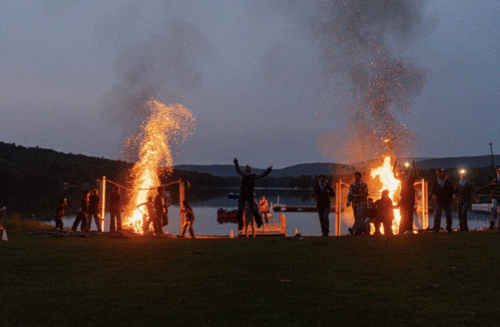
There is something special about tradition. About watching something occur every single year until it is your chance to participate. At my sleepaway camp, Camp Walt Whitman, that tradition is rope burn. At the end of each summer, we have a camp-wide Olympics where, for one intense day, campers are split into two teams to compete in sports and activities, cheering like our lives depend on it. Rope burn comes at the end of Olympics. It is the deciding factor of which team will take home the victory. Two ropes are soaked in water from the lake and two teams of about ten senior campers (the oldest age group) try to burn the ropes. The team that burns it first wins. Each team has two fire captains, a girl and a boy, tasked with being the rope burn leaders.
The role of fire captain is not taken lightly. The fire captain and crew are decided based on the votes of fellow campers and counselors. Though a seemingly small accomplishment from someone who has not experienced camp, for me being fire captain meant showing that I could be the leader my seven summers at CWW helped me become.
After the votes were counted, a few days before Olympics, we found out the fire team results. When I saw my name on the sheet listed below “fire captain,” my heart skipped a beat. A surge of pride and excitement filled my body; the weight of anxiety was lifted off my shoulders. All that was left to do was prove that I deserved it.
Olympics came a few days later. The regular excitement I felt each year gained new meaning. This year, my last year, I was leading the chants. I was leading my team. To prepare for rope burn throughout the day, I went around camp asking former fire captains for their tips and regrets, carefully crafting a plan. I learned about the importance of making a strong wooden base. How oxygen fuels a fire. How a pyramid shape can help direct the heat to the rope. I went from having no knowledge of making a fire to learning everything I possibly could.
When activities were over and dinner arrived, the nerves set in. Minutes before the competition, our team finalized our plan and finished organizing the wood and supplies needed for the fire. Before I knew it, the blow horn went off and rope burn had begun.
We ran with our wood and started by digging a hole to ensure the fire had oxygen, just as we had planned. As we were placing our strong base in the hole, the other team’s fire was set ablaze. My heart began to beat faster. Seconds later, we lit our fire, and it caught. The plan was going perfectly. We continued to add to the structure, and our fire grew. I felt the heat start to get to me, and the physical strain of building something powerful enough to kill me made me want to try even harder. The fire slowly grew, and the rope began to thin.
The other team’s fire was furious. It was massive and deadly. Its red and orange blaze nearly swallowed the rope whole. I felt helpless. A surge of adrenaline filled my body, but this time, there was nothing I could do. Both fires were too big for campers to work on, and the rest of the competition was down to the counselors.
I stood there, gazing at both fires. My body sunk into itself and sweat dripped down my forehead as I watched the fires burn like the spectator I had been each year before.
And then it broke. The other team’s rope broke. I would not let the thought that I had lost reach my head until ours broke too. None of us had given up. Even if we had lost, we would not let down our team even more. Our rope broke, and tears streamed down my face. We did it.
I went to find the fire captain on the other team, one of my close friends. When we hugged, I knew that I was not fully a loser because she had won. “I am so proud of you,” we said simultaneously. We walked to greet the two separated sides of the camp and put our hands up together.
A few days after the Olympics, I would have to leave camp and was terrified to do so. Terrified to say goodbye to friends. Terrified to let go of traditions like ropeburn. Terrified to venture into an unfamiliar world without the promise of coming back to my home every summer. Rope burn was never about the outcome. It was never about whose rope burned first. It was always about getting to be a part of the experience and finishing strong. As I leave camp for the last time, I know, like rope burn, the memory of camp is not about the sadness of the end but the gratitude to have experienced it.