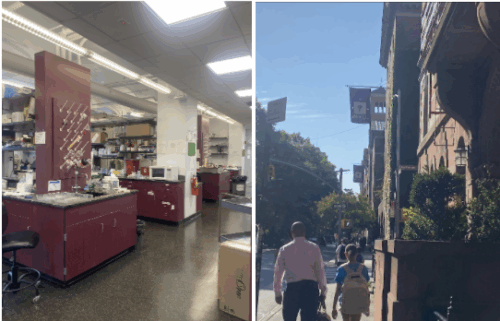
This summer, I interned at a DNA nanotechnology lab at New York University. The experience completely changed my perspective on the functions of DNA, strengthened my chemistry knowledge and enhanced my laboratory skills.
DNA nanotechnology extracts DNA from its genetic context: the one usually taught in school. When I used to think about DNA, I pictured the well-known double helix structure with a sugar-phosphate backbone and base pairs (A-T and G-C) joined in the middle. But the DNA I observed in the lab this summer looked completely different. By placing specific strands of DNA together, researchers can create more complex structures, such as self-assembling DNA tensegrity triangles. These triangles then connect to form larger structures (DNA crystals) that are visible under a microscope.
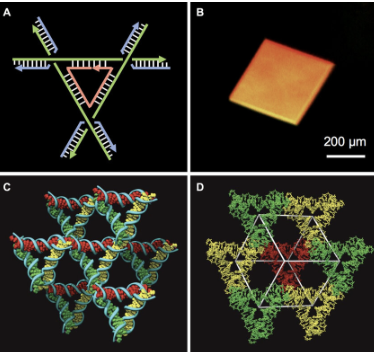
DNA Tensegrity Triangles (Top Left and Bottom Two) and DNA Crystals (Top Right) (Source: ResearchGate)
These crystals have many potential applications in medicine. Because DNA is naturally found in the body, crystals could be used for targeted drug delivery, disease detection and possibly even tissue regeneration.
Given their potential, it is essential to study, experiment with and better understand these structures. During my time in the lab, I witnessed experiments involving these diamonds and even contributed to some. Two topics that I learned about stood out to me in particular, both of which I explored by reading research papers and participating in the lab.
1. Making DNA Crystals Stronger
A challenge with DNA crystals is that they are extremely fragile. They can fall apart just from exposure to room temperature or sudden movement of the tray holding them. This is a serious issue because if DNA crystals are ever used in medicine, they must be able to withstand body temperature (about 98°F).
In freshman year biology class, I learned about an enzyme called ligase, which helps bind DNA ends during replication. It seemed logical to try using ligase to bind the ends of DNA triangles, making them more robust. However, it turns out that ligase is too large and it disrupts the delicate crystal structure. The solution to this problem is a much smaller chemical called EDC. EDC is capable of binding DNA strands together without damaging them. It effectively connects the DNA strands and strengthens the crystals, allowing them to survive higher temperatures like that of the human body.
I observed many experiments where EDC was applied to different types of DNA crystals to determine which structures became stronger and which were less compatible with the chemical. My mentors tested the crystals at various temperatures to see which designs remained the most stable.
2. Binding Metal to DNA (Metal-Mediated DNA)
Another topic I found interesting was how metal ions can be used to bind DNA base pairs that normally would not pair. In biology, we learn that base pairs are very specific: A always pairs with T, and G always pairs with C. However, researchers are now using metal ions to connect non-corresponding base pairs.
A metal ion (in the diagram – blue and white stripe circle labeled M²⁺) is placed between two bases that normally would not bond, like A and C. The metal ion serves as a bridge and brings them together. In the diagram, non-corresponding bases are represented as “X” and “Y,” which are shown on the DNA triangle with an M²⁺ (metal ion) sandwiched between them. This is especially interesting because it shows that metal ions can be used to manipulate DNA into forming structures, even when the base pairs do not naturally match.
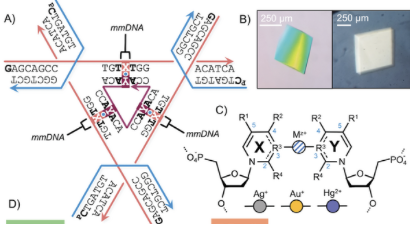
Metal Mediated DNA Tensegrity Triangle (Source: ResearchGate)
There are so many concepts and experiments related to DNA nanotechnology that I explored during my time in the lab. But the best part was that I was actively contributing to these experiments. I learned how to work with the materials, mix DNA strands, plate DNA crystals and analyze them. This was an incredible experience that I will never forget. I had the opportunity to observe real scientific breakthroughs. My time in the lab completely transformed my understanding of DNA, a topic I thought I already knew very well, and gave me a new perspective on how it can be manipulated to save lives someday.
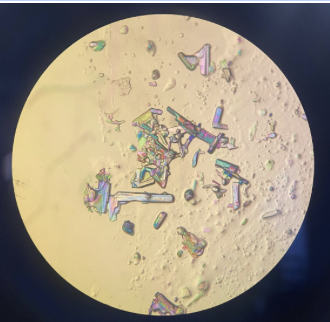
DNA crystals I saw and worked with under the microscope (Source: Lucia Mastroianni)