As children, many of us once believed the only way to live forever was through magic or in fictional stories with some crazy science. However, as we know, immortality is simply not a reality. But there may be an exception for people living in Blue Zones. They tend to live longer and healthier lives than almost everybody else, producing a disproportionately high number of centenarians compared to most other regions in the world.
What exactly are blue zones? They are geographic regions where cultural and lifestyle practices lead to notable longevity, with many residents living beyond ninety years old or even beyond one hundred. One major characteristic of people from blue zones is their diet, which is heavily plant-based and clean. Beyond diet, their lifestyles are characterized by low-intensity activities, little or no alcohol, and low stress. Just as important, the individuals who live in these regions are often connected and deeply committed to their rituals. This raises an important question: should we be incorporating these practices into our daily lives?
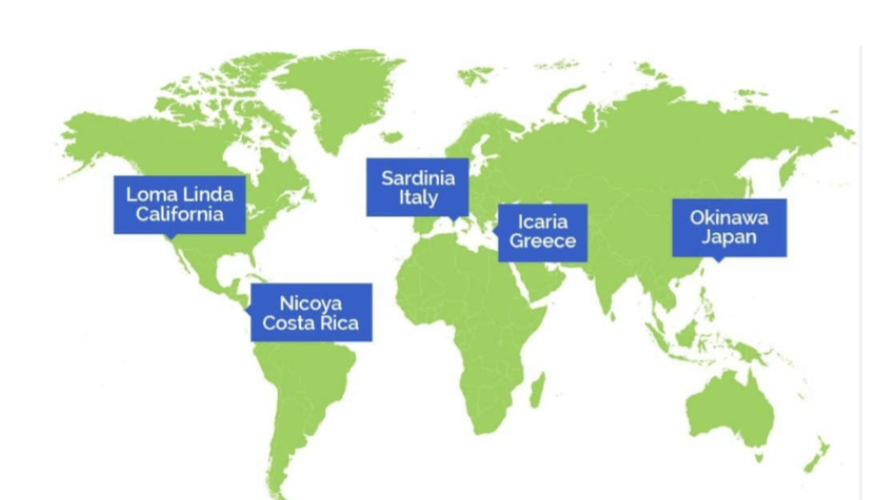
Blue zones have been the focus of extensive study, largely thanks to research done by Dan Buettner, an explorer, researcher, author and founder of Blue Zones, as well as scientists from the National Geographic. There are five recognized Blue Zones around the world, located in Okinawa, Japan; Sardinia, Italy; Nicoya Peninsula, Costa Rica; Ikaria, Greece and Loma Loma, California.
Source: Jamestown Spine
While there are many similarities among the five, there are also some differences. The most distinct commonality is the cultural diet they all share. The societies in each of the five different locations survive on plant-based diets. Vegetables, beans and nuts, often locally grown, make up the foundation of their meals, while meat is consumed rarely, both because it’s expensive and not as accessible. Portion size is another common characteristic. People follow the 80% rule, tending to eat until they are satisfied, and not overly full at 100%. The lifestyle in Blue Zones tends to be slower and less stressful, with a heavy reliance on farming and a more active daily set of activities. Movement throughout the day is usually seen as natural rather than a workout, such as household chores, walking and gardening.

Source: Alina Health
While diet is a common characteristic among all Blue Zones, exactly what people eat is distinctly different in each of the regions. In Okinawa, Japan, for example, people eat lots of sweet potatoes, tofu and soy as their primary source of protein. While in Sardinia, Italy, they eat more bread, beans, green vegetables, and pecorino cheese, with local red wine consumed regularly but in moderation. Lastly, as many may imagine, in Ikaria, Greece, they rely on a more Mediterranean diet with olive oil, vegetables and goat milk. As mentioned, while red wine is more common in Sadinia, it’s almost nonexistent in Loma Linda, California. Many people in Loma Linda are Seventh-day Adventists; they follow a strict diet and avoid alcohol.
A common criticism of Blue Zones is that their isolation might lead to mental health concerns. However, the opposite is often true; people in Blue Zones feel well-connected with their families and communities, which provide a sense of belonging and support. Constant activity keeps them engaged, making them feel that they have a sense of purpose.
The big question is whether characteristics from Blue Zones should be incorporated into modern lifestyles. The unequivocal answer should be yes! People who come from Blue Zones consistently achieve the longevity I’ve described. However, according to research, moving to a Blue Zone, instead of being a native, does not lead to the same outcome. But at the end of the day, the characteristics of Blue Zone living are healthy and lead to admirable outcomes. So why not adopt the same way of living? Fieldston students and families would be better off if they included these aspects of living in their daily routines. We should all give it a try and no, we don’t need magic!