United States
United Kingdom
Canada
China
Germany
India
Kazakhstan
Türkiye
United Arab Emirates
The above is a list of some of the many countries from where I made friends this summer. I had the fortune of spending a month at the University of Pennsylvania, doing a course on theoretical computer science called PACT (Program in Algorithmic and Combinatorial Thinking). On a sunny June afternoon, the air filled with the smell of freshly cut grass and hum of families helping their kids move in, I dragged my suitcase into Lauder College House, nervously anticipating a rigorous month of proofs and counting. However, what I did not anticipate was the global community awaiting me, making the experience twice as enriching.
I was part of PACT Group 1with Dr. Rajiv Gandhi– a hands-on professor who teaches at the University of Pennsylvania and Rutgers University, Camden. In group one we covered many topics that laid the foundation of the math behind computer science: counting, proofs and probability, to name a few. Among the proofs we learned, Dr. Gandhi introduced us to induction: a topic that I had already covered at Fieldston, but this time we went past the banal ladder of operations one is forced to climb. We learned about strong induction, a more powerful tool when it came to proofs. It quickly became my favorite topic!
An easy way to explain strong induction is to use monkey–banana terms. Picture a monkey climbing a tree: in weak or standard induction our base case would be the monkey on the first branch. On the one hand, our weak induction hypothesis would be, “if the monkey can reach branch (k), then it can reach branch (k+1).” On the other hand, for strong induction our base case would be the monkey on the first branch, and the strong induction hypothesis would posit, “if the monkey can reach, from branch 1, all the branches up to branch (k), then it can reach the next branch (k+1).” This tool opened doors by condensing problems, especially those featuring sequences or integers with divisibility properties.
Although the lectures were intense, we spent evenings after class exploring Penn’s campus and enjoying a slice of college student life and its responsibilities. My favorite facet of our simulated college experience was the diverse, tight-knit community we built by the end of the four weeks. Especially during the weeks we had tests or a hard set of homework problems, we would come through for one another by offering hints, company and ramen. By the end of the program, we ventured through the arteries of University City and even tried all of the restaurants within half a mile radius. Our housing organization, BOLD summers, also organized trips over the weekends to Downtown Philadelphia, bowling alleys, arcades, beaches and even a Yacht party!
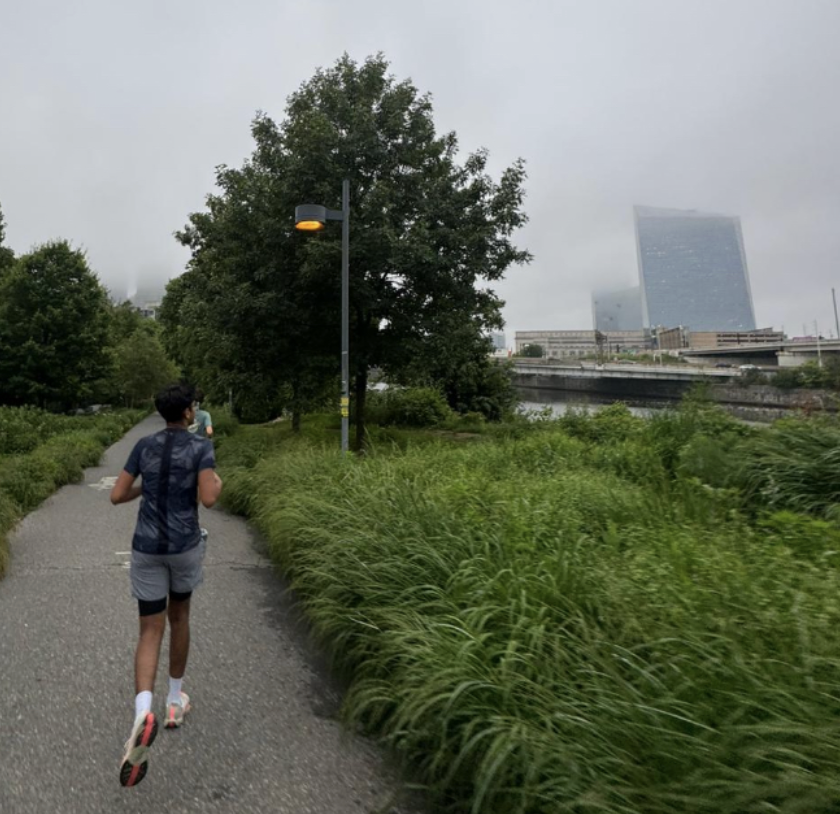
Running along the Schuylkill River Trail (Source: Aarav Dalal)
Philadelphia provides an excellent escape for runners and cyclists alike. The Schuylkill River Trail is a picturesque 30 mile, multi-use path that stretches from Central Philadelphia to Parker Ford, Chester County, PA. The trail features all there is to see in Philly: the skyline, the Philadelphia Museum of Art (where the iconic scene from “Rocky” was shot) and a close vantage point of the vibrant rowing community along the Schuylkill river. My favorite time to go for a run was in the morning before classes began. The tranquil view and the smell of dew paired with the cool breeze made it one of the best places to run.
Looking back, the whole program vaguely reminded me of Fieldston. The driven, inclusive community along with the exemplary learning environment took me back to our nest on the hill.
All in all, my summer at Penn was an intellectually and socially enriching experience. I made lifelong friends, learned intriguing things and overall had an unforgettable time. If any underclassmen or juniors are considering applying to PACT or any program at the University of Pennsylvania, I would strongly encourage them to do so. My month at Penn did not just sharpen my proofs but broaden my global perspective.