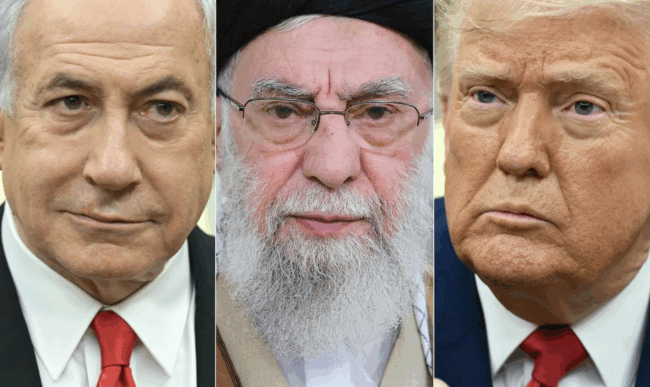
“We basically have two countries that have been fighting so long and so hard that they don’t know what the f*** they’re doing,” President Trump said to the press shortly after the Iran/Israel ceasefire he had taken credit for and boasted about less than a day earlier. Trump, unlike any of his presidential predecessors, thought that dropping a few bombs on Iran’s nuclear enrichment sites would abruptly solve the decades-long battle between Iran and Israel; apparently, that does not seem to be the case. Trump’s obvious frustrations appear to be a sign of a bumpy road that lies ahead, and perhaps expose the shortcomings of his brand of diplomacy by might.
The Middle East appears to be at a crossroads, with many questions as to what happens next. With a fragile ceasefire that hangs in the balance, Iran and Israel are in uncharted territory when it comes to their conflict. Israel’s attack on Iran has clearly demonstrated its military prowess and exposed an incredibly vulnerable Iran. The lopsided exchange between the two countries, with Israel in total control militarily, has shocked the world. The Israeli defense system, known as the Iron Dome, has significantly mitigated structural damage and civilian casualties, while a less effective defense on the Iranian side has seen a decimation of military leadership, nuclear scientists, state media centers and innocent civilians. The US involvement vis-à-vis the surprise bombing of the three nuclear enrichment sites of Isfahan, Fordo and Natanz stunned the world. As a result, there have been questions regarding the leading mullah group run by the Supreme Leader Khameini and the potential stepping up of the Islamic Revolutionary Guard Corps (IRGC) in a position of greater power. With the so-called “Axis of Resistance,” which includes Hamas, Hezbollah and Houthi groups weakened by Israeli attacks, the power vacuum in the region has further destabilized this area of the world.
Constantine Svoronos, a recent Fieldston graduate and Fieldston News reporter, who has written extensively on international affairs and crises, has graciously made himself available to share his opinion on the Iran/Israel ceasefire and what comes next. In a wide-ranging exchange that covers aspects of the conflict, Svoronos helps our readers understand the political landscape of the region and offers some insights as to what the future may hold.
SF: There have been some concerns as to what will happen to the current regime in Iran. The world view of the nation has changed since its anemic response to Israeli attacks. Some experts believe another hard-line group, the IRGC, may pose a threat to the Supreme Leader Khameini, and their power and control may be ascendant. What do you think will happen to the Iranian regime?
CS: I imagine that the current Iranian regime will remain wholly intact. I think that, with the exception of a major uprising on the part of the Iranian people, no global actor is really going to be willing to face all the challenges and struggles that would come with overthrowing a powerful authoritarian government that rules over nearly 100 million people. Israel, for example, while it may desperately wish for an end to the current dictatorship in Iran, would not incur the huge existential risks of increased global isolation and total war with Iran that would come about with attempting to overthrow the Iranian government. As for the United States, the truth is that most Americans these days, from the left, right, and everywhere in between, would not support the kind of major American involvement in Iran that would be necessary to truly overthrow the government. Nowadays, with mass governmental surveillance becoming easier and easier and with covertly forming dissident political groups becoming harder and harder, a successful overthrow of the Iranian regime by its people is not feasible. While many Iranian people may wish for this, many support their government too, and in this situation, the regime is safe, for now. I believe that the status quo of Iran’s government will be upheld. I could imagine increased authoritarian measures being instituted by the government as a means of ensuring that those in power remain in power in these increasingly troubling times for Iran.
SF: Since the U.S. bombing of the nuclear enrichment sites in Isfahan, Fordo, and Natanz, there have been initial assessments that there was severe damage to the operations that will significantly set back the nuclear program in Iran. What do you think will happen to the Iranian nuclear enrichment program?
CS: So far, different people have said different things about the effect of the American attacks on the program. However, it seems likely that not as much damage was done as intended, and that the Iranians still hold on to some degree of their enriched uranium. Nevertheless, there’s no doubt that the Israeli and American attacks have done some major damage to the program and its leaders. But for those in power, this is likely a mere setback. In reality, the incentive for the Iranian regime to continue its pursuit of nuclear weaponry remains strong, and maybe even stronger than ever. Nuclear weapons can nearly ensure a nation’s survival, as no other state is likely to want to risk nuclear war in order to overthrow another. The Iranians (and the Israelis and Americans) know that once Iran has their hands on a nuclear weapon, it becomes a much more serious force to reckon with. So, it is likely the Iranians will continue their nuclear enrichment program, albeit with potentially more secrecy this time.
SF: For decades, Iran has waged a shadow war with Israel through the use of proxies in the Middle East, which they have funded, such as Hamas, Hezbollah and Houthis. Israel has strategically attacked and weakened this group, the so-called “Axis of Resistance,” over the last 18 months. Now with Iran on its heels militarily, what do you think will happen to the proxy groups that Iran used to wage its previous shadow war with Israel?
CS: Iran’s various proxies across the Middle East have already been hugely debilitated in the time since October 7. Syria’s Assad has been deposed, Hamas has been hugely weakened, and Hezbollah, which did not join the war between Israel and Iran, has also seen its power greatly decreased. The Houthis, though they continue to be a nuisance in the Middle East, especially for Israel, have also seen their capabilities decrease. While other, smaller groups also fall under Iran’s “Axis of Resistance,” all the main groups have had their power severely limited. In spite of this, however, the fight against Israel is one of the most fundamental parts of the Iranian regime’s entire existence. So while I think they have faced major setbacks, I think Iran will attempt to continue to fight against Israel by any of the means that it can. One of Iran’s worst fears is that of a real, genuine Arab and Saudi coalition that features Israel as a full member, and by forcing Israel into constant wars in the Middle East, Iran prevents Arab nations from wanting to side with Israel, stopping that coalition from truly forming. Iran does not have infinite economic or military resources by any means, but it will likely continue to use what they have in an attempt to keep fighting Israel.
SF: For decades, Iran has been financially hobbled by sanctions levied by Western nations due to their unwillingness to give up their nuclear program, in addition to funding terrorist groups. As a result of this recent war, and now fragile ceasefire, what do you think will happen to Iran’s economy?
CS: I am not super well educated on the nature of the Iranian economy, but I can try to give a brief answer. Iran’s economy has already seen years of decline. Sanctions and other measures mean that the nation’s ability to participate in the global economy is seriously restricted. While the current attacks may not have as major an impact on the Iranian economy, I think that they do force Iran to keep rebuilding its military and defense capabilities, which requires money, a thing they don’t have a whole lot of. Iran’s economy is one of its main weaknesses, and as long as that continues, Iran is limited in its ability to wage war.
SF: While there is a ceasefire in place, and even if the war comes to an end, there is no love lost between Iran and Israel. Now that the US has entered the fray, they are now entangled in this conflict. Nations never forget the past. Twain famously said, “History doesn’t repeat itself, but it often rhymes.”. We have seen the aftershocks of terrorist attacks after wars have long ended. Do you think there will be some type of retaliation or terrorist attack later down the line, either in Israel or the United States?
CS: I think it’s hard to say, especially since terrorism could come from so many sources. I think, sadly, Israel is certain to continue to face terrorist attacks or threats from some or all of the various groups that seek to end its existence. On the other hand, I believe that for Iran to back a terrorist attack against the United States would (on top of being an evil thing to do) be a strategically stupid thing to do. As I said earlier, a good majority of Americans do not want to enter a full-on war against Iran at the moment. That reality has the potential to be turned on its head were Iran to initiate a major terrorist attack against the United States. Not only does Iran have little incentive to do that, as that would not come close to posing a threat to the existence of the United States, but that would be a thing that could genuinely result in the toppling of the Iranian regime. However, I do think there are rogue groups that just hate America and Israel so vehemently, they simply wish for death and destruction to reign down upon those countries, no matter the strategic significance of those actions. For example, the flag and slogan of the Houthis feature the phrases “Death to America” and “Death to Israel.” Many other groups also chant these slogans frequently. Motivated by pure hatred, anyone may engage in terrorist attacks against anyone, so I think there is no real saying either way for sure.
While there are no absolutes in geopolitics, no one knows for sure what will happen next now that a temporary ceasefire has been brokered between Iran and Israel. The war between Israel and Iran, in addition to the US involvement, has no doubt further destabilized the region. There are many questions that are left to be answered since the Iran/Israel ceasefire, chief among them: What now?
Thank you to Constatine Svoronos for shedding light on the landscape of this overarching question and shaping some of the answers.