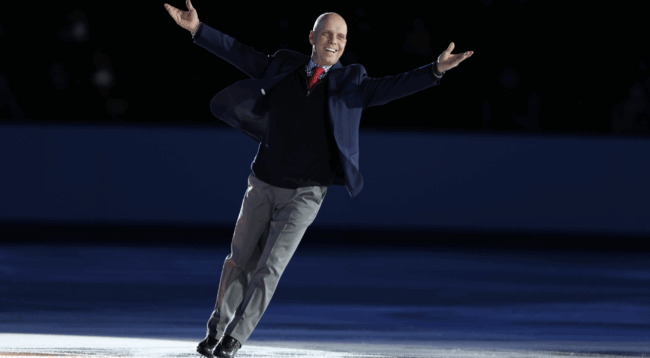
American flags waved fervently amongst the roaring sea of spectators gathered inside Zetra Ice Hall on a cold February day when 25-year-old Scott Hamilton finished his free-skate routine. The American figure skater placed first at the 1984 Winter Olympic Games in Sarajevo, Yugoslavia (present-day Bosnia and Herzegovina)—bringing home the United States’ first gold in men’s figure skating in 24 years.
Since that historic victory, Hamilton has become a household name, not only for his extraordinary achievements in figure skating, but also for his role as an NBC television commentator and work as a dedicated philanthropist through the Scott Hamilton CARES (Cancer Alliance for Research, Education and Survivorship) Foundation.
Yet, few figures in American sports have so meaningfully transformed their personal triumphs and tragedies into a life devoted to public service. After losing his mother to cancer in 1977 and his own diagnosis of Stage III testicular cancer in 1997, Hamilton began a lifelong commitment to cancer advocacy and research.
Founded in 2014, the Scott Hamilton CARES Foundation supports and funds innovative cancer research. Among its initiatives is Sk8 to Elimin8 Cancer®, a national program that mobilizes local skating communities to raise funds and awareness through performances and events.
I recently had the privilege of speaking with Mr. Hamilton about his extraordinary journey of turning “passion into purpose.”
Sarah Damon: Your journey—from losing your mother to your own battle with cancer—has involved so much personal adversity. How were you able to turn such profound challenges into a mission that now brings hope and healing to so many others?
Scott Hamilton: Losing my mom to cancer changed everything. She was my rock, my biggest cheerleader, and when she passed, I was heartbroken. Then, years later, I heard those same three words “You have cancer.” Suddenly, I was on the same path she had walked. But instead of fear, I felt a strange kind of clarity. I knew I wanted to use my platform not to dwell in the pain, but to do something with it. I wanted to change the way people experience cancer, to fund smarter research, and to give patients and families hope. Turning adversity into purpose is the greatest form of healing I know.
SD: As someone who has competed at the most elite level in sports, what values from your time as an athlete have shaped the way you approach advocacy and leadership?
SH: Figure skating taught me a lot more than just how to land a jump. It taught me how to get back up. I fell thousands of times on the ice, and every single fall was a lesson in resilience. As an athlete, you learn discipline, focus and the importance of working as a team even in an individual sport. That mindset shaped how I lead today with determination, humility, and a belief that every setback is a setup for something greater. Whether in sport, cancer or life, we keep showing up. That’s how we win.
SD: The Sk8 to Elimin8 Cancer® program is such a unique and inspiring initiative. How has combining your background in skating with your work in cancer advocacy helped the way the public connects with this cause?
SH: Skating was always my first love, and I wanted to find a way to use it for something bigger than medals. Sk8 to Elimin8 Cancer® was born from the idea that everyone can do something to help, and why not make it fun, active and community-driven? It gives skaters both young and old a way to turn their passion into purpose. Watching local rinks and families come together to raise funds is one of the most inspiring things I’ve ever seen. It makes cancer advocacy personal, joyful and empowering.
SD: There are many organizations working to fight cancer. In your view, what sets the Scott Hamilton CARES Foundation apart in the way it supports both research and the patient community?
SH: What makes CARES different is that we’re not just focused on fighting cancer; we’re focused on changing the experience of cancer. We invest in research that treats the cancer while sparing the patient—it’s about connection. It’s about hope that’s backed by science. And because we’re small but mighty, we can be nimble and personal while making a big national impact.
SD: With 98 research grants already funded, the CARES Foundation has become an incredible national movement. What are your hopes for how the foundation will continue to shape the future of cancer research and patient care?
SH: My dream is that CARES becomes a force that helps accelerate the most promising science and makes it available faster to the people who need it most. I want us to keep funding game-changing research, especially in areas like immunotherapy. But just as importantly, I hope we keep telling the stories of patients, researchers, and families when people connect to the mission, they become part of the solution. That’s how we change the future: together.
SD: What advice would you share with young athletes, not just about striving for success in their sport, but also about finding purpose and making a difference beyond the competition?
SH: I’d tell them: your sport is a gift, but it’s not your whole identity. Use it to learn who you are, to grow strong in character, and then look for ways to use what you’ve learned to serve others. Don’t be afraid to dream big but remember that impact often starts small. Be kind. Be resilient. And know that real greatness comes not just from what you accomplish, but from how you lift others along the way. That’s the legacy worth chasing.
Thank you, Mr. Hamilton, for taking the time to share your insights and experiences with the Fieldston News. Your journey and dedication continue to serve as a profound source of inspiration for myself and many other young athletes. We are truly grateful.