

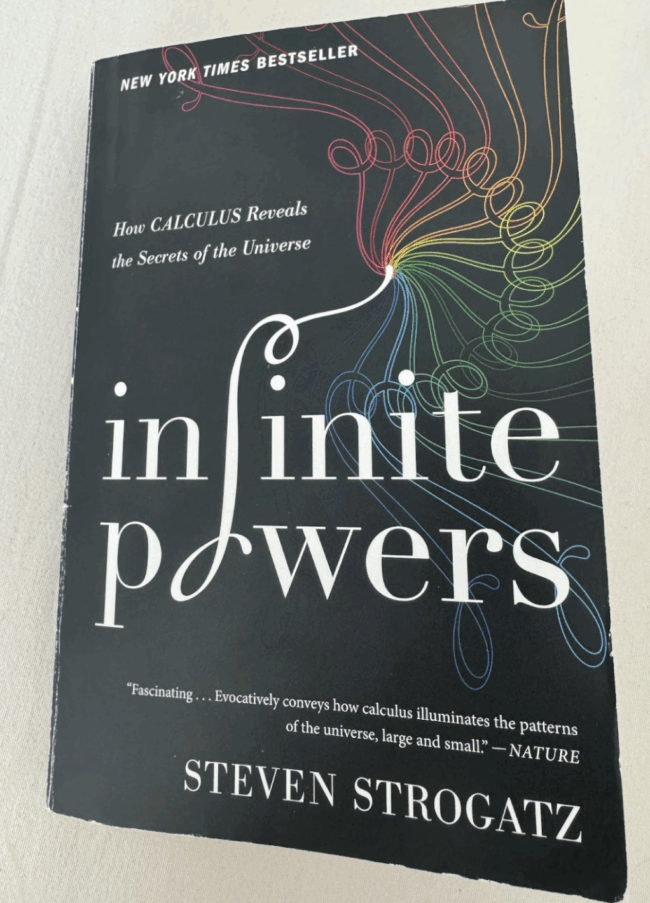
To the fourth-century philosopher and theologian Saint Augustine, infinity was “too incomprehensible for the human mind.” Yet, in his New York Times bestselling book, “Infinite Powers,” applied mathematician Steven Strogatz contends that humanity has not only dared to confront this unfathomable concept, but has learned to use it through the mathematical discipline of calculus. In Strogatz’s hands, the infinite transforms from a philosophical impasse to the very foundation for understanding reality.
Calculus is the mathematics of change, the defining constant of existence. As Henry David Thoreau once wrote, “All change is a miracle to contemplate, but it is a miracle which is taking place every instant.” By partitioning space and time into infinitesimal pieces, calculus addresses the two fundamental mysteries of the physical world: curvature and motion. It enables scientists and engineers to model everything from planetary motion to the way light bends to the behavior of epidemics with staggering precision.
Yet, calculus rests on a paradox. Strogatz argues that infinity is calculus’s “original sin” — the source of its astonishing power and its logical peril. Dissecting reality into endlessly small parts raises ontological quandaries. How can adding an infinite number of infinitesimally small quantities yield a finite result? In other words, summing “infinitely many nothings” shouldn’t amount to something, and strangely, it does. Time and time again, calculus works—predictably, repeatedly and somehow precisely. “The one represents the many and stands for it,” Strogatz writes, “representing it perfectly and faithfully.”
Quoting Picasso’s remark that “art is a lie that makes us realize truth,” Strogatz suggests that the infinite in calculus functions similarly: an “elegant fiction,” an abstraction that, while not literally accurate, reveals hidden truths about the natural world. Though infinity itself eludes complete comprehension, it nonetheless remains instrumental in explaining other fundamental mysteries of the universe. According to Strogatz, infinity is “the numerical counterpart of something deep in our psyches, in our nightmares of bottomless pits, and our hopes for eternal life.”
The book takes readers on a historical tour. It begins with the work of Archimedes, the ancient Greek mathematician whose treatise, “The Method,” was believed lost until its rediscovery in 1906. The writings, recovered from a palimpsest in a Byzantine prayer book, contain Archimedes’ use of infinitesimals to calculate areas and volumes; the Sicilian had anticipated integral calculus by over a thousand years. Archimedes hoped his work “would survive the seas of time and be appreciated by a more modern world,” Strogatz writes. In the late sixteenth century, Galileo Galilei of Pisa resumed his line of inquiry by demonstrating that existing mathematical tools inadequately described continuous change, through his experiments on motion and falling bodies. The French mathematician and philosopher René Descartes further advanced the field in the early 17th century by introducing a coordinate system that formally linked geometry and algebra.
In the late seventeenth century, at the dawn of the Age of Enlightenment, these earlier developments culminated in the formulation of calculus by Isaac Newton in England and Gottfried Wilhelm Leibniz in Germany. They discovered that by breaking complex phenomena into infinitesimal parts and reassembling them—processes known as differentiation and integration—they could accurately model the natural world. Even more remarkably, they realized these two central operations are inverse processes, a relationship later defined as the Fundamental Theorem of Calculus.
Physicist Richard Feynman, once a young scientist working on the Manhattan Project, once called calculus the “language God talks.” Robert Montera, who teaches 9th grade history at Fieldston, says “it helps to map the contours of our realities.” While Newtonian physics breaks down at the subatomic scale, Newtonian calculus remains applicable. Strogatz asserts that the enduring relevance of calculus across centuries makes it humanity’s most powerful tool for understanding the universe.
Erudite without being esoteric, Infinite Powers is no daunting academic text meant only for mathematicians. Strogatz delivers a deftly written exploration of calculus and its role in shaping the modern world. For those interested in math, science, philosophy or the history of ideas, this book is an essential read.
Ultimately, Infinite Powers is a beautiful tribute to human ingenuity. It is a grand narrative about the power of the infinite, and, despite the warning from a particular bishop from Hippo, the incredible minds who dared to tame it.
