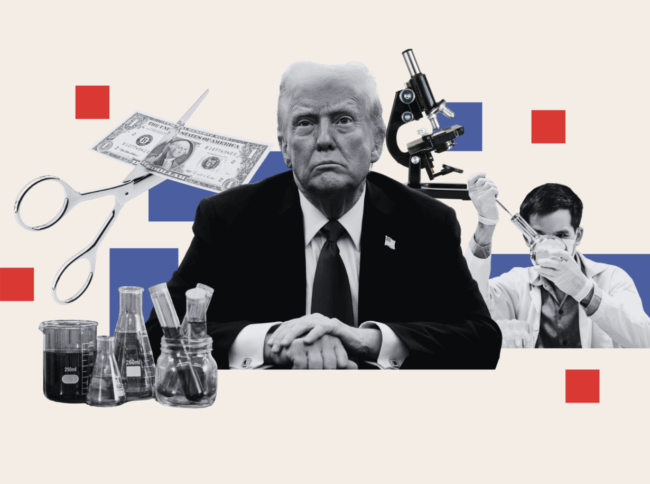
Donald Trump’s second presidency, which began on January 20, 2025, has already brought about changes that have drastically affected science and healthcare, and for many, these are deeply concerning. Major federal funding cuts have forced research projects across the country to shut down, with the National Institutes of Health (NIH) facing an estimated $5 billion loss in federal funding. As a result, laboratories are struggling to obtain the funding they need for their research projects, forcing them to lay off staff, shut down or operate on tight budgets. With these abrupt policy changes, the future of American science and healthcare innovation has suddenly become uncertain.
On January 27, 2025, the Trump administration introduced a controversial policy that capped indirect cost reimbursement for research grants at just 15% of the total expenses. This means that research projects are given significantly less money for indirect costs, which typically help institutions cover vital expenses such as lab maintenance, utilities and support staff. This number previously ranged from about 30-60%. The policy was implemented to reduce what the administration sees as high government spending, but these cuts have had a significant impact on science and healthcare.
This sudden change threatens the financial stability of research institutions that rely heavily on federal grants. Many are now struggling to keep labs open, pay staff, and continue essential projects. “The administration is very concerned with cutting government spending, and science agencies like NIH and NSF are one of the targets,” said Fieldston’s Science Research class teacher, Dr. Koppa. With frozen funds, many principal investigators (PIs), the scientists who run research labs, can’t access their grant money. The administration also temporarily froze the NIH grant review process, delaying funding decisions for both new and ongoing projects. This suspension risks delaying critical scientific and medical advancements and creates financial uncertainty. “There are career scientists who have spent their whole lives tracking data. NOAA has collected climate data for as long as I can remember… These scientists are being fired, retiring, or switching fields. A backbone of researchers who have provided steady data forever, we are losing them,” said Fieldston biology teacher Ms. Repole.
Universities are among those most affected by funding cuts. In New York City, Columbia University is projected to lose $111 million in NIH funding, NYU may lose around $63 million, Icahn School of Medicine at Mount Sinai could lose up to $93 million and Weill Cornell is estimated to lose $55 million. These massive cuts don’t just impact researchers; they affect future scientists, including current high school students looking to work in science fields. As labs close and budgets shrink, research opportunities for high school students, and our futures, are disappearing quickly. Koppa explained, “Universities are rescinding offers for PhD programs, and they are accepting fewer and fewer students.” Repole similarly expressed, “Universities can’t recruit new people into science positions because there’s no funding… It’s concerning for young people looking to pursue careers in STEM.”
The administration’s cuts go beyond affecting research. The administration has issued executive orders eliminating federal grants entirely for projects related to diversity, equity and inclusion (DEI). Grants have been canceled for studies such as those looking into Alzheimer’s disease and other forms of dementia in LGBTQ+ adults, with the argument that “Research programs based on gender identity are often unscientific.” This wording comes straight from termination letters for these projects. Advocates warn that cutting these programs affects marginalized groups and undermines health equity. “As a country, we have always invested in research and development for rare disease treatments and vaccines in the interest of public health,” said Repole. “There seems to be a reversal in that trend right now,” she asserted. The impact of these federal funding cuts influences public health needs. Research projects that develop essential treatments and create innovative medical and scientific discoveries could be shut down. And when these programs are unsupported, communities that rely on medical advancements and accessible healthcare suffer as well.
As critical research projects lose funding, Repole speaks to her concerns about the future, “What will we see in the fall? Will we still have access to our annual flu vaccine? Things we take for granted, like yearly vaccines, could be at risk.” These cuts and policy changes raise concerns about the long-term stability of scientific research and innovation. With so much uncertainty ahead, it’s hard not to worry about what will be left for future generations. Will the opportunities and programs that we have come to depend on still be around?