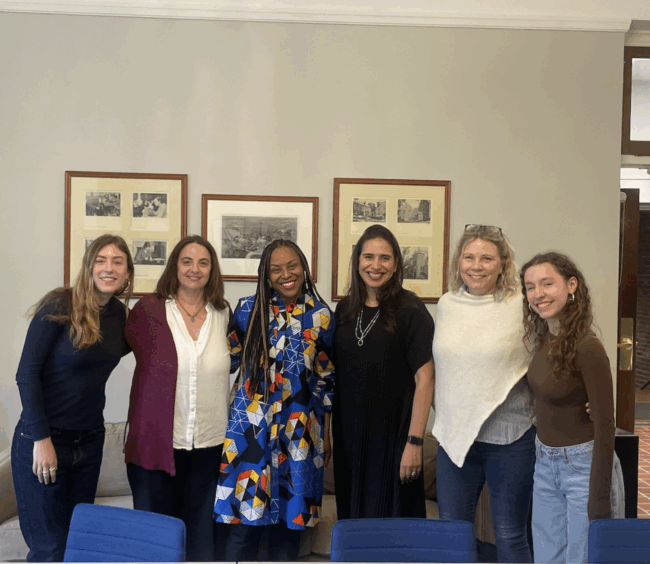
On Friday, April 11, Fieldston’s Reproductive Rights Club hosted its second panel of the year—a thought-provoking and educational conversation with three OB/GYNs working at the frontlines of reproductive healthcare. The event brought together Dr. Kameelah Phillips (Calla Health), Dr. Rachel Friedman (Northwell Health) and Fieldston alumna Dr. Ana Cepin ‘91 (New York Presbyterian) to provide a clear view of the challenges patients and providers now face.
The conversation resumed where a similar October panel left off, delving deeper into the real-world impact of political and legal restrictions on reproductive care. The panelist explored the vast challenges doctors face, the lives impacted by recent laws and what it means to continue fighting for access to healthcare in a constantly evolving environment. Students and faculty gathered, ready to listen and ask difficult questions.
“I came up with the idea for this panel because there is so much news surrounding reproductive rights today, and I wanted the Fieldston community to learn about how it affects different communities directly from OB/GYNs experiencing it firsthand,” shares Form V student and reproductive rights club co-leader Margot Pliska.
The conversation opened with a powerful reminder from Dr. Cepin: “Abortion is part of healthcare.” She discussed situations where pregnancy can be dangerous or even life-threatening, describing several medical reasons why someone may need an abortion. “A pregnancy might be complicated by cancer, where you need to start treatment, or you discover a genetic or anatomical anomaly that’s not compatible with life.”
Dr. Friedman added a broader perspective: “Stats show that anywhere between 16% to 35% of homicides in pregnant women are due to intimate partner violence. So, social reasons matter too. Some women can’t safely continue a pregnancy if they’re in an abusive situation.” But it is not merely about access, it is also about fear. In states with restrictive abortion laws, providers risk legal action for doing what used to be routine care. “It’s putting providers in a position where they have to wait until it’s life-threatening and be able to defend that versus having to think about going to jail,” said Dr. Cepin. “So now there’s this real, almost desert in certain areas where people don’t want to practice because you have your family, things you care about, and I personally don’t know if I could put myself in that position—watching someone be so sick and not able to take care of them.”
That disconnect between medicine and politics was underscored in discussions regarding ectopic pregnancies—pregnancies that implant outside the uterus and are never viable. Dr. Friedman criticized lawmakers’ medical ignorance. “You have absurd suggestions from legislators like ‘move the pregnancy to a different location’, which is something that doesn’t make any sense.” The panel also highlighted issues of equity, specifically the disproportionate toll of poor maternal health outcomes on racially diverse communities.
“The current state of black maternal health did not become so in a vacuum. Black women in labor are, depending on where you look, three to four times more likely to die in some places, like in the Bronx, that number is even higher,” explained Dr. Phillips. She adds how these disparities stem from the legacy of slavery and a healthcare system that historically devalued black people. Dr. Phillips then urged the attendees to research the term “social determinants,” explaining how in this country, “we all live, pray, have hospitals very differently from one another. And this ongoing trend has continued to impact how black women receive and engage in the medical community.”
In her work abroad, Dr. Phillips has seen systems that challenge the assumption that the U.S. provides the best care. She explains how when she travels to countries like Cuba, she sees a “fabulous system, even though we tend to look down at that island as a third world.” She adds, “Their medical system and training is amazing, as are other countries we tend to look down on. America’s one of the most, if not the most, dangerous places to have a baby when you look at all the quote unquote first world countries.”
Dr. Cepin, who works closely with Latino communities in Washington Heights, tied health disparities to broader systemic issues. “80% of health outcomes are tied to social determinants of health,” she said. “A lot of this came to light around COVID because it was the epicenter where people were of poor backgrounds living in multigenerational homes, essential workers had underlying conditions that made them work as they did not have a primary doctor…So it was this grand awakening for people.” She also described how even the language of equity is now under threat. “Given there are all these words we’re not supposed to use anymore, how are we going to address these problems?”
In response to a question regarding the causes behind black maternal mortality, Dr Phillips explained, “It’s not genetic…There is a bias in medicine. There is racism in medicine.” She emphasizes how this is not always conscious but is systemically rooted. “It’s just like that…If one patient is wealthy, am I going to treat that patient more carefully than someone who is an undocumented immigrant, who just crossed over the border and is here alone?” Dr. Phillips continues, “I want to think I’m providing the same, but is there a time where I’m found prioritizing one life over another? We’re all human, so probably. And that’s why it’s really important for us to put these systems in place—to reduce harm caused by those biases.”
The conversation took on a more urgent tone when a student asked, “What can we do to help? Given that we’re teenagers, and don’t have any money or power…”
Dr. Phillips replied, “There’s a lot you can do. And listen, you’re broke now, but you’re not going to be broke your whole life.” She adds, “Your advocacy and activism grow with age.” Dr. Phillips encourages students to speak up when someone says something inaccurate and to “challenge people who vote differently, donate, et cetera, on whatever their biases may be.”
Despite legal challenges and funding cuts, Dr. Cepin explained how she remains motivated. “It’s just gotten harder, but we’re doing what we did before.” She shares how she’s gotten better at providing space for crying patients, but this does not come without challenges. “We walk into the next room, and they’re mad because you’re late and I’m trying to explain that I would do that for you, too, if you were crying. And even if you’re not today, maybe you will be next year.”
The panel ended on a reflective note: “Try to be thoughtful to your fellow humans. It’s not a restaurant.”
Ultimately, the message was clear: the fight for reproductive rights is urgent and ongoing. At Fieldston, students are listening carefully, asking thoughtful questions and preparing to navigate a post-Dobbs climate.