“Without music, life would be a mistake” are surprisingly poetic words from one as austere as Friedrich Nietzsche. Yet, as I carried my violin case across the campus quad, bathed in the fading light of a golden spring evening, I understood why music — of all things — had so profoundly touched the German philosopher famed for his critiques of sentimentality.
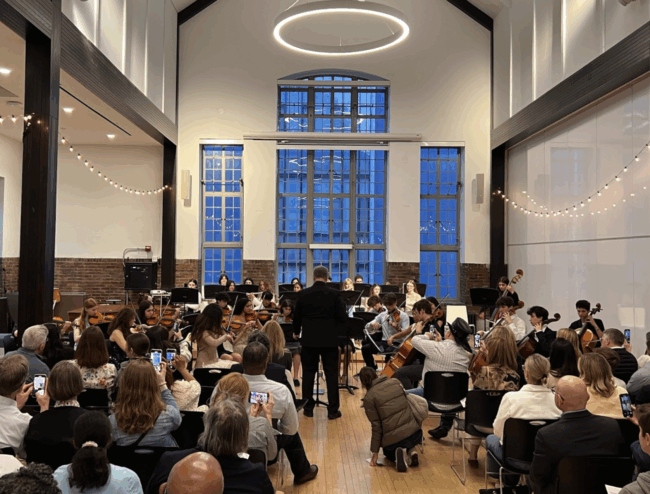
On Tuesday, April 29th, Fieldston High School Orchestra and Jazz Ensemble held a concert in the Student Commons. The brilliant rays of the setting sun poured through the tall windows, casting a warm glow over an eager audience as the two groups performed a vibrant and eclectic program.
The Jazz Ensemble opened with “Cute” by Neal Hefti, then launched into an energetic arrangement of “Sweet Dreams (Are Made of These)” by Eurythmics, reimagined by the Soul Rebels. The Orchestra followed with Soon Hee Newbold’s dramatic “Gravitas” and concluded with a spirited rendition of the timeless “Hungarian Dance No. 5” by Johannes Brahms.
Gizem Yucel, the Strings Director, commented on the evening’s repertoire. “It’s an exciting program to play,” she said. “We get to play a wonderful piece by Brahms—Hungarian Dance—which is very well-known. It’s hard, but we are challenging ourselves.” She also noted the appeal of Newbold’s contemporary composition, “‘Gravitas’ is a great piece for us to discover the sections separately and hear how the winds are carrying the long tones while we’re playing the motor on the violas and second violins.” Looking ahead, Yucel expressed her hope that the orchestra will continue to grow, aspiring one day to expand it into a full philharmonic ensemble.
Brahms’ Hungarian Dance No. 5 is among his most celebrated and enduring compositions. In the early 1850s, while still a young and relatively unknown musician, Brahms encountered the Hungarian violinist Eduard Reményi in a tavern and subsequently toured with him. During their travels, Reményi introduced Brahms to the vibrant rhythms and melodies of Hungarian csárdás dances and Romani musical traditions. Enthralled, Brahms was inspired to compose his Hungarian Dances—a set of 21 works originally written for the pianoforte. The first ten dances were published in 1869, followed by the remaining eleven in 1880. These pieces were later arranged for full orchestra, both by Brahms himself and by other composers such as Antonín Dvořák. As the California Symphony observes, in orchestrating these works, Brahms “transforms the intimate drama of the Gypsy band into a big orchestral party—with wild string melodies and brassy foot-stomping rhythms.”
Prior to the concert, Tom Christensen, Chair of Fieldston’s Music Department, expressed his enthusiasm, stating, “This is a new concert we added this year, so I’m looking forward to it and curious to see how it turns out.”
For Eric Gilley, the Band Director, the concert was as much a reflection of diligence as it was to musical skill. “It’s always great to put on a concert to show the effort that you put in by creating the music and putting the music together,” he remarked, “You finally get to see your efforts come to realization.” This spring, the rehearsal schedule was anything but routine, disrupted by a succession of holidays that left little time for the ensemble to meet. “We never met together the entire month of March,” Gilley explained, “So it’s been really neat to see everybody come together and learn the music.”
Cellist Alexander Goodman (Form V) echoed Gilley’s appreciation for collective effort. “This is the culmination of a lot of hard work,” he said, “I think it went well.” Cristina Ellis (Form V), a first violinist, agreed, “I think it’s so exciting to see the end of all the hard work we’ve been doing in strings culminating in this moment.” Fellow first violinist Soleil Gargano (Form IV) enjoyed performing in the Student Commons, sharing, “I felt more connected with the other musicians and the audience than I usually do in the auditorium.”
As the concertmaster of the Orchestra, I would like to add that it’s been an incredible honor to help lead the group through months of rehearsal. Showcasing all of our hard work and bringing it to life on stage was truly a fulfilling moment. Hungarian Dance is one of my favorite pieces, and I believe we did justice to Brahms’ work.

The audience, composed of faculty, parents and students alike, thoroughly enjoyed the evening. Among those in attendance was math teacher Clay Kaufman, who captured the general spirit and palpable enthusiasm of the event. “I love the Fieldston music program,” he said. “I love the fact that there are athletes and scholars and artists participating in all the different events and activities at Fieldston just for the joy of doing it,” he observed, “You don’t have to be the best player on the team. You don’t have to be the best instrumentalist. As long as you’re participating, having fun, enjoying it and working together—that’s what Fieldston stands for.”
Albert Einstein once said, “A table, a chair, a bowl of fruit and a violin; what else does a man need to be happy?” Walking out of Fieldston School on that warm April twilight, I understood why. Music, that profound force that stirs even the most stoic of hearts, continues to thrive at Fieldston.
Recordings of Hungarian Dance No. 5 and Gravitas from the concert are available at the links provided.