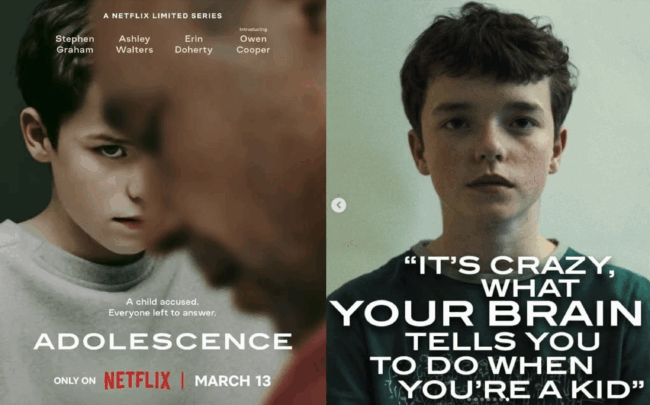
The new show “Adolescence,” streaming on Netflix, directed by Philip Barantini, has made a huge splash in the last few weeks. The show’s writers include Jack Thorne and Stephen Graham, who also plays the role of the father Eddie Miller in the series. The show has dominated a media discussion on the subject of social media and its influence on teenagers.
The book “The Anxious Generation” by Jonathan Haidt has served as a rallying cry for parents to curb the continued negative impact of social media, smartphones and the internet on teenagers.
On the heels of this hugely popular book, “Adolescence” has struck a nerve with millions of viewers. The premise of the show aims to shed light on the dangers of social media and the disconnect felt by parents with this generation of adolescents.
The four-episode arc begins with the arrest of a 13-year-old boy named Jamie Miller, played expertly by young actor Jamie Cooper, for the alleged stabbing murder of a teenage girl, Katie Leonard. The police have footage of the heinous act, which Jamie denies as absolute proof that he is the murderer. His parents, Stephen Graham as the father, and Christine Tremarco as Manda Miller the mother, are dumbfounded and in disbelief about what their son is accused of. Despite seeing the video footage, the boy’s father still believes in his son’s innocence. Viewers watch Jamie go through the process of being arrested, interrogated, and finally jailed for the crime.
The story unfolds through the investigation carried out by lead detective Luke Bascombe, played convincingly by Ashley Winters, and his partner. Detective Bascombe struggles to find out why Jamie killed Katie, whom the detective believes commented favorably on Jamie’s social media posts. Detective Bascombe and his partner visit the school and interview students who know both kids. They don’t seem to be getting anywhere with the students, hitting several dead ends, and being dismissed by the adolescents. It’s only when the detective’s teenage son deciphers the true meaning of the emojis in the posts for his father that the detective finally realizes the motive of the murder; Katie is mocking and cyber-bullying Jamie. Jamie appears to have murdered Katie for trolling and bullying him online.
Detective Bascombe, shown throughout the show as bumbling around for the truth, is a metaphor for this generation’s parental disconnect with social media culture. The detective has the same tone-deaf and emotionally ignorant characteristics that the parents of the convicted boy demonstrate in the show. The parents are completely unaware of what their son has been doing online and the danger he has gotten himself into as a result.
One of the most gripping scenes is an interview between the boy and a mental health specialist, Briony Ariston, played with compassion by Erin Doherty, assessing Jamie’s state of mind. This long, disconcerting scene unfolds when Jamie finally screams at the therapist because he is unhappy with the line of questioning. The chilling, final exchange involves Jamie screaming at the therapist, “Do you like me!” which, on the face of it, seems absurd, since she is a stranger to him. Despite that, he is desperate to be told whether he is liked, not unlike his posts, that he eagerly waits to be “liked” by followers who also seem to be unaware of him. This desperate need to be “liked” speaks to the unreal, manicured social media landscape that has become a central part of present-day adolescence.
Jamie’s face is not shown at all during the final episode. The only remnant of him is a severed voice on the phone calling from prison to wish his father a happy birthday. The parents mourn the loss of their son to prison, and can’t imagine how this happened. How could they not have seen what was happening to their son? The show attempts to reveal what has potentially become of our adolescence, no longer a rite of passage through a gauntlet that, at the very least, contains boundaries and an identifiable end. The final episode sounds the alarm that social media has made adolescence akin to walking the plank, stepping off into its abyss, now bottomless and without borders, with the possibility of grave outcomes a chilling reality of everyday life.
Overall, “Adolescence” is definitely a compelling watch. The brutal final scene of the show depicts the father sitting on his son’s bed, distraught at his fate. He whispers the final line in what is undoubtedly the director’s call to action for anyone willing to listen: “I should have done better.”